
Global Government Quantum Funding Dataset
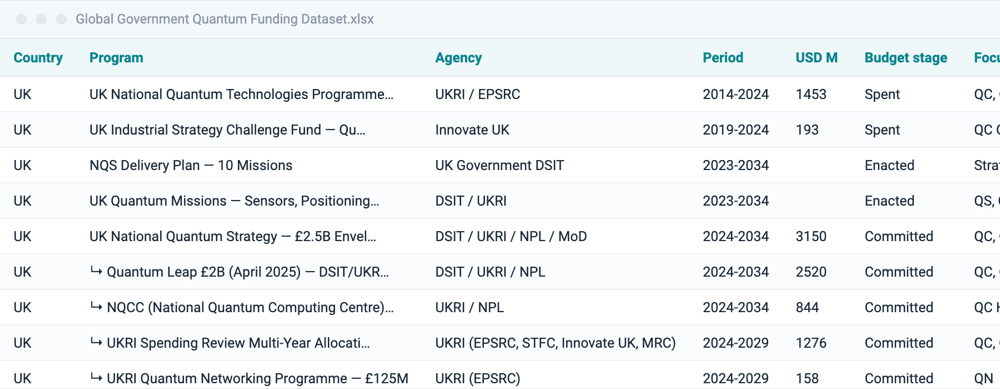
Program-level government quantum funding for 63 nations and the EU, split confirmed versus announced, with agency, period, budget stage, focus areas, confidence tier, and a verified source URL on every line.
- Records
- 657 program lines, 21 fields
- Coverage
- 2016 to 2030 commitments
- Geography
- 63 nations and the EU, plus US, Canadian, Indian, and Australian subnational programs
- Update cadence
- Monthly
- Last updated
- Q3 2026
- Format
- Excel workbook and PDF briefing
- Single license
- $2,999
- Corporate license
- $5,999
How you can use it
One named user at your organization, for internal work.
Everyone at your organization, and use in deliverables for your own clients.
One-time purchase, not a subscription.
This is the data only. It does not include access to the TQI Intelligence Platform.
Both licenses permit the citation Source: The Quantum Insider. Neither permits redistributing the workbook, reselling the data, or publishing the full tables.
Delivered by email link as an Excel workbook and a PDF briefing. Invoice or payment link on request. Purchase orders accepted.
Sheets and fields
Americas, Europe, Asia-Pacific, Middle East and Africa
National program lines by region with the 21 fields below.
US states, Canadian provinces, Indian states, Australian states
Subnational programs with source URL, verification flag, and confidence tier.
Timeline
Every program by stage year with budget stage and confidence.
Time series
Annual allocation by country, 2016 to 2030, for 45 countries with regional subtotals.
Dashboard
Confirmed, announced, and grand totals with regional and stage splits.
Methodology and uncertainty
The budget ladder, counting rules, currency conversion, and the four-factor confidence model.
Review log
One row per completed country review with the headline change.
| Field | Type | Description | Example |
|---|---|---|---|
stage_year | integer | Year the program reached its current budget stage. | 2019 |
envelope_id | text | Stable identifier for the funding envelope; line items share it. | US-NQI-2019 |
line_type | category | Envelope, Line item, or Supplement. | Envelope |
country | text | Country, or state and province on subnational sheets. | United States |
program_name | text | Official program or act name. | National Quantum Initiative Act |
agency | text | Funding agencies. | NSF, DOE, NIST |
period | text | Years the money covers. | 2019 to 2023 |
total_local_m | number | Amount in local currency, millions. | 1275 |
currency | text | ISO currency code of the local amount. | USD |
amount_usd_m | number | Amount converted to USD millions at the conversion date in the methodology sheet. | 1275 |
outstanding_usd_m | number | Portion not yet spent, USD millions. | 0 |
status | category | Program status at the last review, as defined in the methodology sheet. | Active |
budget_stage | category | Proposed, Strategy, Announced, Authorized, Approved, Committed, Enacted, Allocated, Awarded, Ongoing, Spent. The methodology sheet fixes which stages count as confirmed; the June 2026 report names Allocated as the threshold. | Enacted |
focus_areas | text | Technology areas funded. | Computing, sensing, networking |
source | text | Document or announcement the figure comes from. | Public Law 115-368 |
source_url | url | Link to the source. | https://www.congress.gov/bill/115th-congress/house-bill/6227 |
url_verified | yes/no | Whether the URL resolved at the last review. | Yes |
confidence_tier | category | A to D from the four-factor uncertainty model. | A |
last_updated | date | Date the line was last reviewed. | 2026-08-15 |
notes | text | Analyst notes on scope, overlaps, and conversions. | Authorization; appropriations tracked as line items |
counting | category | Count (in the confirmed total), Outstanding (announced, not yet allocated), or a reference code (Ref-Context, Ref-Federal, Ref-Elsewhere, Ref-NoShare) for lines kept for context but excluded from totals to avoid double counting. | Count |
What the current version shows
As of Q3 2026
As of Q3 2026
As of Q3 2026
As of Q3 2026
How this dataset is built
Sources
- Budget acts, appropriations, agency announcements, national strategies, and procurement portals in 19 languages.
- Cross-checked against the Quantum Procurement Atlas built from USAspending, CORDIS, UKRI, and open.canada.ca records.
Inclusion rules
- A line is included when a government body commits money to quantum technology with a named program and a period.
- Every line is tagged with a budget stage: announced, allocated, or spent. Only allocated and spent lines count toward the confirmed total.
- Overlapping envelopes and line items are flagged in the counting field so totals never double count.
Validation
- Each country is reviewed as a unit; the review log records the date, scope, and headline change of every completed review.
- Every source URL is re-checked at review and flagged if it no longer resolves.
Confidence
The four-factor uncertainty model scores source quality, stage clarity, period clarity, and currency risk into tiers A to D, recorded on every line.
Known limitations
- Currency conversion uses a fixed date per review; local amounts are preserved so you can reconvert.
- Multi-year envelopes without an annual profile are apportioned evenly in the time series.
- Twenty-three tracked countries have announced intent but no verifiable budget and are not in confirmed totals.
- Classified defense programs are not visible and are not estimated.
What buyers do with it
National benchmarking
Compare your country or state against peers on confirmed and announced funding, stage, and focus areas.
Budget cases
Cite program-level figures with source URLs in strategy documents and funding proposals.
Market entry
Find where public money is flowing by technology area and period before committing sales or partnership effort.
Versions
- Quarterly refresh. Records, sources and the methodology sheet reviewed.
- August review round; US state and Indian state sheets extended.
- Asia-Pacific country reviews completed.
- US state comprehensive review integrated.
- Global Quantum Funding Report published from the tracker.
Read before you buy
How much are governments spending on quantum technology?
Governments have confirmed $40.9B of quantum funding and announced a further $160.6B across 40 nations and the EU. Where the money stands, by region and stage.
What is the difference between announced and confirmed government quantum funding?
Announced funding is a stated intention. Confirmed funding has been allocated or spent. How The Quantum Insider counts $40.9B confirmed against $160.6B announced.
About this dataset
Confirmed funding has reached the allocated or spent stage of the budget ladder, meaning a legislature or agency has assigned the money to a program with a defined period. Announced funding is a stated intention that has not yet been allocated. Only confirmed funding counts toward the headline total.
Sixty-three nations plus the EU are tracked, and 40 of them plus the EU carry confirmed national budgets. Subnational sheets cover 28 US states, Canadian provinces, Indian states, and Australian states.
Every line keeps its local amount and currency alongside a USD conversion at the date recorded in the methodology sheet, so you can reconvert at your own rate.
Yes, through publicly reported national and provincial commitments, with confidence tiers reflecting the limited transparency of Chinese budget documents.
Monthly. Country reviews run continuously and each release notes which reviews completed. You receive the version current at purchase.
Request the Global Government Quantum Funding Dataset
Enter your work email and we send the invoice or payment link within one business day. Files follow as soon as payment clears.