

Insider Brief
- Quantum Rings data show users are running larger quantum circuits while price, speed and hardware performance increasingly shape where workloads are executed.
- The 95th-percentile circuit grew from 20 to 96 qubits, although the median remained at six qubits and most recognized circuits focused on testing hardware.
- Rigetti’s Cepheus-1-108Q processed 57% of jobs as median waits remained at two minutes or less across all six systems.
Quantum computing users are pushing toward larger circuits while concentrating most jobs on cheaper hardware, offering an early view of how price, speed and technical needs are shaping demand for commercial quantum systems.
The typical circuit submitted through Quantum Rings’ Open Quantum platform still used six quantum bits, or qubits, during the summer. At the upper end, however, the 95th-percentile circuit expanded from 20 qubits in the spring to 96 qubits between June and August, according to the company’s first Open Quantum Insights report.
The study, which Quantum Rings published Sept. 1, found that 11% of jobs used at least 50 qubits, up from 2% during the March-to-May period. The share of jobs using more than eight qubits also rose to 39% from 14%.

Those results point to a widening gap between ordinary users, who are often learning or testing small circuits, and a smaller group attempting work at a scale that cannot be directly reproduced through brute-force simulation on conventional supercomputers.
A full state-vector simulation tracks every possible condition of a quantum system. The amount of conventional memory needed doubles with each added qubit, making direct simulation impractical as circuits grow. Other classical methods can approximate or exploit patterns in certain large circuits, meaning qubit count alone does not prove that a quantum computer has outperformed classical machines.
The report does not measure whether the submitted circuits produced useful answers or advantages over classical computers. It instead provides a snapshot of what users chose to run across a commercial network connecting six quantum processing units, or QPUs, from four hardware suppliers.
Price Begins to Shape the QPU market
Rigetti Computing’s 108-qubit Cepheus-1 system processed 57% of all completed jobs included in the report, more than any other machine. Quantum Rings listed the system at $0.000425 per shot. Rigetti’s price per shot is the lowest price on the network, the company reported.
A shot is one execution of a quantum circuit. Because quantum measurements are probabilistic, users generally run the same circuit hundreds or thousands of times to estimate the likelihood of different results.
Retail prices across the six systems ranged from Rigetti’s price of $0.000425 to 8 cents per shot, a difference of about 188 times. Demand was heavily concentrated at the cheaper end of that range, suggesting that users are beginning to compare QPU prices and adjust their activity accordingly.
Users ran a median of 2,000 shots per job on Cepheus-1, compared with 100 on IonQ’s Forte-1, which carried an 8-cent-per-shot price. Across the network, the median job used 1,024 shots. About one-quarter used no more than 500 shots, while three-quarters used 2,048 or fewer. Seven percent reached the platform’s 10,000-shot limit.
However, the company reported that low price did not explain every hardware choice. The report found that IonQ’s higher-priced trapped-ion systems attracted a greater concentration of variational circuits, a class that includes some quantum machine-learning and optimization methods. Such systems generally offer strong gate accuracy and flexible connections among qubits, characteristics that can be important for circuits whose results are sensitive to errors.
Variational workloads made up 29% of trapped-ion jobs, compared with 11% across the entire network. Fourier-related circuits, by contrast, ran almost entirely on superconducting machines. Quantum Rings cautioned that trapped-ion systems represented a relatively small portion of overall volume, making those comparisons preliminary.
The findings suggest that an emerging QPU market may divide into at least two segments. Lower-priced systems can attract high-volume experimentation, while more expensive machines can compete for technically demanding work in which fidelity, connectivity or other hardware qualities justify the premium.
Most Jobs Study the Machines
The report also indicates that quantum computers remain primarily experimental instruments rather than production tools.
Quantum Rings used a proprietary classifier to examine the gates, layouts and structural patterns of submitted circuits. The system attempted to match them with known algorithm families such as Grover search, the quantum Fourier transform, the Quantum Approximate Optimization Algorithm and quantum machine-learning feature maps.
Of the circuits that the classifier recognized, 66% were designed mainly to prepare quantum states or benchmark hardware. Applications accounted for 20% of recognized traffic and tended to use smaller circuits, according to the report. Overall, 37% of jobs contained circuits that did not match any of the classifier’s known categories.
The rate of unclassified work increased with circuit size. Among circuits using at least 33 qubits, 62% did not match a standard algorithm family. Quantum Rings described these circuits as bespoke, although the classification results cannot establish whether they represented novel algorithms, modified benchmarks or patterns that the company’s model failed to recognize.
The structural analysis sometimes differed from the research categories selected by users when they submitted jobs. Among jobs declared as machine learning, for example, 22% were classified as quantum machine learning, while 21% appeared to be benchmarks and 34% were considered bespoke. Among jobs declared as optimization, 38% matched optimization circuits and 41% involved state preparation.
Quantum Rings reported that direct circuit analysis can provide more detail than surveys or submission forms. The comparison also highlights a limitation of automated classification. A circuit’s structure does not always disclose its full purpose, and one research problem can be approached through several kinds of circuits.
Only 40% of completed jobs declared a research category. Among those, physics simulation accounted for 77%. Machine learning, optimization and finance followed at much smaller percentages.
Optimization circuits were the deepest among the declared categories, with a median depth of 91 layers and a median of 360 gates, according to the report. Physics circuits were generally wider and shallower, using a median of seven qubits but reaching 54 qubits at the 95th percentile. Finance jobs were the smallest, using a median of two qubits.
Circuit depth measures how many sequential layers of operations a circuit contains. Deeper circuits can perform more complex calculations but are also more exposed to noise and and more likely to accumulate errors.
Waiting Times Stayed Short Across the Network
The study challenges the common view that using a real quantum computer typically requires waiting hours or days in a queue.
Median time from submission to the start of execution was no more than two minutes on each of the six systems. Median waits were two minutes for Rigetti’s Cepheus-1 and IQM’s Emerald, 60 seconds for IQM’s Garnet and IonQ’s Forte-1, 38 seconds for IonQ Forte Enterprise and 54 seconds for AQT‘s IBEX Q1.
Quantum Rings said the figures suggest that long waits result from demand concentrating on a limited group of popular systems rather than from an inherent property of quantum hardware. A multi-vendor network can distribute jobs across several machines, allowing users to submit a circuit, inspect its output and try again within minutes.
The measurement excludes time spent waiting for a system operating on a limited schedule to reopen. For those machines, Quantum Rings counted only jobs submitted while the hardware was operating. The report therefore does not represent the complete elapsed time experienced by every user.
Execution speeds varied more sharply by hardware type. Median runs ranged from three seconds on IQM Garnet and four seconds on Cepheus-1 to seven minutes on IonQ Forte-1 and 10 minutes on Forte Enterprise. AQT’s IBEX Q1 recorded a median of two minutes, while IQM Emerald took 33 seconds.
Shot count did not produce a consistent increase in running time across systems. Median execution times rose by as much as 10.2 times between shot-count groups even though a directly proportional increase would have been about 40 times. Gate count was also only weakly related to execution time, leaving the main causes of performance differences unresolved.
Limits and Next Steps
The report analyzed Open Quantum Public Plan jobs completed from June 1 through Aug. 31. It drew on hundreds of active users across 47 countries and excluded internal accounts, tests and private executions.
Completed jobs grew 115% from the spring, while the number of active users rose 206%. Quantum Rings cautioned that those figures measure adoption of its own network, not the overall growth of the quantum computing market.
Usage was concentrated among a relatively small group. While 56% of active users completed five or fewer jobs during the summer, the 13% who ran more than 20 jobs generated 60% of the total. More than 90% of the season’s heaviest users had not been active in the previous season, suggesting that demand often arrives in bursts tied to individual projects.
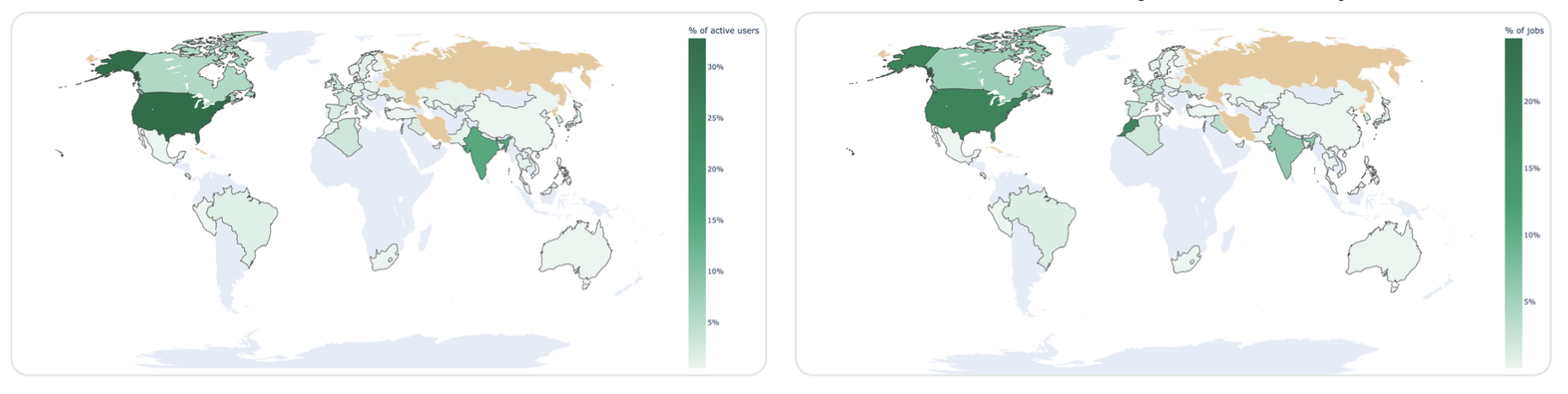
The U.S. accounted for 33% of active users and 19% of jobs. India represented 15% of users and 6% of jobs, followed by Canada with 6% of users and 5% of jobs. The report cautioned that a few high-volume accounts can substantially alter a country’s job share.
“Quantum computing has no shortage of forecasts and no surplus of measurements,” said Bob Wold, founder and CEO, Quantum Rings, in the report. “As the open infrastructure layer across hardware vendors, Open Quantum sits somewhere rare: a cross-vendor record of real quantum workloads, down to the circuits themselves, contributed by our users, by their own choice, with permission to study it, publish from it, and put it to work wherever it creates value. We believe datasets like this are how a young industry discovers what it actually is. Publishing these seasonal insights is the first thing we are doing with ours; it will not be the last. For those whose questions run deeper than a seasonal report, the door is open. To everyone who runs on the Public Plan: this exists because of you. Argue with our bottom lines — that is what they are for. The measurements are yours now too.”
The largest limitation is the study’s reliance on Public Plan traffic. Users who select the plan agree to share execution data in exchange for free or discounted computing time. Private jobs are excluded, which probably causes the dataset to overrepresent education, benchmarking and early-stage research while underrepresenting confidential commercial work.
Quantum Rings also reported job volume only through percentages, growth rates and unscaled trends. The absence of raw job totals could complicate the ability to judge the statistical weight of changes or compare Open Quantum’s activity with other cloud quantum services.
Submission tracking was available for only 30% of job preparations. Among that group, Quantum Rings’ own software development kits accounted for 55% of submissions. Other routes included the Qiskit and PennyLane plugins, qBraid and the company’s web portal. The platform also recorded its first circuits submitted by artificial-intelligence agents through the Model Context Protocol, though Quantum Rings said the sample was too small to draw conclusions.
Future editions could show whether the move toward wider circuits continues, whether application-oriented work gains ground and whether users remain strongly responsive to per-shot pricing. They could also indicate whether AI agents become a meaningful source of demand and whether workload preferences by hardware type persist as the dataset grows.
You can read the complete report here: Open Quantum Insights, Edition 001, Summer 2026, Quantum Rings