

Insider Brief
- Researchers directly measured gravity’s predicted effect on the quantum phase of freely falling atoms, finding Einstein’s equivalence principle consistent with quantum mechanics under the tested conditions.
- The Quantum Galileo Interferometer split ultracold rubidium atoms into two quantum paths, holding one stationary while the other fell freely before recombining them to measure their phase difference.
- The experiment neither unifies gravity with quantum mechanics nor proves gravity is quantum, but the technique could support future tests using heavier objects such as nanodiamonds.
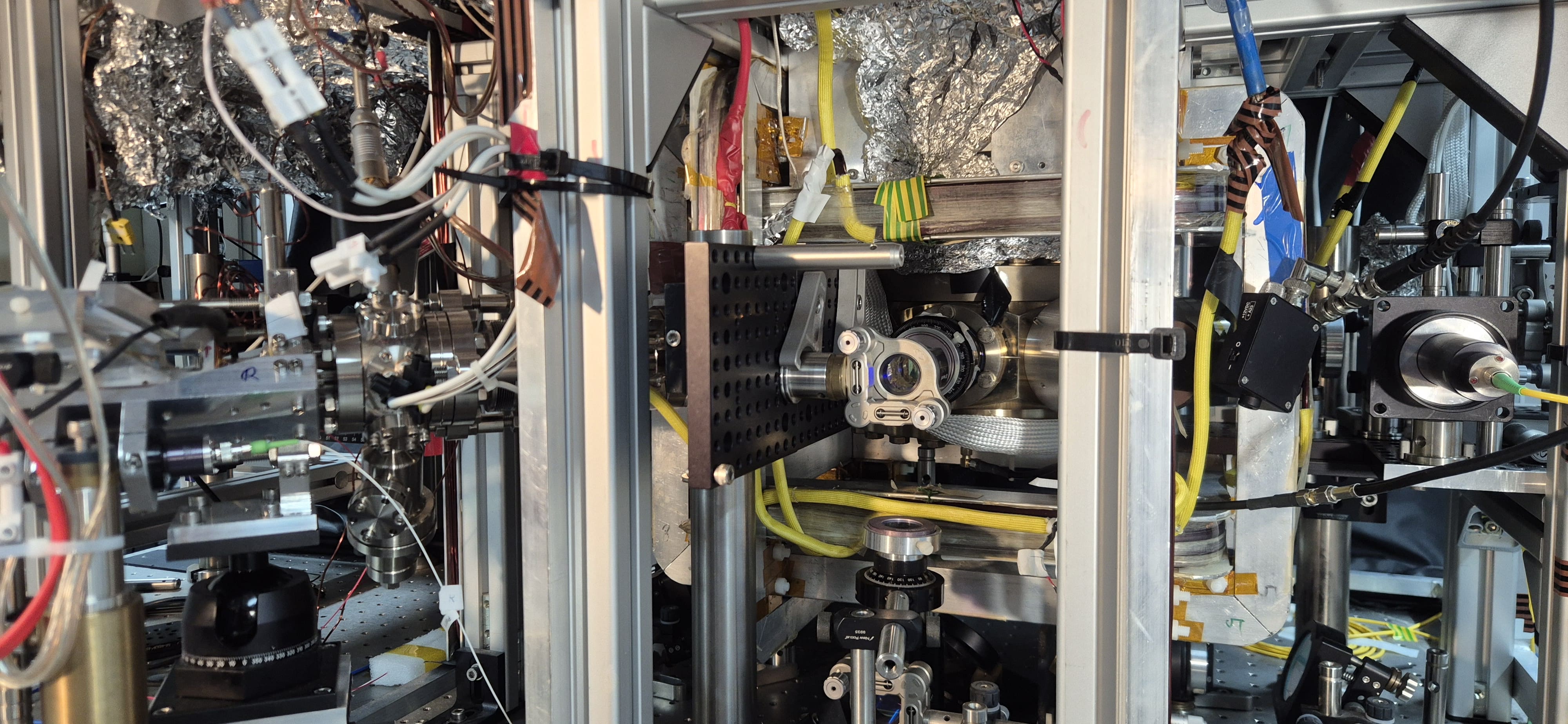
- Image: A general picture of the experimental setup. At the heart is a vacuum chamber in which conditions
such as those in space mean that atoms can be kept undisturbed. On the left is a 2D MOT, a device
that feeds atoms into the science chamber where the atom chip is positioned. Around the chamber
are antennas, coils and optical fibres, enabling atoms to be trapped and cooled, then manipulated
into two distinct paths. Finally, the relative phase between the two paths is detected. (Or
Dobkowski.)
PRESS RELEASE — An international team including Nobel Prize-winning physicist Professor Sir Roger Penrose has observed a long-predicted effect of gravity on a falling quantum object for the first time. The result shows that a fundamental principle at the heart of Einstein’s theory of gravity remains consistent with the behaviour of matter in the quantum world. The study, led by Ben-Gurion University of the Negev, The University of Ulm and the University of Oxford, has been published today (2 Sept) in Science Advances.
For more than a century, physicists have relied on two extraordinarily successful descriptions of nature. Quantum mechanics explains the strange behaviour of atoms and other tiny objects. Einstein’s theory of gravity explains how objects fall and how gravity shapes the Universe. Yet physicists still do not fully understand how the two fit together.
Now, an international team has performed an experiment that probes the point where they meet. In the study, the researchers observed a distinctive change in the quantum properties of atoms as they fell under gravity. Crucially, the effect they measured is the same one predicted when Einstein’s equivalence principle, a cornerstone of his theory of gravity, is applied to a quantum object.

The equivalence principle states that for an observer in free fall, gravity should locally disappear. Someone falling freely in a lift, for example, would experience weightlessness. Whilst this theory has survived extraordinarily precise tests involving ordinary matter, it was unclear how this could be experimentally tested with quantum objects, which can behave as waves and effectively travel along more than one path.
At the heart of the experiment is a new apparatus the researchers call the Quantum Galileo Interferometer. It allowed them to do something unusual: effectively split the quantum wave associated with an atom into two paths, hold one in place while allowing the other to fall freely, and then reunite them to see how gravity had changed the falling wave.
Putting an Einstein principle to a quantum test
The experiment was carried out at Ben-Gurion University using clouds of rubidium atoms cooled to just above absolute zero and manipulated close to the surface of a specially designed atom chip.
The experimental team, including PhD student Or Dobkowski, first used microwave pulses to put the ultracold atoms into a quantum superposition, effectively allowing each atom to travel along two different paths at once. They then used tiny electrical wires on the chip to generate precisely controlled magnetic fields. One part of the atomic wave responded to this magnetic field, allowing the researchers to apply an upward force that exactly counteracted the downward pull of gravity. In effect, this part was held stationary relative to the laboratory and the Earth.
The other part was pushed upwards with a precisely controlled magnetic pulse, then switched into a state almost unaffected by the magnetic field so that it could fall freely under gravity – following a ballistic trajectory, similar to a ball thrown into the air.
At the end of the fall, the researchers used another precisely controlled magnetic pulse to bring the two parts back together. When the two waves were reunited, they interfered with each other. That interference allowed the researchers to measure the tiny difference in quantum phase accumulated while one was falling and the other was held still.
The phase measured in the new experiment is the same as the one predicted when Einstein’s principle is applied to such a quantum wave. The result therefore provides an experimental connection between quantum physics and Einstein’s theory of gravity.
Although previous experiments have used quantum particles to measure gravity, the researchers say this is the first direct measurement of the predicted quantum phase of a freely falling object.
Lead author Professor Ron Folman (Ben-Gurion University of the Negev) said: “This is a unique paper, in the sense that it combines a hard experiment with a far-reaching theoretical interpretation, about one of the most fundamental questions in physics: How can gravity (described by Einstein’s theory of relativity) and quantum theory, be unified into one understanding of the universe? These two pillars of modern physics have so far eluded all attempts at a unified theoretical framework, but this complex experiment gives more hints as to how such a unification may be achieved.”
Study co-author Professor Vlatko Vedral (Department of Physics, University of Oxford) added: “We have no consistent theory telling us why quantum physics should fail. This experiment pushes quantum mechanics into one of its most intriguing frontiers, gravity, and shows that, once again, its predictions hold.”
The result does not unite quantum mechanics and gravity, nor does it show that gravity itself is quantum. Instead, it demonstrates that Einstein’s equivalence principle remains consistent with quantum mechanics in the regime tested.
Also, the study does not overturn an argument made by study co-author Professor Sir Roger Penrose (University of Oxford) that quantum mechanics could break down for sufficiently massive objects held in quantum superpositions for long enough times. Whilst the present experiment did not reach the masses or timescales needed to test this idea, the research team hope the technique will be a step towards experiments with much heavier objects, including nanodiamonds, that could investigate this possibility. Such an experiment is now underway in the same group at Ben-Gurion University of the Negev.
The international study included researchers from Ben-Gurion University of the Negev; the University of Oxford; the University of Southampton; German Aerospace Center, the Institute of Quantum Technologies, Ulm; Universität Ulm; and Texas A&M University.