



Insider Brief
- Researchers developed QuPepFold, a hybrid quantum-classical software package for exploring the low-energy structures of short peptides.
- The system performed well on six- and seven-residue peptides, but its success rate fell sharply as sequences approached 10 residues.
- The study did not demonstrate a quantum advantage, and the package remains limited by simplified protein models, hardware noise and heavy sampling demands.
Researchers have developed a software package that uses quantum and classical computing to search for the shapes of short peptides, a package that could serve as an early approach to studying flexible proteins linked to cancer and other diseases.
The open-source package, called QuPepFold, is designed to make quantum-assisted protein-folding simulations available to researchers who do not have expertise in quantum programming. In tests described in PLOS One, the system examined peptides containing six to 10 amino acids and performed best on the shortest sequences.
The researchers reported that an optimization method used by QuPepFold reached the lowest-energy state about 30% faster than a standard version of the quantum algorithm. The researchers also reported that tests using IonQ’s Aria-1 quantum computer reproduced ground-state energies with fidelity above 90%.

The findings suggest that hybrid quantum-classical systems can run small protein-folding experiments consistently across simulators and quantum hardware. QuPepFold could also make such experiments more accessible by allowing biologists to test quantum methods without designing circuits themselves. If the approach scales with improvements in hardware and algorithms, it could eventually complement classical and AI tools in studying flexible protein regions that are difficult to model and target with drugs.
It’s also important to note that the results do not yet establish that quantum computers can outperform the best classical protein-modeling tools or predict the structures of medically important proteins.
Hitting Moving Targets
Proteins are chains of amino acids that fold into three-dimensional shapes. A protein’s shape affects how it operates inside a cell and how it interacts with drugs, other proteins and biological molecules.
Many protein-modeling systems seek a stable arrangement of the chain, called a low-energy structure. Finding that stable arrangement is difficult because even a small protein can potentially adopt an enormous number of shapes. And by an enormous number, a good estimate of that enormity would be — for a protein with 100 amino acid — 100 quindecillion different backbone shapes. That’s a 10 followed by 47 zeroes — or about a thousandth of the estimated number of atoms in Earth.
The challenge becomes different for intrinsically disordered proteins and intrinsically disordered regions. These sections do not settle into one stable structure under normal biological conditions. Instead, they move among an ensemble of shapes.
Disordered regions are involved in cellular signaling and regulation, but abnormal activity has been associated with cancer, neurodegenerative disease and diabetes. The study cited estimates that roughly one-third of proteins in complex organisms contain long disordered regions and that about 79% of human proteins associated with cancer contain at least one such region.
Their flexibility also makes them difficult drug targets. Conventional drug design often looks for a stable pocket where a molecule can bind. A disordered protein might present only a temporary binding site, or it might form a more ordered structure only after interacting with another molecule.
Artificial Intelligence systems have improved the prediction of folded protein structures, but they generally produce a likely structure rather than a complete picture of a protein’s changing conformations. QuPepFold is intended to explore whether a boost of quantum algorithms could eventually contribute to the sampling of these broader ensembles.
How QuPepFold Works
QuPepFold converts an amino-acid sequence into a simplified mathematical representation that can be divided between a quantum processor and a classical computer.
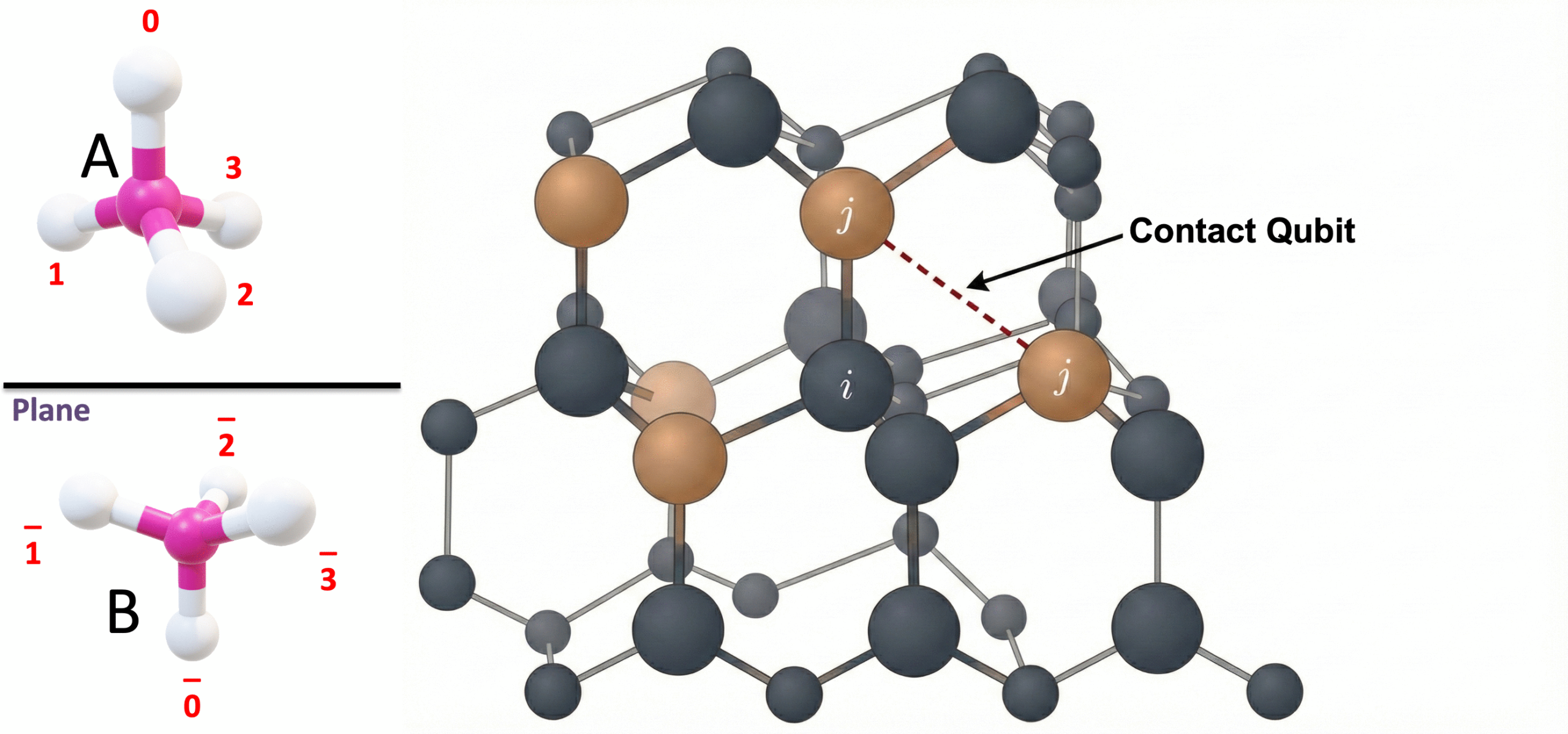
The package places the peptide on a tetrahedral lattice, which can be thought of as a three-dimensional grid that limits where each amino acid can sit and the directions the chain can take between them. Each binary string generated by the system represents one possible arrangement of the peptide backbone.
The software assigns energy values to those arrangements. It penalizes structures with invalid distances, incorrect local geometry, steric clashes or cases in which the chain folds back over itself. It also includes values intended to represent whether different types of amino acids tend to interact favorably.
QuPepFold then uses a variational quantum eigensolver, or VQE, to search for low-energy arrangements. VQE is a hybrid algorithm in which a quantum circuit prepares and measures possible states while a classical optimizer adjusts the circuit and repeats the process.
Rather than judge each round by the average energy of all measured states, QuPepFold uses a method called conditional value at risk, or CVaR. The technique keeps its attention on the lowest-energy fraction of the results.
In simple terms, the optimizer gives more weight to its most promising candidates and largely ignores the many poor structures produced during the search. The researchers said this approach can speed convergence and reduce the influence of noisy, high-energy measurements.
The package can run locally through IBM’s Qiskit Aer simulator, on Amazon Braket’s tensor-network simulator and through Braket on IonQ’s Aria-1 trapped-ion quantum computer. It also converts selected results into three-dimensional peptide-backbone models and produces energy charts, circuit diagrams and convergence plots.
QuPepFold is distributed as an installable Python package. Researchers can change the quantum-circuit design, number of measurements and other settings without constructing the full workflow themselves.
Performance Declines With Length
The team benchmarked the software on 1,224 peptide sequences ranging from six to 10 amino acids. The study reports different totals for the number of conformations evaluated in separate sections, but the sequence counts and length-by-length results are consistent.
The system performed best on peptides containing six or seven amino acids, reliably finding low-energy arrangements that the model classified as stable. Each seven-amino-acid sequence took about 7.5 seconds per round of optimization, but performance weakened as the peptides grew longer.
The share of searches that found a stable, negative-energy arrangement fell from 97.3% for seven amino acids to 13.4% for eight, 4.7% for nine and 1.5% for 10. Processing time also increased, with each round of optimization taking about 4.7 seconds for six-amino-acid peptides and 16.2 seconds for 10-amino-acid peptides.
The researchers found that a peptide’s overall shape accounted for about 68% of the differences in predicted stability, while its specific amino-acid sequence accounted for the remaining 32%. That suggests the software was sensitive to both how the chain folded and what it was made of, rather than simply finding the same compact arrangement for every peptide.
The current version uses randomized versions of an amino-acid interaction matrix for demonstration, according to the study. Future versions are expected to support empirical interaction values, experimental constraints and more realistic physical models.
Early Software, Not a Biological Predictor
QuPepFold does not yet model proteins at the level needed for drug development. Its lattice representation removes much of the continuous movement and atomic detail found in real molecules. The study does not at this point show that the generated structures match experimentally measured peptide ensembles or that they improve predictions of drug binding.
Finding a low calculated energy also does not prove that a structure is biologically accurate. The result depends on the energy function used to score each candidate, and an oversimplified function can favor an unrealistic structure.
Quantum resource requirements also grow rapidly with peptide length. A 10-residue peptide typically requires 20 to 25 qubits in QuPepFold, along with Hamiltonians containing thousands of mathematical terms. The researchers said VQE experiments can require millions of circuit measurements, which can make physical quantum-hardware runs costly and vulnerable to noise.
Future versions could add realistic force fields, the effects of surrounding water, peptide-drug interactions and improved quantum circuits, the researchers said. QuPepFold-generated structures could also be passed to classical molecular simulations or AI systems for refinement.
Future research could also be focused on expanding QuPepFold beyond finding a single lowest-energy structure to mapping the range of shapes that intrinsically disordered regions adopt. Capturing those changing structures would provide a more complete picture of how these proteins function, interact with other molecules and respond to potential drugs.
The research team included Akshay Uttarkar and Vidya Niranjan of R V College of Engineering in Bangalore, India, along with Amit Saxena of the Centre for Development of Advanced Computing in Pune and Vinay Kumar of Presidency University in Bengaluru. Niranjan is also affiliated with MIT Vishwaprayag University in Solapur.
QuPepFold is available on github here.