Xanadu and Mitsubishi Chemical Advance Quantum Computing Work on EUV Lithography


Insider Brief
- Xanadu and Mitsubishi Chemical are expanding their collaboration to develop quantum computing methods for improving EUV lithography and semiconductor materials.
- The second phase will integrate parameters from Xanadu’s quantum simulations into Mitsubishi Chemical’s multi-scale models to study radiation-induced blur in EUV lithography.
- The project is supported by Canadian and Japanese innovation programs, including NRC IRAP and Japan’s Strategic Innovation Promotion Program, with the goal of developing an FTQC-ready software workflow.
Press release – Xanadu Quantum Technologies Limited (“Xanadu“; NASDAQ/TSX: XNDU), a leading photonic quantum computing company, has announced the next phase of its collaboration with Mitsubishi Chemical, a major Japanese chemical manufacturer, to advance semiconductor fabrication technologies using quantum computing algorithms. This next phase is supported by national innovation programs from both the Canadian and Japanese governments, aiming to scale Xanadu and Mitsubishi’s previous work in simulating a vital process in next-generation semiconductor fabrication: extreme ultraviolet (EUV) lithography. Bringing together both Canadian and Japanese expertise in quantum computing and materials science, this collaboration underscores a shared commitment to driving global innovation in the semiconductor industry through quantum technologies.
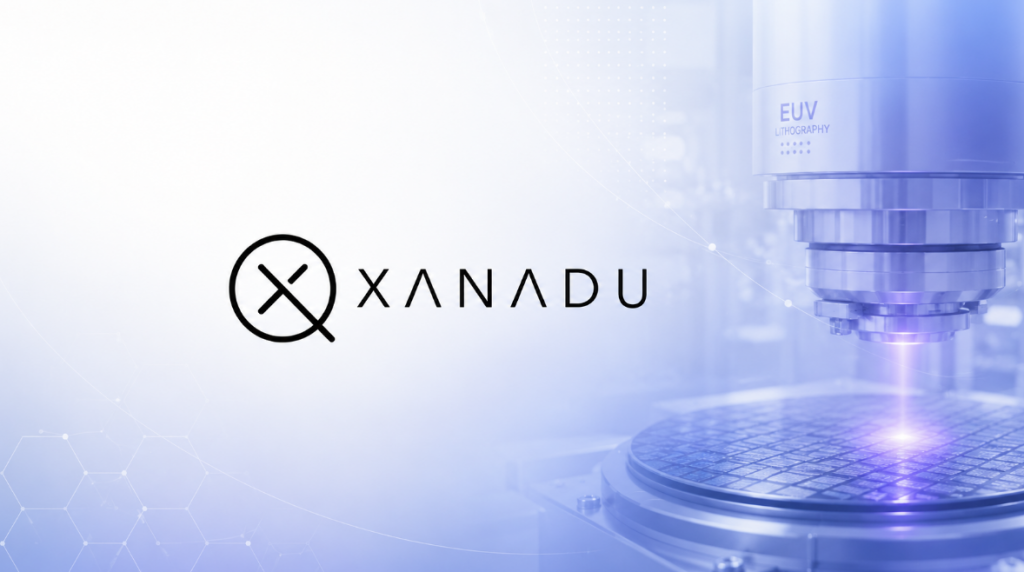
EUV lithography enables the creation of powerful chips used across multiple industries, such as mobile, AI, and advanced computing, and is crucial for current and next-generation semiconductor manufacturing. However, its efficiency is often hindered by radiation-induced blurring, an inherently quantum phenomenon that remains a major bottleneck for classical simulations.
In phase one of Xanadu and Mitsubishi’s collaboration, the two companies demonstrated that quantum algorithms can accurately model key aspects of EUV lithography, specifically the optical properties of the photoresists used to etch lithographic patterns. The next phase of the collaboration aims to develop a production-ready workflow that will take parameters derived from Xanadu’s quantum computing simulations and integrate them directly into Mitsubishi’s multi-scale models to predict blur. The result will be a fault-tolerant quantum computing (FTQC)-ready software pipeline designed to identify materials that prevent blurring and secure a competitive advantage in semiconductor manufacturing.

Xanadu plans to provide a concrete demonstration and roadmap for how quantum computing can contribute to the development of EUV resist materials through this collaboration.
This second phase of the collaboration is being advanced with support from the National Research Council of Canada Industrial Research Assistance Program (NRC IRAP) and Japan’s Strategic Innovation Promotion Program (SIP). The relevant SIP project is led by the National Institute of Advanced Industrial Science and Technology (AIST) and the Global Research and Development Center for Business by Quantum-AI Technology (G-QuAT). The collaboration aims to further strengthen research and business collaboration between the two countries’ technology sectors.
Xanadu has previously received advisory services and more than $800,000 in funding from NRC IRAP, supporting its R&D in quantum computing across several projects, which helped lay the groundwork for this advancement.
“Our collaboration with Mitsubishi bridges quantum simulation and semiconductor fabrication, eliminating a critical manufacturing bottleneck and securing a competitive advantage for next-generation semiconductor technology. The funding from both the Canadian and Japanese governments underscores the importance of this partnership to advance the semiconductor industry globally,” said Dr. Christian Weedbrook, Founder and Chief Executive Officer of Xanadu.
“This partnership expands on Mitsubishi’s previously successful collaboration with Xanadu, where we demonstrated the utility of quantum computing in simulating EUV resist materials for semiconductor manufacturing,” said Dr. Qi Gao, Senior Chief Scientist at Mitsubishi Chemical. “With support from national innovation programs and research organizations in both countries, we’re excited to bring together Canadian and Japanese expertise in quantum computing and materials science.”
“This project is a great example of connecting cutting-edge quantum computing research with real industrial challenges. In the critical field of semiconductor materials development, we expect this Japan-Canada collaboration to accelerate the real-world implementation of quantum technology. At SIP, we look forward to the new industrial value this initiative will create,” said Dr. Masahiro Horibe, Sub-Program Director, Cross-ministerial SIP and Deputy Director, G-QuAT, AIST.
This shared initiative between Xanadu and Mitsubishi aims to showcase quantum computing innovation on the world stage while advancing critical quantum simulation capabilities for the global semiconductor industry. By bridging quantum innovation with industrial application, this continued partnership will establish a blueprint for quantum-driven material discovery. As Xanadu and Mitsubishi Chemical advance this joint pipeline, their work aims to unlock commercial value for early FTQC systems, while driving the future of global semiconductor fabrication.
For more background on semiconductor manufacturing and EUV lithography, readers can check out this explainer on ASML’s role in the semiconductor industry.

Keep track of everything going on in the Quantum Technology Market. In one place.

Mohib Ur Rehman
Covering quantum and emerging technologies, Mohib explores the intersection of technology, security, and society. His work also frequently examines surveillance infrastructure and the institutions shaping the digital world. In addition to his work at The Quantum Insider, he co-runs SK NEXUS, an independent technology publication that helps readers understand the technologies shaping their lives.

Stay Ahead of Quantum
Get the latest research, company news, and market intelligence every week.
MENTIONED IN THE ARTICLE

Xanadu
Xanadu is a Canadian photonic quantum computing company founded in 2016 that is building fault tolerant systems utilizing light. The company collaborates with defense and hardware partners like AMD and Lockheed Martin to accelerate computational fluid dynamics simulations and train an aerospace engineering workforce.
→
Mitsubishi
The Mitsubishi Group is a group of autonomous Japanese multinational companies in a variety of industries.
→