Sui Co-Founder Works on $10 Quantum-Safe Hardware Wallet Cards


Insider Brief
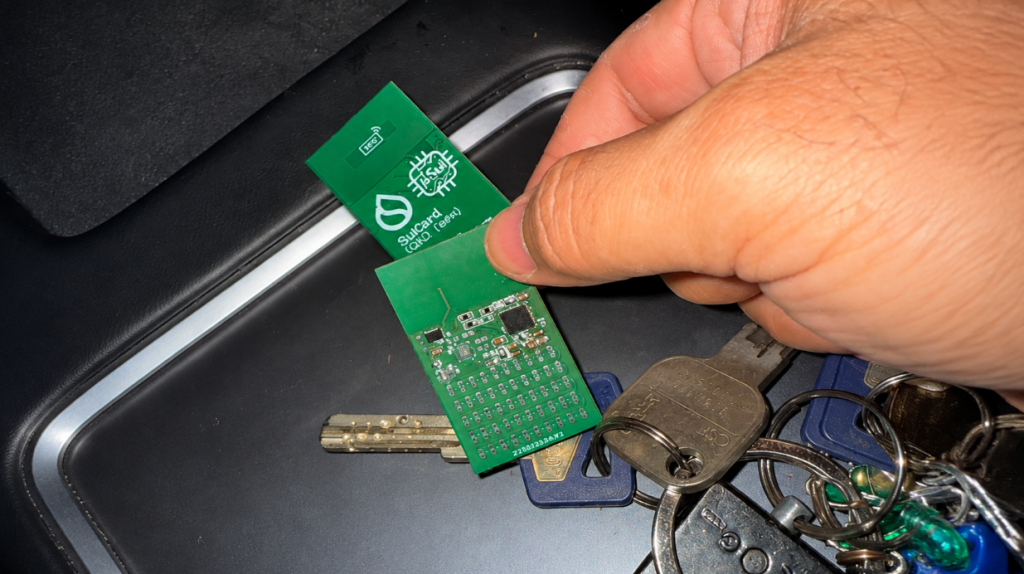
- Sui co-founder Kostas Chalkias is developing quantum-safe hardware wallet cards designed for Sui users, with a target cost below $10 per card.
- The project aims to provide quantum-resistant authentication hardware while addressing broader concerns around hardware wallet security failures.
- Sui is also working on protocol-level upgrades to support NIST-approved post-quantum signature schemes for future account security.
Kostas “Kryptos” Chalkias, co-founder and chief cryptographer at Mysten Labs, the company behind the Sui blockchain, has disclosed that he has been personally working on affordable quantum two-factor authentication cards for Sui users.
In a post on X, Chalkias said he leased a dedicated factory at an undisclosed location to manufacture quantum-safe wallets at scale. He has set a target price of under $10 per quantum card key, with a target NFC quantum signature time of one to two seconds. Chalkias stated that he took on the project using personal time outside his regular work and said he may go as far as sponsoring the cards for users who cannot afford them.
Coldcard Incident as Backdrop
Chalkias directly referenced the Coldcard hardware wallet incident as motivation, writing: “What happened to Coldcard will NEVER happen to my people.”

According to Bitcoin news – Coinkite, the maker of the Coldcard hardware wallet, disclosed in late July that a firmware flaw dating back to a 2021 update had bypassed the device’s dedicated hardware randomness chip during key generation, substituting a predictable software-based process that in some cases relied on values such as device serial numbers, according to Bitcoin News.
Attackers began draining funds on July 30. Losses accumulated across multiple wave invluded roughly 594 BTC in the first wave, approximately 1,082 BTC by August 1, and an estimated 2,055 BTC. All of this is worth close to $130 million. Alex Thorn, head of research at Galaxy Research, said at least 15 different attackers were working through the remaining vulnerable wallets, the publication noted.
The Coldcard flaw was not a quantum attack. Chalkias nonetheless cited it as illustrating the broader risk of hardware wallets that fail at the cryptographic level and become attack vectors before users move funds.
Sui’s Broader Quantum Roadmap
The wallet card project sits alongside work Sui is already carrying out at the protocol level. Sui has stated it plans to add two signature schemes approved by the National Institute of Standards and Technology for quantum resistance — one for everyday accounts and a second for high-value Move-based vaults, source reported.
Existing Sui accounts could transition to quantum-resistant keys derived from their current recovery phrases, avoiding the need for users to move funds to entirely new wallets. Chalkias has argued that Sui’s flexible authentication model could make future cryptographic upgrades easier compared with blockchain networks that may require larger protocol changes, such as a hard fork.

Keep track of everything going on in the Quantum Technology Market. In one place.
Topics

Mohib Ur Rehman
Covering quantum and emerging technologies, Mohib explores the intersection of technology, security, and society. His work also frequently examines surveillance infrastructure and the institutions shaping the digital world. In addition to his work at The Quantum Insider, he co-runs SK NEXUS, an independent technology publication that helps readers understand the technologies shaping their lives.

Stay Ahead of Quantum
Get the latest research, company news, and market intelligence every week.
MENTIONED IN THE ARTICLE