

Insider Brief
- Three recent experiments show how quantum technology could protect ballot secrecy and help verify election integrity, moving quantum voting from theoretical protocols into laboratory demonstrations.
- Two experiments used entangled photons for elections involving up to eight voters, while a third demonstrated a two-voter quantum voting system across 50 kilometers of optical fiber.
- Major challenges including scalability, noise, hardware reliability, voter authentication and coercion resistance remain before quantum voting could be practical for real-world elections.
Teams of scientists are voting yes on moving proposals for quantum-secured elections out of the lab and into actual experiments to test whether the laws of physics can protect ballot secrecy while also helping voters verify that an election was conducted correctly.
A series of recent studies have demonstrated different versions of quantum voting, including systems based on entangled photons and another that sent quantum signals over 50 kilometers, or about 31 miles, of optical fiber. Two of the experiments were published in Physical Review Letters — including one from the University of Geneva and another from Sorbonne University and ICFO — while a third was published in June in npj Quantum Information.
The experiments remain small and lack the scale, reliability and administrative complexity required for a national election. One study involved only four voters, for example. Another experiment tested configurations with as many as eight voters, while the fiber-network demonstration involved only two. They are far removed from

But overall, the studies show how a field that just years before existed primarily as a collection of theoretical protocols is beginning to advance to actual tests of whether quantum physics can help prove that votes were properly recorded without revealing who cast them. If it does, the technology could resolve one of electronic voting’s central problems.
In one Physical Review Letters study, researchers at Sorbonne University and the Institute of Photonic Sciences, or ICFO, demonstrated an electronic voting protocol designed to provide information-theoretic security without relying on an election authority. A separate team at the University of Geneva experimentally implemented a four-party election in which even a potential central authority could not determine an individual voter’s preferred candidate.
The third study, published in npj Quantum Information, demonstrated a different quantum voting architecture over 50 kilometers of standard optical fiber. The researchers said their system performed voter authentication, anonymous voting and vote tallying.
The experiments don’t mean quantum voting machines are headed for polling places any time soon, but these studies do suggest that some of the properties required for a secure election can be built around physical laws rather than only around trust in election officials, hardware or the assumed difficulty of mathematical problems.
The Problem of a Secret but Verifiable Vote
Voting systems face requirements that, on the surface, can appear contradictory.
A voter should be able to determine that a ballot was properly included in an election. Election participants should have confidence that the final count is legitimate. At the same time, neither the government, election administrator nor another voter should be able to connect a particular ballot to the person who cast it.
Classical cryptography offers ways to address those problems. Electronic voting systems can use encryption and other cryptographic techniques to hide ballots while providing ways to verify results. Those approaches, however, depend on assumptions about software, trusted parties or the computational difficulty of certain mathematical problems.
Quantum voting researchers are investigating whether some of those assumptions can instead be replaced by properties of quantum mechanics.
One important tool in two of the recent experiments is entanglement, the quantum phenomenon in which particles share correlations that cannot be reproduced by ordinary classical systems.
The researchers used a particular form called a Greenberger-Horne-Zeilinger, or GHZ, state. A GHZ state entangles three or more quantum particles so that measurements made on the particles are strongly correlated.
For voting, those correlations can be distributed among multiple participants. Each voter receives part of the shared quantum state. The resulting measurement outcomes can then provide correlated pieces of information that are useful for constructing and checking a ballot without exposing the voter’s individual choice.
The attraction isn’t that a quantum computer counts the votes — in fact, a quantum computer isn’t necessarily required.
In the University of Geneva experiment, the researchers said the core voting scheme remained classical, according to New Scientist. The quantum system was used to distribute random but correlated bits of information among voters. Those correlations could then be tested to determine whether the quantum resource being distributed was legitimate.
This suggests that quantum voting is closer to quantum communication and quantum cryptography than to running an election algorithm on a quantum computer.
Entanglement > Trust
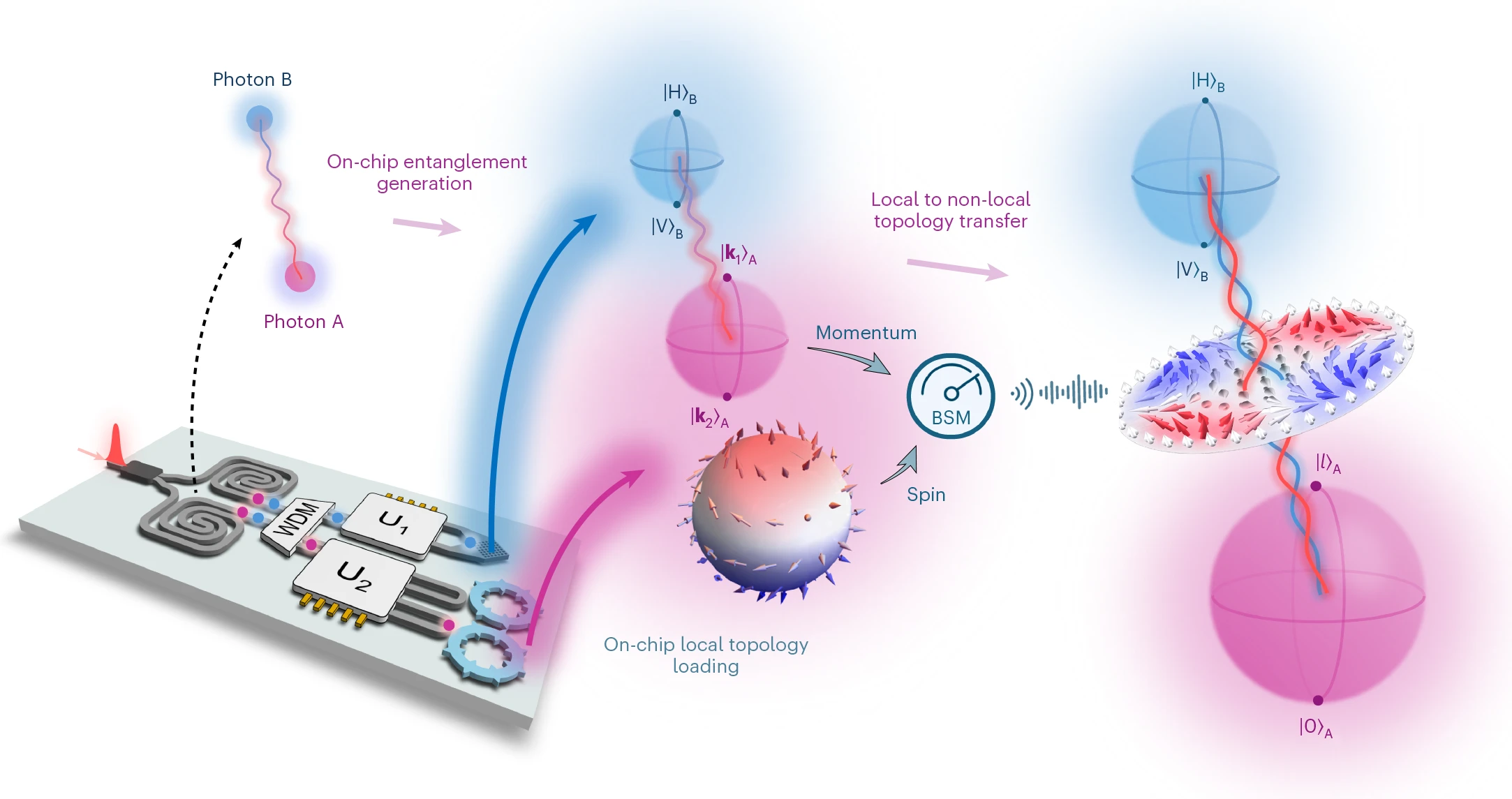
The University of Geneva team, led by F. Joseph Marcellino, Mingsong Wu and Rob Thew, implemented a four-person election using four-partite photonic GHZ states.
Their experiment was based on an earlier voting protocol designed to provide anonymity without requiring voters to trust one another or the source distributing the quantum states.
That source is a potential weakness. If an election depends on a central machine to distribute the information needed to vote anonymously, a dishonest source could theoretically undermine the system.
Quantum mechanics provides a possible way around that problem because the participants can test the correlations in the distributed states.
In the Geneva experiment, the researchers generated and distributed four-photon entangled states among four participants. The states had about 89% fidelity, a measure of how closely the experimentally produced quantum state matched the desired state.
The system successfully performed voting or state verification about 87% of the time, according to the study.
The protocol alternates between using quantum states for voting and using them to check the integrity of the system. Participants don’t simply assume that the source distributed the correct entangled state. Some rounds are effectively sacrificed so that the participants can test whether the expected quantum correlations are present.
The researchers modified the original protocol so that it could be implemented without quantum memory, devices that store fragile quantum states for later use. That makes the experiment more feasible with current technology, but introduces trade-offs. Among them, the modified protocol requires more quantum states and at least three honest participants, according to the study.
The approach illustrates that instead of trusting the distributor, participants can test the physical evidence produced by the quantum system.
A second team took a related approach, but took it a little further.
Nicolas Laurent-Puig, Matilde Baroni, Federico Centrone and Eleni Diamanti experimentally demonstrated an information-theoretically secure electronic voting protocol that does not rely on election authorities.
Information-theoretic security is a particularly strong form of security. Conventional cryptography frequently protects information by making it computationally impractical for an attacker to solve the mathematical problem needed to decrypt it. Information-theoretic security instead aims to make the protected information inaccessible even to an attacker with unlimited computing power, provided the protocol’s assumptions hold.
The researchers demonstrated two election scenarios.
One involved four voters choosing between two candidates and incorporated additional privacy-enhancement techniques. The other supported as many as eight voters choosing among 16 candidates.
The latter scale is still tiny compared with a public election, but the researchers said it could be suitable for applications such as board-level elections in organizations or small government settings. Also, people might be more worried in smaller elections — where anonymity can be linked with things like job security, or ostrasization — than people are in mass elections.
This experimental system also relied on GHZ states produced from entangled photons. Broadly, the protocol distributes an entangled resource among the participants, randomly assigns roles associated with voting and verification, and then uses the quantum correlations to support both the voting and checking processes.
That means the same underlying physical resource that makes anonymous coordination possible can also provide evidence that the system hasn’t been improperly manipulated.
A Different Route Over 50 Kilometers
Researchers in China demonstrated another approach that may address a different obstacle — integrating quantum voting with communications infrastructure.
The team, led by researchers at Shanghai Jiao Tong University, reported in npj Quantum Information that it had built a two-voter anonymous voting prototype using continuous-variable quantum technology.
Continuous-variable systems encode quantum information in properties of light that can vary continuously, such as the amplitude and phase of an electromagnetic field. That differs from photon-based approaches in which information is often treated as discrete quantum units.
This might be important in deployment because continuous-variable quantum systems can use components and techniques related to conventional optical telecommunications.
In the experiment, two voters operated over 50 kilometers of single-mode optical fiber. The researchers reported authentication rates of 336 and 406 times per second for the two voters.
The system also generated signed voting files at a quantum signing rate of 966 times per second, with overall voting rates of 244 and 279 times per second for the two participants, according to the study.
The researchers described the work as the first experimental implementation of a continuous-variable quantum anonymous voting prototype.
Unlike the authority-free approach demonstrated in the other work, the architecture incorporates authority-assisted anonymity. It combines voter authentication, anonymous voting and tallying within the same system.
The researchers said the architecture was designed to be compatible with existing coherent optical communication networks. If such systems are eventually developed beyond laboratory prototypes, compatibility with telecommunications equipment could prove as important as the underlying security theory.
From Four Voters to Millions Is a Long Road
The clustering of experiments — which is likely completely coincidental — doesn’t mean the main obstacles to quantum voting have been solved, or will be solved anytime soom.
A January analysis of the practicality of quantum voting protocols, for example, by Nitin Jha and Abhishek Parakh of Kennesaw State University identified substantial barriers, including photon loss, noise, imperfect devices, scalability and coercion resistance.
Like many of the quantum use cases that scientists encounter, scaling is an especially obvious problem.
Generating a high-quality entangled state among four participants in a laboratory is fundamentally different from distributing secure quantum resources among thousands or millions of voters scattered across a state or country.
Quantum states are also fragile and photons can be lost as they travel through fiber. Noise can damage the correlations that the protocol depends on. Detectors and other equipment are imperfect. Large networks would also have to authenticate participants and their conventional communications without accidentally creating another security weakness.
Beyond physics, elections introduce some unique problems.
A practical system must establish voter eligibility, prevent duplicate voting, handle malfunctioning equipment, resolve disputes and support recounts or audits. It also needs defenses against compromised voter devices and malicious participants.
Coercion presents another difficult problem. A ballot can remain cryptographically anonymous while a voter is still pressured to vote a particular way or prove how they voted. In other words, quantum mechanics doesn’t automatically solve that political and procedural challenge.
Jha and Parakh concluded that near-term applications are more plausible for small-scale elections than national voting. They suggested that a practical path could combine quantum mechanisms for anonymity and tamper detection with classical end-to-end voting methods and post-quantum cryptography for authentication and record keeping.
That hybrid approach may also offer a more realistic picture of where the field is headed.
Quantum voting doesn’t necessarily require replacing every part of an election with quantum technology. Instead, quantum communication could eventually provide particular security functions inside a broader election system.
The latest experiments offer early evidence that some of those functions can move beyond equations and security proofs.
As for next research steps, researchers will likely need to go beyond showing that such guarantees can be written into a protocol. They will need to determine how much of those guarantees can survive the noise, scale and institutional complexity of an actual election.