
Insider Brief:
- The Quantum Kid celebrates its first anniversary as host Kai Weber turns 10, with the YouTube channel surpassing 115,000 subscribers and earning shortlist recognition in the Webby Awards and Publisher Podcast Awards.
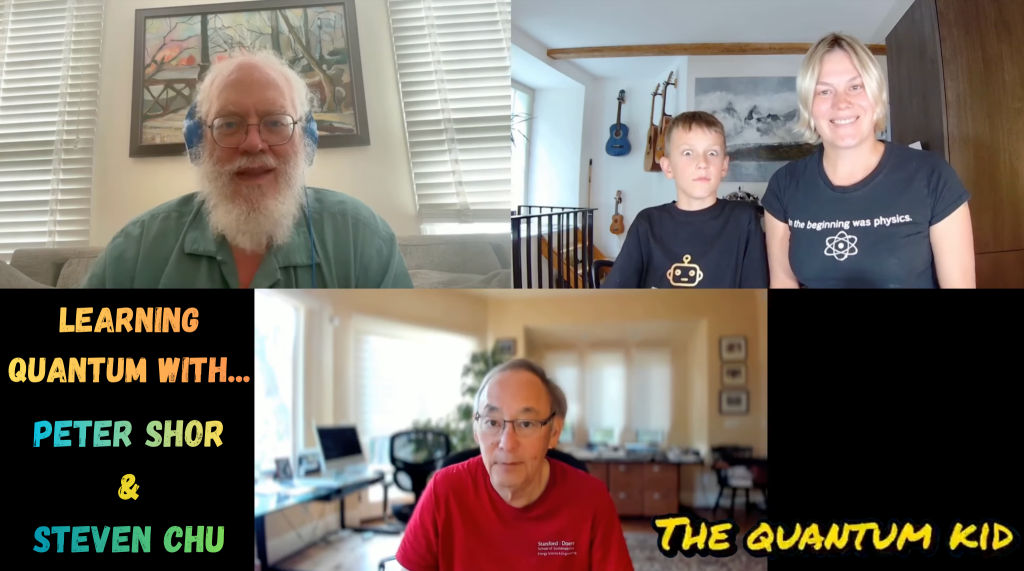
- Over the past year, Kai has interviewed leading figures including Nobel laureates Steven Chu and John Martinis, quantum pioneers Peter Shor, David DiVincenzo and Scott Aaronson, and astrophysicist Avi Loeb.
- The anniversary episode features filmmaker Mark Levinson (Particle Fever, The Universe in a Grain of Sand) and Roger Highfield of the Science Museum Group, exploring how art, museums and storytelling can make quantum science accessible to broader audiences.
- Subscribe to The Quantum Kid on YouTube to follow future conversations with leading scientists, founders and innovators shaping the quantum future.
He giggles. He makes faces. And he loves to ask big questions – about time, quarks, the Universe, and everything.
He’s 10 now – Kai Weber, one of the youngest science YouTubers out there and possibly the youngest quantum YouTuber, celebrated his birthday by recording an anniversary episode for his YouTube channel, The Quantum Kid. This show, aimed at communicating quantum science to children and their parents, has grown to more than 115,000 subscribers in just one year and has been shortlisted for both the Webby Awards and the Publisher Podcast Awards.
And later in the day, Kai had a nerf gun fight with his friends, like a typical 10-year-old would do.
Now that The Quantum Kid is 1 year old, Kai has already hosted the first in-person event, at the Innovation Park Zurich – talking about quantum to around 100 kids in the audience, answering questions after they have watched an episode on Quantum and Robots. Kai wasn’t alone – a golden retriever-size robot dog ANYmal kept him company, driving excitement to even higher levels. The next in-person event is coming up soon – Kai will be on stage in Geneva on 8 July, presenting the show at the AI for Good Summit and speaking to a quantum researcher in real time. Or rather, asking questions – and in return, the audience gets extremely easy-to-understand answers, as after all, in Kai’s case, this approach of “Explain complex science to me as if I’m 10” has given this figure of speech its most literal sense.
Kai started The Quantum Kid together with his me, his mum, science communicator and theoretical physicist Katia Moskvitch, in June 2025. In some way, it was inevitable: he started coding when he was 6, and decided to record his own Python courses on YouTube to teach others. So when I suggested they do a show together where he’d get to ask anything he wants on quantum and beyond and hear a reply from the world’s top scientists, he immediately said yes.
A Year of Quantum Adventures
Over this past year, The Quantum Kid has had some truly incredible people chat with Kai, including Nobel laureates Steven Chu and John Martinis, quantum pioneers Peter Shor, John Preskill, David DiVincenzo and Scott Aaronson, astrophysicist Avi Loeb, and many other scientists, entrepreneurs and innovators. Every episode is inevitably filled with laughter, jokes and a lot of useful information.
Today, Kai can explain entanglement and superposition to his friends and knows that a qubit is not like a regular bit, which is typically a 0 or a 1. A qubit can exist in a superposition of 0 and 1, and as more qubits are added, the number of possible quantum states grows exponentially, allowing certain computations to be performed much more efficiently than on classical computers. He’s seen superconducting qubits with his own eyes, on a chip at a quantum lab at ETH Zurich – and was happy to share that visit with all of the show’s followers. That particular episode was even covered by New Scientist and Ars Technica.
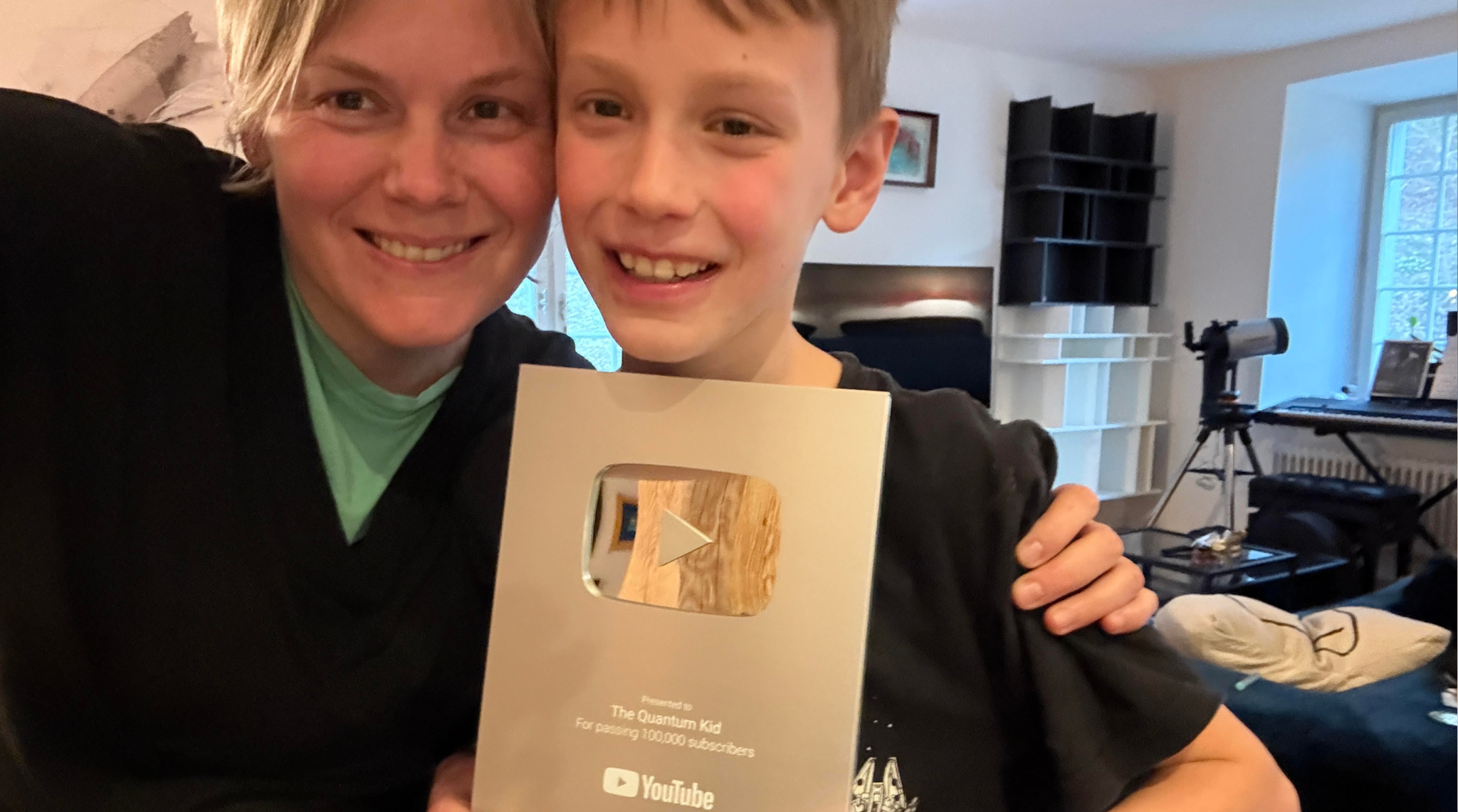
As a kid would do, Kai also enjoys getting comments under the videos and absolutely loved receiving the YouTube Silver Play Button when the channel reached the whopping 100k subscribers in under a year. The live unwrapping video of the Button was his idea!
How Quantum Could Change Our Lives
Every month, the show tackles a new way in which quantum computing, this emerging technology poised to transform our lives, will impact a specific field. Kai has learned that, for instance, it can help researchers discover new drugs and materials – as a quantum computer should be much faster than a traditional computer at going through lots of possibilities of the arrangement of atoms into a new molecule, the one that we need for that specific new compound that we are looking for. No longer relying solely on trial and error, as we largely do today. Quantum computers could make it much easier and hopefully help us fight pandemics more effectively, find cures for deadly diseases and create new materials – anything from more energy efficient solar panels to better protection for spacecraft from solar storms so that we can finally get to Mars.
Kai has also learned all about optimisation – for instance, when it comes to choosing the best route for an aircraft from, say, London to Sydney. Or the best path for a robot at a huge manufacturing warehouse. Or optimising the logistics of goods unloading and reloading at a busy port. A quantum computer could explore many different possibilities at once and give the best outcome much faster a classical machine ever could. For Kai, learning this triggered a question: “If I 3D-print a DIY model airplane, can a quantum computer help me calculate how to best fly it to avoid collisions with birds and other planes?” We are not there yet, as Prof Renato Renner from ETH Zurich, our first guest on the very first episode of the show told Kai – but the boy is clearly thinking in the right direction.
Can Art Explain Quantum?
The anniversary episode is something different, though – and deals with how to get more people excited about science in general. Not everyone likes science books or math classes, but especially for the young people, it is important to be aware that quantum computing will be around when they grow up. Even if they end up working in finance, or pharma, or manufacturing – they may be relying on quantum computers at some point, and understanding the potential of this technology today can benefit them greatly a decade from now. So what are the ways to raise that awareness? In the June episode, Kai meets Mark and Roger – each of whom have been communicating science to the broader public for years.
More specifically, one of the guests is Mark Levinson, an award-winning documentary filmmaker and the director of the famous film Particle Fever on the discovery of the Higgs boson at CERN in 2013. His latest movie, The Universe in a Grain of Sand, talks about quantum, among other things – and about getting people excited about quantum through art. Paintings, sculptures, cinema, his own movie with mesmerizing images are all unique, indirect ways to blend science and art and blur the borders between these two worlds just a little bit more.
And the second guest is Roger Highfield, the Director of Science at the Science Museum Group in the UK. Kai specifically wanted to talk to someone from the Science Museum in London, having visited the museum earlier this year. He loved the experience, especially Wonderlab – the part of the museum where visitors are allowed, and even encouraged, to touch the exhibits, and where what’s on display comes to life through interactive experiments with the enthusiastic curators. One can see the passion in the eyes of even the youngest visitors of the Wonderlab – and it’s important to keep that passion alive when the kids leave the museum. As Roger said on the show, a lot depends on the enthusiasm of the school teachers, and a passionate physics teacher can do wonders to inspire future scientists – or at least make kids aware that emerging tech like quantum is what will literally shape our future.
What’s Next for The Quantum Kid?
On the agenda for the episodes to come are Quantum Chess, Quantum Video Games, quantum and finance, perhaps at some point security and cryptography, and a lot more. But one of the main next steps for the show and its parent organisation, Tesseract Quantum, is how to get the insight that the guests provide in front of the right audiences, beyond YouTube. Students. Families with curious kids and science-oriented parents. Quantum computing courses. Companies eager to educate their employees about quantum and its impact. And so much more.
The Quantum Kid combines entertainment and a light-hearted but factually accurate approach to science, innovation and curiosity. If you have ideas how it can help you – get in touch with the team driving it!