

Insider Brief
- Researchers at Zhejiang University experimentally demonstrated a quantum random access memory (QRAM) architecture on a superconducting quantum processor, a step toward improving how quantum computers access classical data.
- The team implemented four-bit and eight-bit QRAM systems using a bucket-brigade architecture, achieving query fidelities of up to about 81% and 60%, respectively, according to a study published in Nature Physics.
- The demonstration remains at the proof-of-concept stage, with significant challenges in scaling, accuracy, error correction and hardware development before QRAM could support applications such as drug discovery, fraud detection or quantum-enhanced AI.
Chinese researchers have experimentally demonstrated a quantum random access memory architecture, or QRAM, on a superconducting quantum processor, marking what researchers describe as a significant step toward improving how quantum computers access large amounts of conventional data.
The work, published recently in Nature Physics by a team led by Zhejiang University and highlighted by the South China Morning Post and Seoul Economic Daily, addresses how to efficiently feed classical data into quantum systems. The bottleneck is considered a challenge that has long limited many proposed quantum computing applications, according to the researchers.
While quantum computers are often promoted for their potential to solve certain problems much faster than conventional computers, that advantage can be undermined when large datasets must be loaded and accessed one piece at a time. Researchers have viewed QRAM as a possible solution because it is designed to allow quantum systems to retrieve classical information in a way that preserves the parallelism inherent in quantum computing.

The Zhejiang University team reported implementing a circuit-based “bucket-brigade” QRAM architecture using a superconducting quantum processor. The researchers successfully demonstrated systems capable of addressing four and eight classical bits while achieving query fidelities of approximately 81% and 60%, respectively.
“We have succeeded for the first time in operating a QRAM prototype that can access 4-bit and 8-bit data on a superconducting quantum chip,” Lu Lichang, assistant professor at Zhejiang University’s College of Computer Science and Technology and a co-author of the paper, told state-run Science and Technology Daily. “We have proven that QRAM can process multiple data inputs simultaneously.”
Although modest in scale, the experiment represents one of the first physical demonstrations of a QRAM architecture, a concept that has largely remained theoretical despite years of research.
A Missing Piece for Quantum Algorithms
Quantum random access memory is often confused with quantum memory, but the two serve different functions.
Quantum memory stores quantum information itself, preserving fragile quantum states known as qubits. QRAM, by contrast, focuses on accessing classical information stored as conventional binary data.
Many proposed quantum algorithms assume the existence of a mechanism that can rapidly load and retrieve large datasets. Without such a system, the theoretical speed advantages promised by quantum computing can be significantly reduced.
Quantum computers process information using qubits, which can theoretically exist in combinations of 0 and 1 simultaneously through a property known as superposition. This capability allows quantum systems to explore many possible solutions extremely efficiently for certain classes of problems.
However, accessing large classical databases remains difficult. Even a powerful quantum processor can be slowed if it must retrieve information sequentially from conventional storage systems.
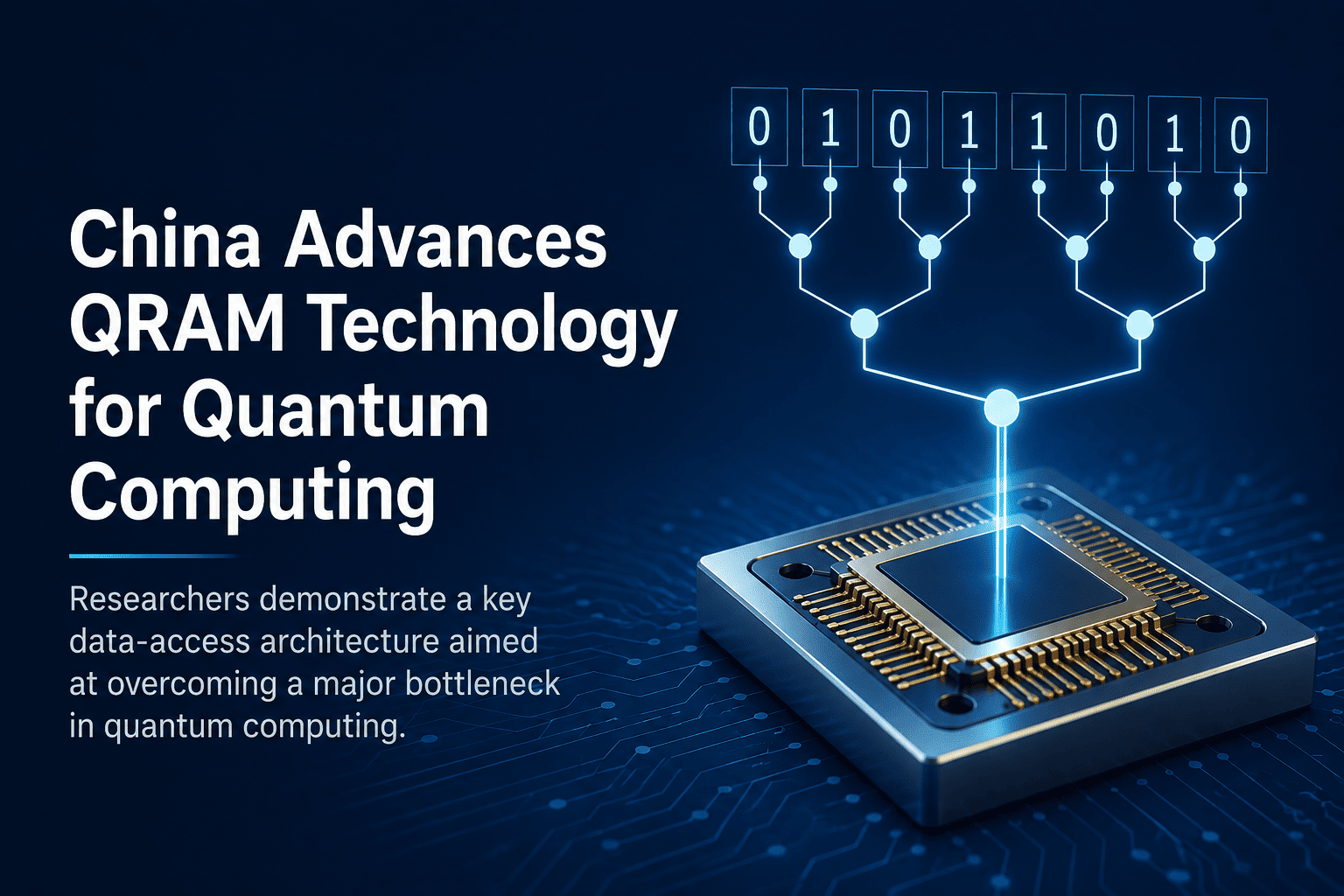
The Zhejiang team’s QRAM implementation uses a binary-tree structure — think of it as a decision tree — composed of quantum routers. The architecture directs queries through branching pathways to locate stored information more efficiently.
To make the system practical for experimentation, researchers developed a new gate decomposition method that reduced the depth of the QRAM circuit compared with conventional approaches. They also introduced an error-mitigation technique intended to improve query accuracy.
According to the paper, the researchers found evidence that the bucket-brigade architecture may be relatively resilient to noise, an important consideration because quantum systems remain highly sensitive to environmental disturbances.
“Our results highlight the potential of superconducting quantum processors for realizing a scalable QRAM architecture,” the researchers wrote in the abstract.
Strategic Importance Beyond the Laboratory
The achievement comes as China and the United States continue investing heavily in quantum technologies as part of broader competition in advanced computing.
China has identified quantum technology as one of seven strategic future industries in its recently announced 15th Five-Year Plan. The designation elevates quantum computing, communications and sensing technologies to national priorities.
At the same time, the United States continues to invest in quantum research through a combination of public and private funding. Seoul Economic Daily reported that the U.S. Department of Commerce recently announced more than $2 billion in support for quantum-related initiatives involving companies including IBM.
The QRAM demonstration is unlikely to alter the competitive landscape immediately, but it highlights China’s continuing efforts to advance across multiple layers of the quantum computing stack rather than focusing solely on processors.
Most current attention in quantum computing centers on increasing qubit counts, reducing errors and building fault-tolerant systems. Yet researchers increasingly recognize that supporting technologies such as memory, networking and data access will also be necessary if quantum computers are to perform useful real-world tasks.
Potential Applications Remain Distant
If scalable QRAM systems eventually become practical, they could support several frequently cited quantum computing applications.
In pharmaceutical research, quantum computers could potentially analyze large molecular databases more efficiently, helping researchers identify promising drug candidates. Financial institutions could use similar approaches to search enormous transaction datasets for suspicious activity or fraud patterns.
Researchers have also suggested that QRAM could play a role in future quantum-enhanced artificial intelligence systems by improving access to large datasets used for machine learning, natural language processing and image recognition.
However, the Zhejiang University experiment involved only four-bit and eight-bit demonstrations, far below the millions or hundreds of millions of data points that would likely be required for commercial applications.
Performance also remains limited. For example, query fidelity — essentially a rate of how accurate retrieval was — fell from roughly 81% in the four-bit system to approximately 60% in the larger eight-bit implementation, illustrating how quickly errors accumulate as systems scale.
The researchers acknowledge that the QRAM demonstration should be viewed as an early proof of concept rather than evidence that practical quantum data centers are imminent.
Lu said, as reported in Seoul Economic Daily, “Current quantum algorithms are theoretically impressive, but to run them on quantum computers, they must efficiently access vast amounts of conventional data,” adding, “Without QRAM, many application fields will inevitably remain pure theory.”
The experiment nevertheless provides an important data point for the field. For decades, QRAM has occupied a largely theoretical place in quantum computing research, often appearing in algorithm papers as an assumed capability rather than a demonstrated technology.
By physically implementing a small-scale version of the architecture, the Zhejiang University team has provided researchers with an experimental platform to study how QRAM behaves under real-world conditions.