


Insider Brief
- IonQ’s CEO describes 2025 as an inflection point, positioning the company as a full-stack quantum platform with growing commercial traction and global expansion.
- The company reports major technical milestones, including high-fidelity quantum operations, advances in networking and sensing, and early evidence of performance advantages in real-world applications.
- IonQ highlights strong revenue growth, increasing enterprise adoption, and a strategy focused on cost efficiency, scalability, and integrated manufacturing to support long-term commercialization.
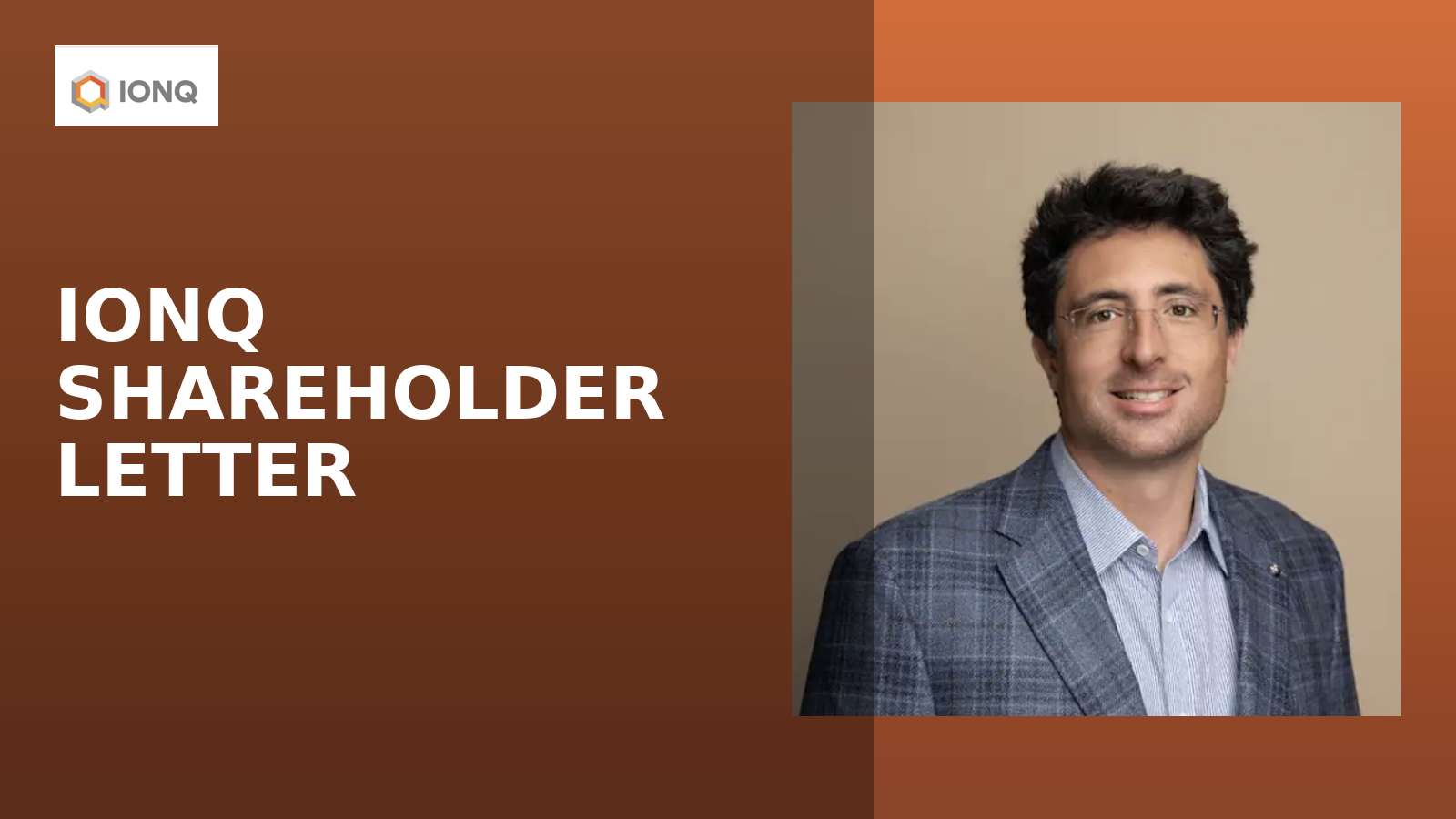
IonQ is positioning itself as a full-stack quantum technology provider with growing commercial traction, arguing that recent technical and financial milestones mark a turning point for the industry, according to its latest annual letter from Chairman and CEO Niccolò de Masi.
The letter frames 2025 as an “inflection point” for IonQ, with the company claiming progress across quantum computing, networking, sensing and security, an integrated approach it says distinguishes it from competitors. De Masi writes that IonQ has moved beyond its origins as a research-driven company to become what he describes as a “preeminent full-stack quantum platform and merchant supplier.”
This emergence is central to IonQ’s strategy to capture value across the quantum stack, from hardware to applications, as the sector moves toward commercialization, writes de Masi, who used the letter to shareholders to mark his first year as CEO of the company.

De Masi ties IonQ’s current direction to its scientific roots, referencing early work on quantum logic gates that helped define the field. He positions the company’s trajectory as part of a longer arc in computing, calling quantum technology a “generational opportunity” to build a new computational platform.
The company’s strategy now emphasizes integration. Rather than focusing solely on quantum computers, IonQ is developing a broader suite of technologies, including networking systems that enable quantum communication and sensors designed for applications such as navigation and defense.
De Masi writes: “We have evolved beyond our origins as a quantum computing pioneer to become the world’s preeminent full-stack quantum platform and merchant supplier. Our leadership now extends not only to each segment of our platform but is highly differentiated by our integration of quantum computing, networking, sensing, and security into a single, cohesive offering. Our complete quantum platform positions IonQ to reshape how quantum technologies are developed, deployed, and commercialized as we deliver end-to-end solutions and capture value at every layer of the stack.”
This integrated model will be key as quantum systems move from laboratory experiments to commercial deployments.
Technical Milestones and Performance Claims
The letter highlights several technical achievements, including a 99.99% two-qubit gate fidelity — a measure of how accurately quantum operations are performed. High fidelity is widely seen as critical for scaling quantum systems because it reduces the need for error correction.
De Masi writes: “With our trapped-ion technology achieving a world-record 99.99% two-qubit gate fidelity, I am proud to say that IonQ is the first company in history that has solved the fundamental science that will underpin utility-scale, fault-tolerant quantum computing. Our systems and applications delivered world-class performance this year and already demonstrate a commercial advantage over classical alternatives in multiple areas related to engineering, life sciences, and AI.”
The company also points to progress in quantum networking, including frequency conversion technology that allows quantum signals to travel over existing fiber optic infrastructure and advances in quantum sensing, such as reducing the size of atomic clocks while maintaining performance.
These developments are aimed at enabling real-world deployment rather than purely experimental demonstrations, according to the letter.
Commercial Growth and Global Expansion
IonQ reports strong financial growth, with a 202% year-over-year increase in revenue and nearly 80% organic growth in its core quantum computing business. The company says more than 60% of its revenue now comes from commercial customers, signaling what it views as increasing enterprise adoption.
De Masi writes: “This organic performance underscores a critical point: our quantum computing business is not just keeping pace with the industry, but is leading it.”
The letter focuses on deployments with research institutions and enterprises, including systems installed in South Korea, Europe and the United States. IonQ says it now operates in more than 30 countries, with international markets accounting for over 30% of revenue.
The company also highlights partnerships with universities and infrastructure projects, including a commercial quantum hub in Tennessee that combines computing and networking capabilities.
A key component of IonQ’s forward strategy is its planned acquisition of SkyWater Technology, which the company says would expand its manufacturing capabilities.
The move reflects a broader push to establish domestic production capacity for quantum technologies, which are increasingly viewed as strategically important.
According to the letter, integrating manufacturing could allow IonQ to act as a supplier to other companies in the quantum ecosystem, while also strengthening supply chain resilience.
The deal is moving through, but is receiving a close inspection from federal authorities.
Competition Policy International reports that the U.S. Federal Trade Commission (FTC) has formally asked for more detailed information about the planned merger between IonQ, Inc. and SkyWater Technology.
Cost, Energy and Scalability
De Masi emphasizes several factors that will determine which quantum technologies succeed commercially, including cost, energy efficiency and system-level performance.
He writes: “Unit economics remain central to commercialization: we anticipate our fully fault-tolerant machine, at scale, can be produced for approximately $30 million, without reliance on constrained supply chains, rare-earth materials, or helium-3 and with modest power and footprint requirements. Not only do we expect to win on outright system performance, but I believe cost per unit of compute will be a decisive factor in broader adoption and ecosystem development.
The letter also positions quantum computing as a potential solution to rising energy demands from artificial intelligence workloads, arguing that IonQ’s systems consume less power than some competing approaches.
In addition, the company stresses metrics such as “time-to-solution” and “cost-to-solution,” which refer to how quickly and economically a system can solve a problem, rather than focusing solely on hardware specifications like qubit count.
IonQ frames its technology as having both commercial and national security applications, particularly in areas such as encryption, navigation and sensing.
The letter notes that its quantum security products are already at levels suitable for deployment in infrastructure and telecommunications systems, while its sensing technologies could be used in military and space applications.
De Masi writes: “We recognize that our quantum platform represents a dual-use advantage for our nation and its allies, underpinning both economic growth and national security. Continuing to provide mature, deployable, quantum security solutions today will be a vital part of ensuring continuity for communication security as quantum computers become ubiquitous.”
This positioning aligns with broader government interest in quantum technologies as part of critical infrastructure and defense strategies.
Outlook and Ambitions
Looking ahead, IonQ sets an aggressive growth target, aiming to become the first quantum computing company to reach $1 billion in annual revenue.
The company indicates that its combination of technical progress, commercial traction and workforce scale—approximately 1,500 employees and more than 1,200 patents — positions it to lead the sector.
De Masi frames the company’s trajectory as part of a transformation in computing, with quantum technologies moving from theoretical potential to practical deployment.
While many of the claims in the letter reflect IonQ’s own assessments, the document underscores a central theme: the company sees itself not just as a participant in the quantum industry, but as a platform builder aiming to shape how the technology is commercialized at scale.