IEEE Study Demonstrates Deployment-Ready Quantum Entanglement Source


Insider Brief
- Researchers from the Austrian Institute of Technology and the University of Vienna demonstrated that time-bin entangled photon pairs can be generated and distributed across a 30 km urban fiber network using commercially available components.
- The setup used modulated GHz laser pulses, a second harmonic generation crystal, and a spontaneous parametric down-conversion crystal to produce entangled photons, with entanglement quality assessed using a commercial Mach-Zehnder interferometer.
- The experiment achieved 93% visibility, exceeding the threshold required for secure quantum key distribution, and is described as the first use of a commercial MZI delay line in a quantum application.
PRESS RELEASE — Researchers explore how reliable quantum entanglement states can be generated and distributed through off-the shelf components. Efficient generation and reliable distribution of quantum entangled states is crucial for emerging quantum applications, including quantum key distribution (QKDs). However, conventional polarization-based entanglement states are not stable over long fiber networks. While time-bin entanglement offers a promising alternative, it requires complex infrastructure. In this study, researchers explore how stable time-bin entangled states can be generated and distributed using commercially available components, paving the way for practical quantum communication networks.
Quantum entanglement links two particles, such as photons, so that measuring one instantly reveals information about the other. Reliable generation and distribution of entangled states are essential for quantum technologies like quantum key distribution (QKD) – a secure communication protocol using quantum randomness for encryption.
Most QKD systems use polarization-based entanglement, but this approach is unstable over long fibers due to birefringence. Time-bin entanglement, which encodes information in photons’ arrival times, offers a more stable alternative, though it has traditionally required complex, custom setups.

To address this issue, a study published in the IEEE Journal of Selected Topics in Quantum Electronics on 6 February, 2025, explores the generation and long-distance distribution of high-quality entanglement in a metropolitan network using off-the shelf components.
“With growing applications of quantum communication technologies, robust entanglement generation and distribution will be highly valuable. To realize this goal, we implemented a sequential time-bin entangled source for quantum key distribution across Vienna’s existing fiber network,” explains Mr. Martin Achleitner from Austrian Institute of Technology (AIT). The research team also included Dr. Alessandro Trenti and Dr. Hannes Hübel from AIT, and Dr. Philip Walther from University of Vienna, Austria.
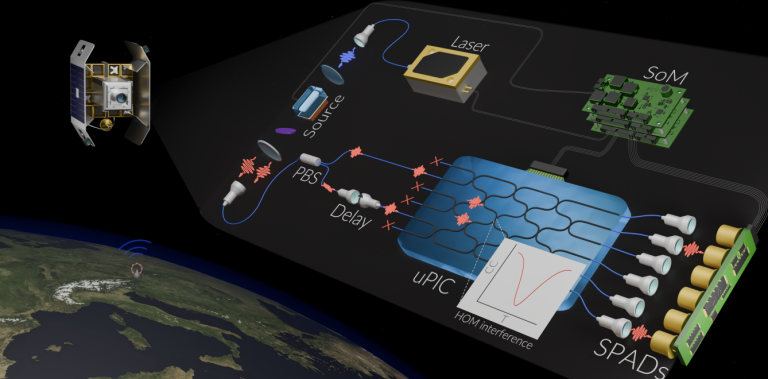
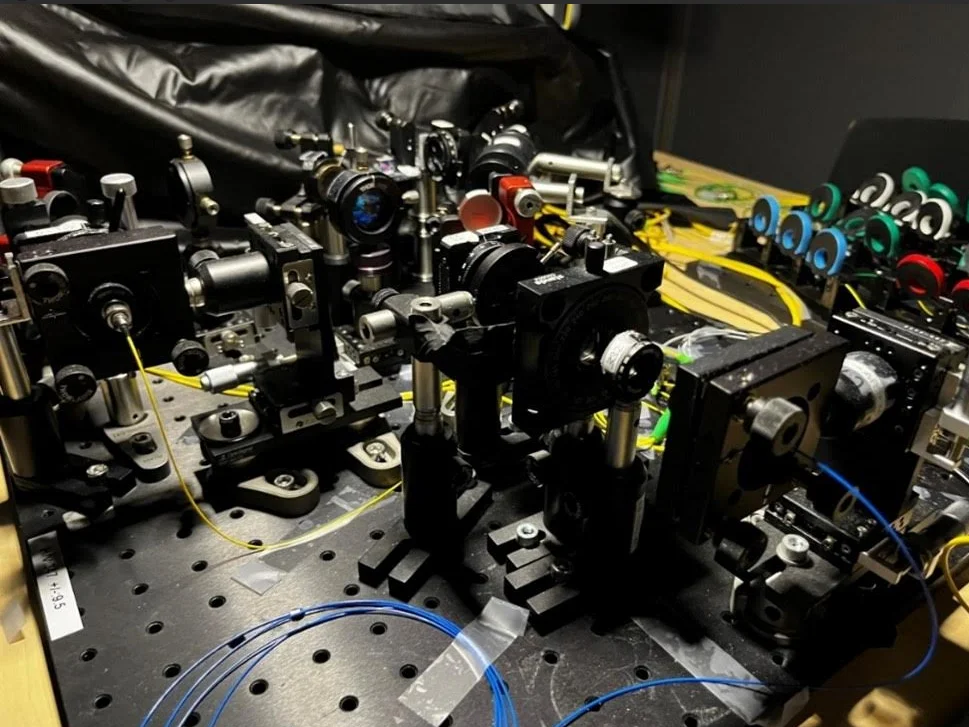
To generate time-bin entangled photons, the team utilized modulated laser pulses in the GHz range. These pulses were amplified and converted into a visible pump beam using a second harmonic generation (SHG) crystal. The pump beam was then injected into a special spontaneous parametric down-conversion (SPDC) crystal to generate the time-bin entangled photon pairs. To assess the quality of entanglement, the researchers used a commercially available Mach-Zehnder delay line interferometer (MZI) and a 50/50 beamsplitter setup.
The entangled photons were transported from AIT, through a 30 km long fiber link deployed across the city of Vienna and were received and measured at the University of Vienna with superconducting nanowire single photon detectors. “´To the best of our knowledge, this is the first time a commercial MZI delay line has been used for a quantum application,” notes Dr. Trenti. The setup demonstrated strong entanglement and excellent visibility of around 93%, well above the requirement for secure key generation.
“Using this type of entanglement source on photonic crystals will significantly improve scalability of quantum networks,” adds Dr. Hübel.
Overall, the study demonstrated how commercially available components can be used to build deployment-ready entanglement sources, paving the way for large-scale quantum communication networks.

Keep track of everything going on in the Quantum Technology Market. In one place.
Topics

Mohib Ur Rehman
Covering quantum and emerging technologies, Mohib explores the intersection of technology, security, and society. His work also frequently examines surveillance infrastructure and the institutions shaping the digital world. In addition to his work at The Quantum Insider, he co-runs SK NEXUS, an independent technology publication that helps readers understand the technologies shaping their lives.

Stay Ahead of Quantum
Get the latest research, company news, and market intelligence every week.