

Insider Brief
- Alice & Bob has proposed a new error-correction approach called “Elevator Codes” that could reduce logical error rates by up to 10,000× on future cat qubit quantum computers while requiring roughly three times more qubits.
- The method extends the company’s existing repetition-code scheme by adding active protection against bit-flip errors, using a reusable logical ancilla qubit that moves through the code to detect errors at the logical level.
- Described in an arXiv preprint by Alice & Bob researchers, the approach is designed to lower the qubit overhead required for fault-tolerant quantum computing and could make large-scale applications such as molecular simulation feasible sooner.
PRESS RELEASE — Alice & Bob, a global leader in fault-tolerant quantum computing, today announced a new way to reduce bit flip errors by “moving” logical ancilla qubits up and down during computation to gain significant performance improvement on the company’s future cat qubit quantum computers.
These new “Elevator Codes” would give Alice & Bob the option to make future quantum processors dramatically more accurate with the trade-off of needing a small number of supplementary qubits. More precisely, compared to Alice & Bob’s current error correction, the researchers expect to be able to reach a 10,000 times lower logical error rate while requiring only about 3 times more qubits using the new approach.
The company’s cat qubits are partially protected from bit-flip errors by design, or “passively”. These elevator codes modify the “active” protection of the repetition code, that in the standard Alice & Bob approach only corrects for phase-flips, so that it tackles bit-flips as well.

Diego Ruiz, a theoretical physicist at Alice & Bob, and Peter Shanahan, a quantum informatics researcher, described these new codes in the pre-print, “Elevator Codes: Concatenation for resource-efficient quantum memory under biased noise,” on arXiv.
“These error rates will make it possible to feasibly tackle problems like complex molecular simulation sooner than expected,” Ruiz said. “Also, this study is based on what our classical computers can simulate, it is reasonable to infer that even better performances could be reached using larger, higher rate codes on quantum hardware.”
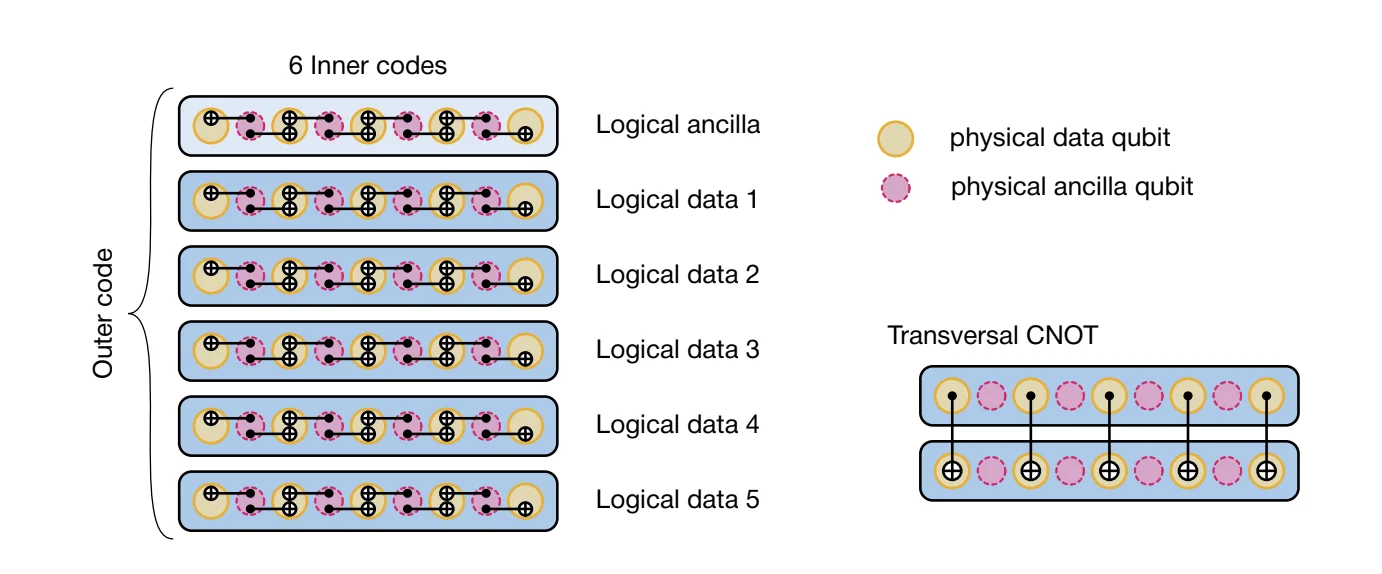
The key to the elevator codes is code concatenation. A code is used on top of the repetition codes to give them bit-flip protection. Concretely, a logical ancilla qubit operates like an elevator: moving up and down the repetition codes during computation, running checks to detect bit-flips at the logical level.
Adding just a single logical ancilla can be done at a really small cost in terms of number of qubits but can significantly boost the logical performance. This is achieved by resetting and reusing the logical ancilla after each check, while the code has a high-encoding rate packing more logical qubits out of the same physical footprint.
Error correction is a fault-tolerant quantum computer’s foundation, and it works by increasing the number of physical qubits to build fewer but more reliable logical ones. This creates extremely large overheads, which poses feasibility challenges for scaling quantum hardware. Error correcting codes that reduce this overhead such as the cat qubit repetition code and others that multiply their resilience to errors such as the new elevator codes, should make it more attainable to run useful, large-scale computations sooner.
This method is tailored to the noise-bias of Alice & Bob’s cat qubits and in the company’s new blog post more information is shared about these novel codes.