

Insider Brief
- Chinese researchers demonstrated fault-tolerant quantum error correction below the threshold using an all-microwave control approach, marking the first such result outside the United States and narrowing the gap with Google.
- The study showed that microwave-based leakage suppression on a 107-qubit superconducting processor reduced errors as the system scaled, confirming stable distance-7 surface code performance.
- By avoiding hardware-intensive control methods, the microwave approach may reduce wiring complexity and improve the scalability of large quantum computers.
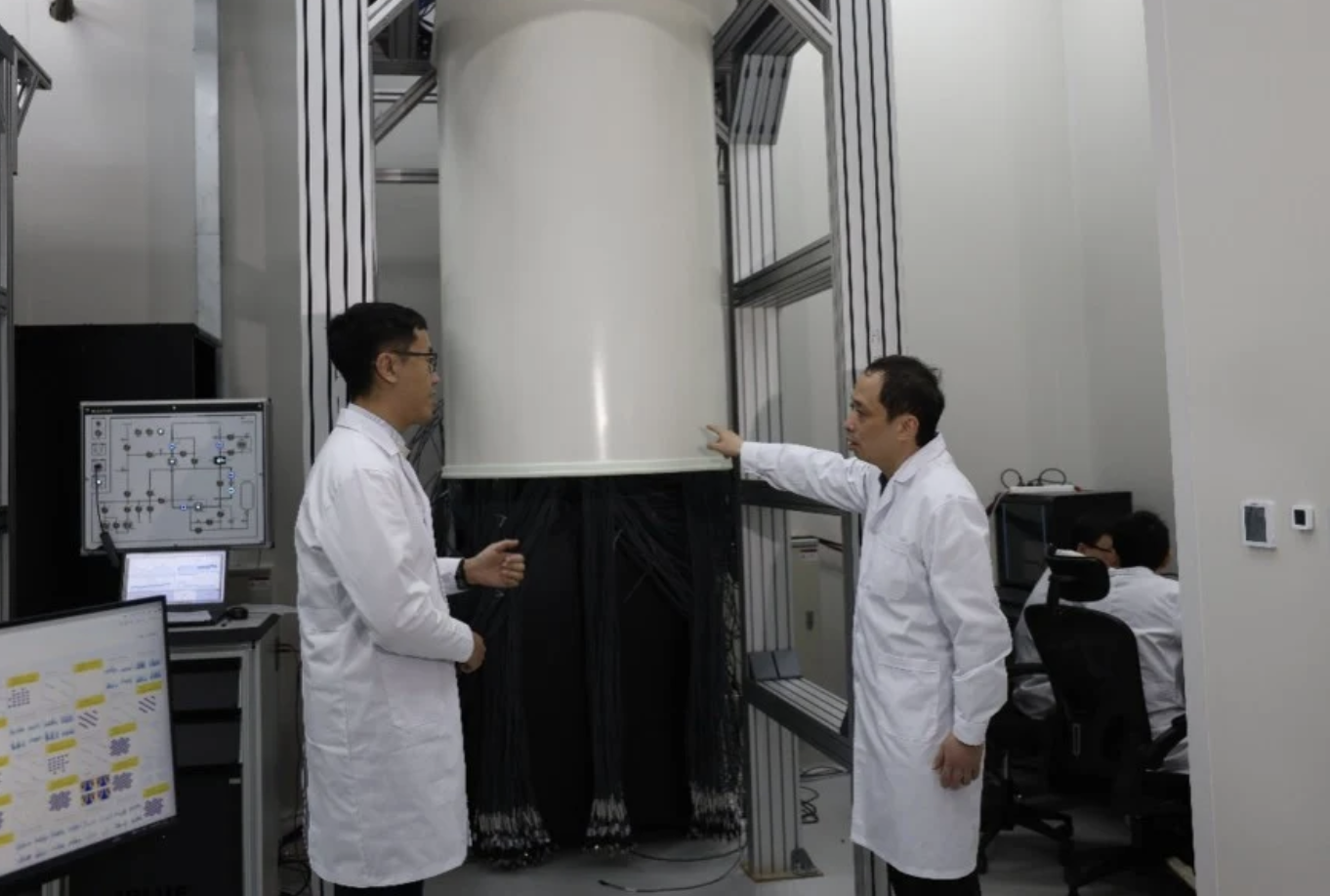
- Image: Researchers at the University of Science and Technology of China, in the central province of Anhui, stand in front of the Zuchongzhi 3 superconducting quantum computing system. (SCMP, Handout)
Chinese researchers have shown that a superconducting quantum computer can cross a key reliability threshold using microwave-based control, a result that could ease some of the hardest engineering barriers facing large-scale quantum machines.
According to reporting by the South China Morning Post (SCMP), the advance comes from a team led by Pan Jianwei at the University of Science and Technology of China, which has demonstrated fault-tolerant behavior on its 107-qubit Zuchongzhi 3.2 processor. The findings were published last week in Physical Review Letters and mark the first time a research group outside the United States has reached this milestone.
The study goes right to the heart of error correction, one of quantum computing’s central challenges. Quantum computers rely on qubits, which are notoriously fragile. Heat, stray electromagnetic signals and tiny environmental disturbances can knock them out of their intended states, introducing mistakes that spread quietly through a calculation. Error correction, which distributes information across many qubits and repeatedly checks for faults, has long been viewed as the only viable path to practical machines. Yet for years, those checks often introduced more errors than they removed.

The field has since focused on the idea of creating a threshold. Below it, error correction makes matters worse. Above it, each added layer of protection improves stability, allowing systems to scale. Crossing that line has become a global benchmark for progress.
From Proofs of Principle to a Threshold
China and the United States both invested early in surface-code error correction, one of the most studied schemes for protecting quantum information, SCMP reports.
The company’s researchers and China’s scientists have been in a bit of a quantum leapfrogging race over the past few years. In 2022, Pan’s group used an earlier processor, Zuchongzhi 2, to demonstrate a minimal surface-code unit, known as a distance-3 logical qubit. The following year, Google advanced to distance-5 error correction. In both cases, however, the underlying qubits were still noisy enough that the systems did not fully cross the threshold.
That changed when Google reported that its Willow processor had achieved a distance-7 logical qubit operating below the threshold. The company relied on hardware-based techniques, using direct-current pulses to suppress a particularly damaging class of errors called leakage, in which quantum information escapes the states used for computation.
While effective, that approach comes with trade-offs, including the suppression of leakage through additional hardware places constraints on chip layouts and increases in wiring demands inside dilution refrigerators, where quantum processors operate just above absolute zero. As systems grow, routing more control lines into these environments becomes a major bottleneck.
All-Microwave Alternative
The Chinese team took a different route, according to SCMP. Working with Zuchongzhi 3.2, they developed an all-microwave method to control and suppress leakage errors. Instead of adding new hardware channels, the system uses carefully timed microwave signals to keep qubits within their intended states and to reset auxiliary qubits used for error detection.
According to the SCMP and the researchers’ own analysis, this approach allowed the team to construct a distance-7 surface-code logical qubit comparable in scale to Google’s most advanced demonstrations. The team reports that as the size of the error-correcting code increased, the overall error rate declined rather than rose.
The team measured an error-suppression factor of 1.4, meaning that each increase in code size reduced logical errors instead of amplifying them. This reversal is a signal that the system is operating below the threshold.
Why Microwaves Matter
The technical significance of the work may lie less in how the result was achieved, rather than the one-upmanship with Google. Microwave control is already central to superconducting quantum computers, which use microwave pulses to manipulate qubits. Extending that same control layer to handle leakage suppression reduces the need for extra hardware.
Because microwave signals can be multiplexed, multiple control tones can share a single physical line. That opens the possibility of reducing wiring density, simplifying chip packaging and easing the thermal and mechanical constraints that plague large cryogenic systems.
In their Physical Review Letters paper, the researchers also report strong suppression of long-lived leakage errors over repeated cycles of error correction, addressing a problem that has been particularly stubborn for surface codes. Leakage errors can persist and correlate across time, undermining the assumptions behind many error-correction schemes.
Independent researchers described the experiment as an important step, while also noting that it remains far from the scale needed for real-world applications.
Today’s demonstrations involve dozens or hundreds of qubits, whereas useful quantum computers are expected to require hundreds of thousands or even millions.