Jülich Celebrates Arrival of Pasqal’s 100-Qubit Quantum Computer: A Step Towards Europe’s Quantum-HPC Integration


Insider Brief:
- The Jülich Supercomputing Centre (JSC) received a 100-qubit quantum computer from Pasqal, integrating it with the JURECA DC supercomputer to provide hybrid classical-quantum resources for European researchers.
- The EuroHPC JU project HPCQS intends to establish a quantum-HPC infrastructure, with Pasqal quantum systems being deployed in Germany and France to solve real-world problems such as drug design and supply chain optimization.
- The HPCQS project contributes to building Europe’s Quantum Computing and Simulation Infrastructure, encouraging collaboration and integration across nations to enhance computational capabilities.
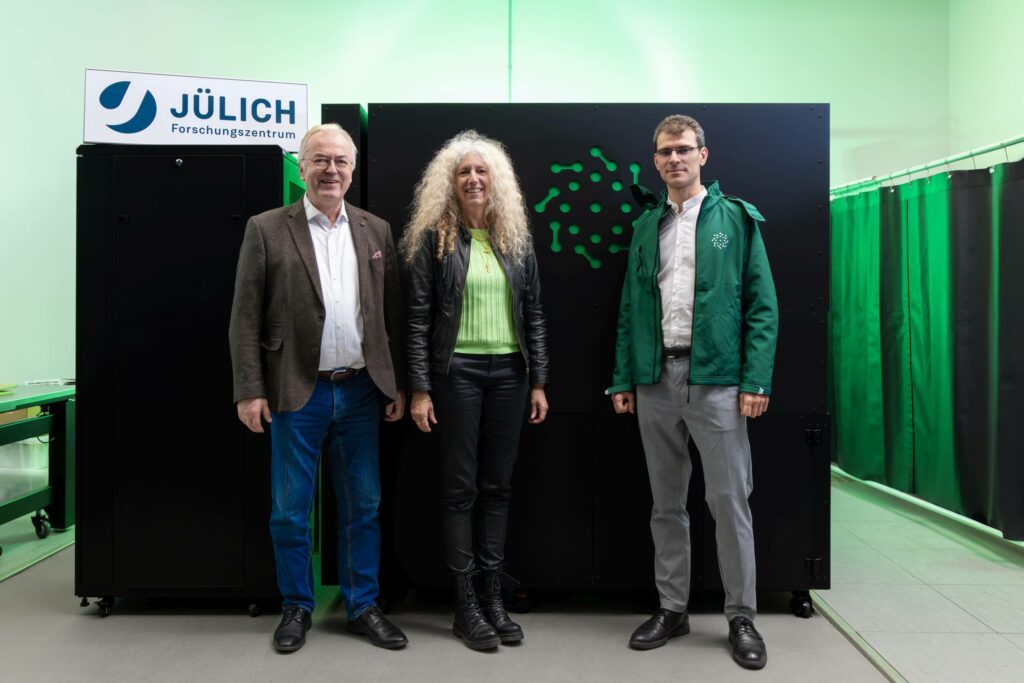
- Image credit: Forschungszentrum Jülich / Jenö Gellinek
PRESS RELEASE — In a recent news release, the Jülich Supercomputing Centre at Forschungszentrum Jülich celebrates a notable moment in European quantum progress with the delivery of a 100-qubit quantum computer from Pasqal. According to the release, this device, powered by Pasqal’s neutral atom technology, is part of the EuroHPC JU project HPCQS–High Performance Computer – Quantum Simulator–which is tasked with seamlessly integrating quantum systems with Europe’s high-performance computing infrastructure.
The quantum computer will connect with the JURECA DC supercomputer at the Jülich Supercomputing Centre, providing a tool for researchers across Europe to access hybrid classical-quantum resources. This step is representative of Europe’s commitment to providing tools and systems that promote advancing current computational capabilities for real-world applications like drug design, supply chain optimization, and intelligent systems.
Expanding JUNIQ and Quantum Access
JSC’s Jülich UNified Infrastructure for Quantum computing (JUNIQ) is a public quantum computing user facility that provides academia and industry with access to the latest in quantum technologies. The integration of Pasqal’s device further strengthens JUNIQ’s current offerings. As Prof. Dr. Astrid Lambrecht, Chair of the Board of Directors at Forschungszentrum Jülich, noted, “The coupling of quantum systems and supercomputers makes it possible to combine the advantages of both systems and to use the potential of quantum computers already today for the first practical applications.”

Prof. Kristel Michielsen, head of JUNIQ & Quantum Computing at JSC, emphasized the broader implications: “We are now on track to implement two hybrid HPC-QS systems in France and Germany that will provide European end users with access to exceptional computing power–and will help solve societal problems in the future.”
The HPCQS Vision and Dual Deployment
The HPCQS project, supported by the European High Performance Computing Joint Undertaking (EuroHPC JU) and six European countries, represents a unified effort to build hybrid quantum-HPC infrastructure. It involves deploying two Pasqal quantum computers, each controlling over 100 qubits, to supercomputing centers in France and Germany.
The first system was delivered earlier this year to GENCI/CEA in France, where it is being integrated with the Joliot-Curie supercomputer. The second system, now at JSC, is expected to be operational by June 2025. As Anders Jensen, Executive Director of EuroHPC JU, remarked, “I am thrilled to welcome the second HPCQS quantum computer—a major step forward in empowering European users to develop groundbreaking algorithms and applications by combining quantum and classical HPC resources. I eagerly anticipate seeing the first projects harness the potential of this cutting-edge technology in the months ahead.”
Pasqal’s Neutral Atom Technology
Pasqal’s quantum computers use neutral atoms as qubits, which are manipulated using laser light. This approach is said to provide stability due to the weak interaction of neutral atoms with environmental electromagnetic fields, making them useful for precision quantum calculations.
Dr. Georges-Olivier Reymond, CEO and Co-Founder of Pasqal, highlighted the potential of this partnership, stating, “Our partnership with Forschungszentrum Jülich and the resulting coupling of our QPU with the JURECA DC supercomputer is a unique opportunity to drive innovation in fields such as materials science, drug discovery and artificial intelligence through the work of European researchers. It is also creating the framework for the private sector to explore and perfect industrial use cases while having access to the latest quantum and high-performance computing technology”
Towards a Unified Quantum Infrastructure
HPCQS is step-by-step building a foundation for Europe’s Quantum Computing and Simulation Infrastructure (EuroHPC-QCS), as outlined in the European Quantum Flagship’s Strategic Research and Industry Agenda 2030. By encouraging collaboration across nations and integrating quantum platforms, this initiative may provide the tools and resources necessary to promote advancements in computation within Europe’s ecosystem.

Keep track of everything going on in the Quantum Technology Market. In one place.
Topics
- Europe, European High Performance Computing Joint Undertaking (EuroHPC JU), European Quantum Flagship’s Strategic Research and Industry Agenda 2030, Forschungszentrum Jülich, High Performance Computer – Quantum Simulator (HPCQS), Jülich Supercomputing Centre, Jülich UNified Infrastructure for Quantum computing (JUNIQ), neutral atom, Pasqal, URECA DC supercomputer

Cierra Choucair
Cierra Choucair is a journalist and data analyst at The Quantum Insider, where she covers quantum computing and emerging technologies. With a background that blends scientific analysis, public communication, and product storytelling, she bridges technical complexity and industry insight across research, startups, and policy. She is the author of The Daily Qubit, a widely read newsletter spotlighting quantum research, use cases, and industry trends.

Stay Ahead of Quantum
Get the latest research, company news, and market intelligence every week.
MENTIONED IN THE ARTICLE

Jülich Supercomputing Centre (JSC)
The Jülich Supercomputing Centre (JSC) is a research center located in Jülich, Germany, that provides leading-edge supercomputer resources, IT tools, methods, and know-how. The center has approximately 250 experts working on all aspects of supercomputing and simulation. The JSC is part of the John von Neumann Institute for Computing (NIC) and the Gauss Centre for Supercomputing (GCS). The JSC is also home to the Jülich Unified Infrastructure for Quantum Computing (JUNIQ), which is a uniform quantum computing Platform as a Service (QC-PaaS) that offers European users support and access to quantum computer emulators and quantum computing technologies of different types and levels of technological maturity. JUNIQ will integrate quantum computers in the form of quantum-classical hybrid computing systems into the modular HPC environment of the Jülich Supercomputing Centre. They operate a quantum annealer with more than 5,000 qubits as part of JUNIQ, making them the first site in Europe to operate a latest-generation system by the Canadian manufacturer D-Wave. The JSC collaborates with renowned hardware and software vendors like IBM, Intel, NVIDIA, and ParTec to meet the challenges that arise from the development of exaflop.
→

PASQAL
PASQAL’s quantum computers control neutral atoms with optical tweezers using lasers to manipulate quantum registers with up to a few hundred qubits. Location in Boston MA.
→

Forschungszentrum Jülich
Forschungszentrum Jülich (FZJ) is one of the largest interdisciplinary research institutions in Europe, focusing on energy, information, and bioeconomy. Located in Jülich, North Rhine-Westphalia, it employs approximately 7,250 staff members, including many international researchers. FZJ operates advanced scientific infrastructures, such as supercomputers and particle accelerators, and conducts research aimed at addressing major societal challenges, including climate change and sustainable resource management. As a member of the Helmholtz Association, it collaborates with over 200 partners globally, fostering innovation in various fields through interdisciplinary approaches and cutting-edge technologies.
→