

Insider Brief
- North Rhine-Westphalia state government supports technology partnership with €21 million in funding
- Quantum computing network “EIN Quantum NRW” acts as nucleus for globally unique project
- NRW-Minister President Hendrik Wüst: We want to further expand our important position in quantum computing
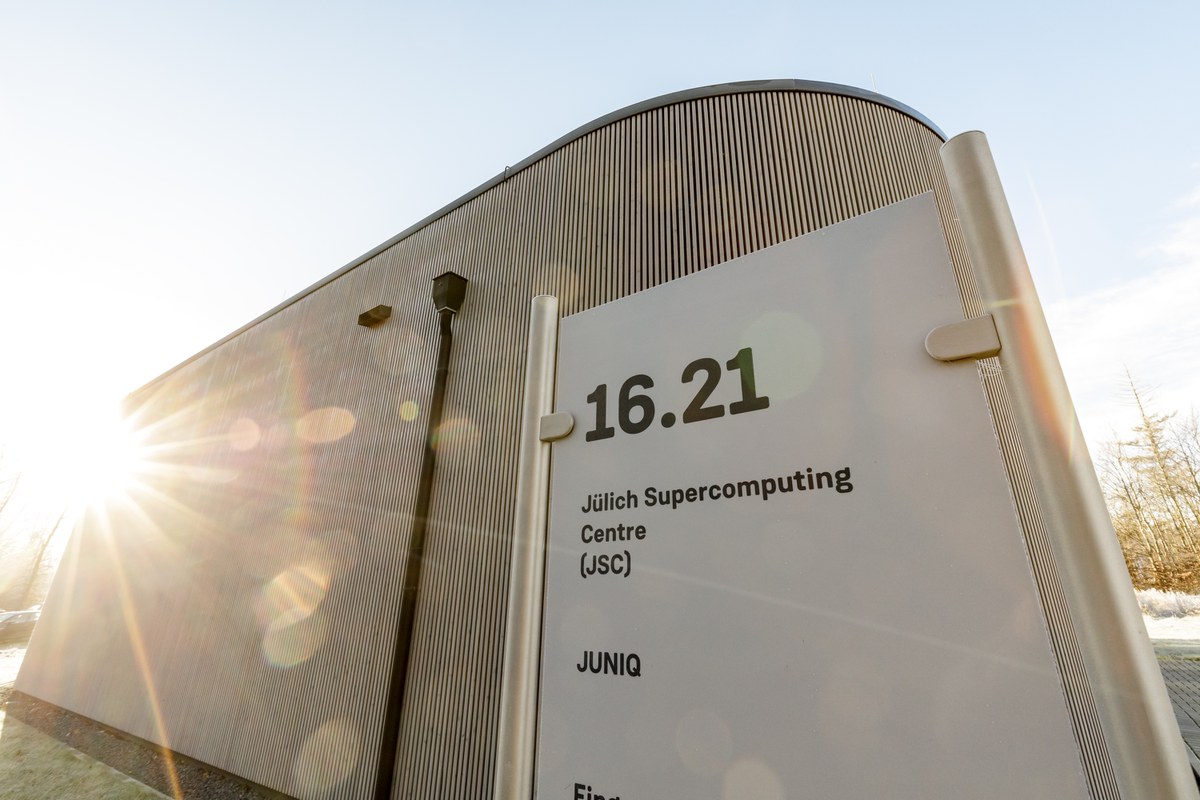
- Image: Research Center Jülich / Sascha Kreklau
PRESS RELEASE — The Siegen-based quantum computer pioneer eleQtron and Forschungszentrum Jülich’s world-leading supercomputing centre are entering into a strategic technology partnership. As part of the now contractually agreed EPIQ project, a development partnership for a trapped-ion quantum computer in North Rhine-Westphalia (NRW), eleQtron is developing a trapped-ion quantum computer by the end of 2024, which will be closely integrated into the high-performance computing infrastructure of the Jülich Supercomputing Centre (JSC). The modular system consisting of supercomputer and quantum computer enables hybrid quantum–classical algorithms to be used in practice for the first time. The Ministry of Culture and Science of the State of North Rhine-Westphalia is providing around € 21 million in funding over a four-and-a-half-year period to the globally unique EPIQ project, which was born out of the quantum computing network “EIN Quantum NRW”.
Hendrik Wüst, Minister President of the State of North Rhine-Westphalia, stated: “With its strong economy, North Rhine-Westphalia offers the best conditions for research into technological innovations. We want to further expand our important position in quantum computing and make our state the technology leader in quantum technologies. The development partnership between eleQtron and Forschungszentrum Jülich is an important step in this direction. The aim is to develop a quantum computer – developed and manufactured by researchers from our state – to series maturity by 2027. This pioneering project will make a significant contribution to ensuring that our state remains at the forefront of research and innovation. North Rhine-Westphalia is the German region of the future for digitalisation.”
Ina Brandes, Minister for Culture and Science of the State of North Rhine-Westphalia (MKW NRW) said: “In the future, computing power will be the decisive key to mastering the major challenges facing humanity. This applies to the fight against widespread diseases as well as to intelligent mobility and the resource-saving use of energy. Quantum computing ‘made in NRW’ is an international leader. We owe this to the exemplary success story of the University of Siegen, its spin-off with eleQtron and the close cooperation with Forschungszentrum Jülich: a real beacon project for North Rhine-Westphalia as a centre of science.”

“The partnership with the renowned Forschungszentrum Jülich and the delivery of our quantum computer are a major milestone for eleQtron. We are very pleased and proud to make this important contribution to innovation for NRW as a hub of technology and industry. Our goal is to quickly establish quantum computers on the market as a key technology of the future for industrial applications. Here in NRW, we have great potential for applications in industry. These companies can be at the forefront of applications when quantum computers arrive on the market and create completely new framework conditions for business models with their disruptive power,” says Jan Leisse, co-founder and CEO of eleQtron. “We are writing future history here for NRW.”
“Forschungszentrum Jülich has made quantum computing one of its primary strategic goals,” explains Prof. Dr. Astrid Lambrecht, Chair of the Board of Directors of Forschungszentrum Jülich. “Developing a quantum computer and putting it into application together with a start-up from North Rhine-Westphalia demonstrates NRW’s capabilities as a high-tech hub in Europe and also the effectiveness of the ‘EIN Quantum NRW’ network, through which the development partnership came about.”
Two pioneers in the deep tech sector
The “EIN Quantum NRW” network, in which the NRW ministries of economic affairs and science are also involved, pools the quantum computing expertise of the state of North Rhine-Westphalia. Fields of application for the quantum computer will include optimization tasks in various industrial areas such as logistics, traffic optimization, and process engineering. The quantum computer will also be used in the basic sciences of physics and chemistry, biology and medicine, and materials research. Machine learning and the training of AI models are further promising fields of application.
The partnership brings together two partners from industry and science, both of which are pioneers in the deep tech sector. Siegen-based start-up eleQtron manufactures quantum computers like no other in the world. Its two founders, Prof. Dr. Christof Wunderlich and Dr. habil. Michael Johanning, were involved in the construction of the first German quantum computer. The quantum computer developed by eleQtron using MAGIC (magnetic gradient induced coupling) technology is promising from a technological perspective, but also with a view to the global competition. eleQtron’s quantum computers are scalable, meaning that more and more qubits can be connected together. The “magic” behind it is that the qubits are not controlled individually with lasers, but with high-frequency waves.
Since 2015, Forschungszentrum Jülich has set itself the goal of establishing a leading development and user community from industry and science for the application of quantum computers in Germany and Europe. The aim is to provide this community with access to quantum computers, user support, and cooperation in the development and implementation of algorithms. To this end, Prof. Dr. Kristel Michielsen and Prof. Dr. Dr. Thomas Lippert created the user facility JUNIQ – JUelich User Infrastructure for Quantum Computing – at the Jülich Supercomputing Centre, one of the world’s leading computing centers. JUNIQ currently offers cloud access and support for two leading quantum computer emulators and a quantum annealer. The first commercial gate-based system that JUNIQ aims to offer is to be expanded and installed in the EPIQ project by eleQtron.
Completed quantum computer to be delivered in 2024 and expanded in 2026
The quantum computer is to be created in two stages at Forschungszentrum Jülich. In the first stage, eleQtron will set up a pilot system with the room temperature QPU (quantum processing unit) “HiQ” with up to 30 trapped-ion qubits by the end of this year and will install it for integration with the Jülich supercomputer JURECA DC over the course of next year. In the second stage, eleQtron will expand the pilot system into an end-user system with the cryo-QPU “HiQ+” with up to 60 qubits and install it at Jülich in 2026. The aim at JSC is to create a hybrid system consisting of both supercomputer and quantum computer. The interaction between traditional digital high-performance computers and the emerging quantum computers offers considerable potential for innovation worldwide.
“This is the third quantum computer we have sold. We are delighted that leading centres also see the potential in our technology. We are excited about the future and hope that the industrial companies here in NRW recognize that they have a unique opportunity ahead of them. They can be among the first companies to use quantum computers. One thing is certain: The competition never sleeps,” adds eleQtron CEO Jan Leisse.
If you found this article to be informative, you can explore more current quantum news here, exclusives, interviews, and podcasts.