Guest Post — The 2026 Finance Quantum Index: Recognizing the Leaders Advancing Quantum in Finance


Guest Post by Steve Suarez, Founder and CEO of HorizonX and Co-founder of The Quantum Index
The 2026 Finance Quantum Index brings together 64 financial institutions across eight regions, more than doubling its coverage from 28 institutions in 2025.
With 36 new additions, this year’s edition provides a broader view of quantum activity across banking, insurance, payments, asset management and central banking.
What stands out is the growing commitment from institutions investing in quantum research, building internal capabilities and exploring practical applications.

Behind every ranking are researchers, engineers, business leaders and partners working to prepare their organizations for the opportunities and challenges ahead.
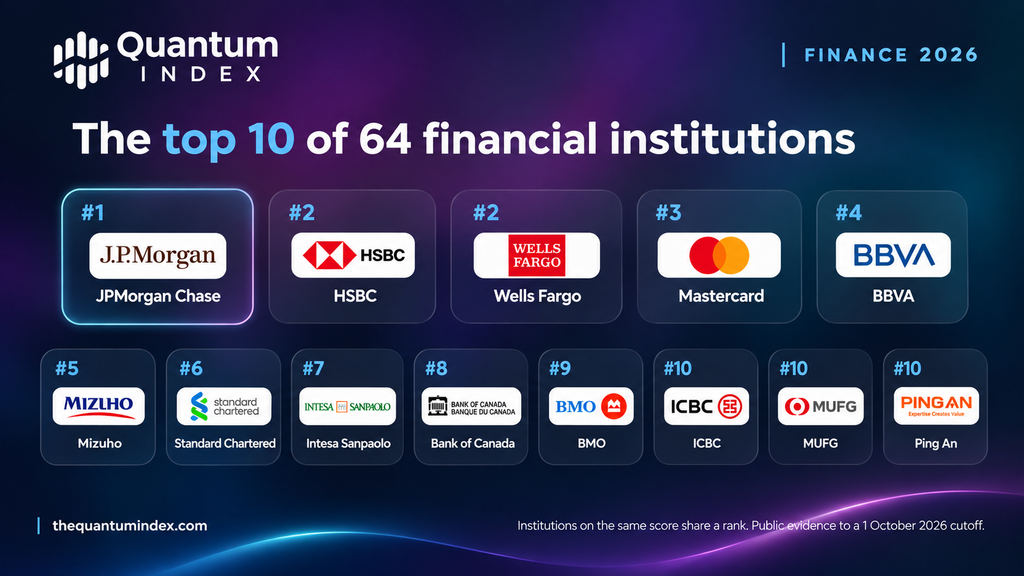
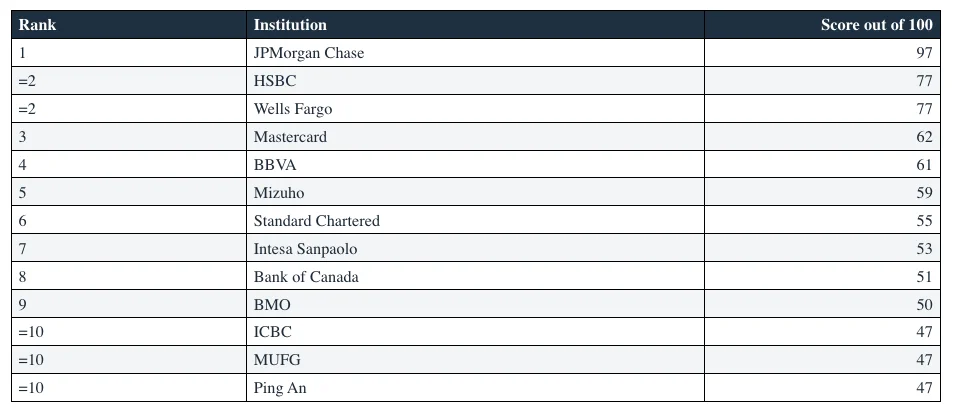
The top 10 ranking positions include 13 institutions, as tied scores share the same rank.
The diversity of institutions in the top 10, from commercial banks and payments networks to insurers and central banking, demonstrates the different ways the financial sector is approaching quantum technology.
JPMorgan Chase leads with a score of 97, reflecting its strength across all three pillars of the Index: workforce, research and development, and adoption. Its 20-point lead reflects the breadth of its documented quantum program. HSBC and Wells Fargo share second place at 77, supported by significant research activities, dedicated teams and industry collaborations.
Mastercard, scoring 62 and ranking third overall, leads the payments category. Its research with Oxford Quantum Circuits explores how quantum methods could improve fraud detection. Mastercard’s quantum research
On November 18, 2026, Mastercard also launched a Quantum Advisory Practice to help financial institutions assess quantum risks, inventory cryptographic systems and plan migration to post-quantum cryptography. Its new white paper, Quantum computing and financial services, provides additional guidance for organizations preparing for these challenges. Mastercard’s quantum readiness announcement
BBVA, scoring 61, has explored quantum approaches to investment portfolio optimization through its work with Global Data Quantum. This is another example of connecting quantum research to practical financial applications. BBVA’s portfolio research
Standard Chartered, scoring 55, is pursuing applications through SC Ventures. Its joint venture with Fujitsu, Qubitra Technologies, is developing quantum and quantum-inspired solutions for derivatives pricing, trading and fraud detection, while connecting technology providers with potential users. Standard Chartered’s Qubitra announcement
BMO, scoring 50, has established its Institute for Applied Artificial Intelligence & Quantum and developed partnerships with Quantum Industry Canada and the Chicago Quantum Exchange. These initiatives support research collaboration, talent development and governance. BMO’s institute and partnerships
One of the most interesting findings is the gap in documented quantum capabilities across the industry. Only five institutions score 60 or above, while the median across all 64 institutions is 26. This suggests that although quantum activity is expanding, the depth of investment and demonstrated capabilities varies significantly. Explore the full results
The 2026 edition also introduces a revised scoring methodology. Workforce accounts for 30%, research and development for 40%, and adoption for 30%. Logarithmic scoring replaces the previous bands, with institutions assessed against the strongest results in each metric.
The Index evaluates documented evidence, including named staff, research papers, citation impact, patent families, partnerships and use cases. It provides a measurable view of quantum activity and a baseline for tracking future progress. The results should be understood as a measure of documented activity rather than a complete assessment of every institution’s quantum readiness.
For me, the most rewarding part of the Index is seeing the people behind these efforts receive recognition. Research papers, dedicated teams, partnerships and practical use cases all represent years of work and institutional commitment.
Congratulations to every institution recognized in the 2026 Finance Quantum Index, and especially to the teams making this progress possible. Your work is helping build the capabilities the financial sector will need as quantum technology continues to develop.
If you would like to explore the full results or ensure your institution’s quantum activities are represented in future editions, please reach out.

Keep track of everything going on in the Quantum Technology Market. In one place.
Topics

Steve Suarez
Steve Suarez is the Founder and CEO of HorizonX, a consulting firm focused on business strategy and the adoption of emerging technologies. He co-founded The Quantum Index and serves on several boards while advising leading organizations as a Senior Advisor on emerging technology. Previously, Steve was Global Head of Innovation at HSBC, Global Functions where he led enterprise-wide digital transformation. He is a guest lecturer at MIT xPRO’s Quantum Computing: Strategy and Impact course, sharing his frameworks for quantum readiness.

Stay Ahead of Quantum
Get the latest research, company news, and market intelligence every week.
MENTIONED IN THE ARTICLE