Quantum Physics Can Verify a Person’s Location, NIST Researchers Show


Insider Brief
- Researchers at the National Institute of Standards and Technology and their collaborators demonstrated a quantum technique that verifies a person’s physical location and closes loopholes in earlier methods.
- In the experiment, two stations 195 meters apart used the timing of responses and measurements of entangled particles of light to verify the claimed location.
- The technique could help secure financial transactions, medical records and critical infrastructure, but practical use may be more than a decade away and will require advances in quantum networks.
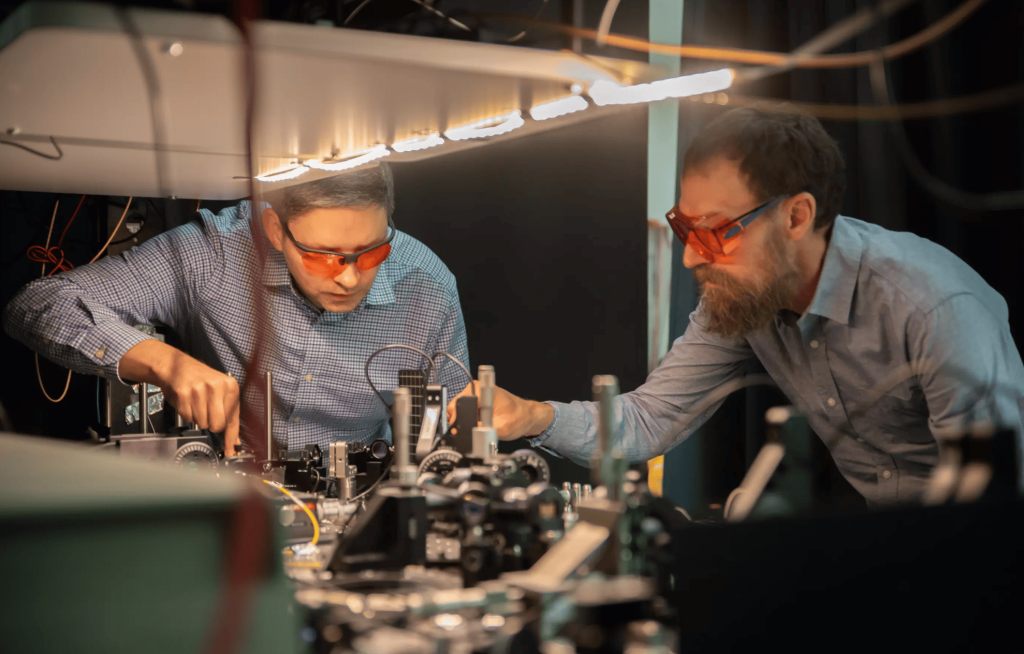
- Image: NIST researchers Krister Shalm (left) and Marty Stevens use optical components to guide entangled photons into an optical fiber. The photons are used to securely verify the position of a distant party in a new protocol developed by NIST scientists.
PRESS RELEASE — Imagine a corporate treasurer directing her company’s financial network to make a $50 million wire transfer. How can the network be certain the command is coming from a secure terminal in the company’s headquarters, and not a hacker’s laptop across the globe?
In a first-of-its-kind experiment, scientists at the National Institute of Standards and Technology (NIST) and their colleagues have demonstrated that the quirks of quantum mechanics can definitively confirm the location of a person. Using exquisitely sensitive quantum sensors and quantum technologies developed at NIST, physicist Krister Shalm and an international team of collaborators eliminated loopholes that had left other quantum-based verification strategies vulnerable to fraudsters.
The researchers reported their findings this week in Nature.

Applying the technique to a real-life situation may be more than a decade away, noted NIST physicist Scott Glancy, a study collaborator. That’s because researchers are still developing the tools that will allow quantum computers and sensors to accurately share quantum information in large-scale networks.
By preventing people outside a specific location from accessing data, the technique has the potential to:
- Safeguard healthcare records and other private information.
- Prevent remote adversaries from issuing commands to critical infrastructure such as nuclear plants, power grids and water treatment facilities.
- Stop hackers from making unauthorized stock transactions in a firm’s trading account.
- Thwart phishing attacks based on video or phone calls from unknown locations.
- Cybercrimes cost U.S. citizens more than $16 billion in 2024. Far fewer than 1% of cybercriminals are caught, in part because many of the thieves operate from outside the country.
“Our results show how digital security can instead be anchored to the physical world,” said Shalm. “Gaining access to a system can only be done by someone who can prove they are in a particular location — such as a bank — thwarting remote would-be hackers.”
Shalm and his collaborators employed a procedure known as quantum position verification (QPV), in which two trustworthy parties, called the verifiers, seek to confirm the location of a third person, dubbed the prover. To make that determination, the verifiers task the prover with measuring a particular property of a photon — a particle of light – and then reporting back the results.
On the NIST campus in Boulder, Colorado, the team built two verifying stations 195 meters apart, connected by electrical cables and ultrathin optical fibers threaded through the corridors of a research building. The purported location of the prover resided somewhere in between them.
In the first step of the experiment, one of the verifiers creates a pair of photons that possess a uniquely quantum property known as entanglement. Entangled particles are so inextricably linked that measuring a property of one particle automatically reveals the property of the other — even if the two particles lie on opposite sides of the galaxy.
In the team’s plan, the verifier keeps one of the entangled photons and sends the other to the prover. The verifiers each send random numbers timed to arrive simultaneously at the prover’s assumed location. The prover uses the random numbers to compute how to measure a particular property of the entangled photon — its polarization, or the direction in which the electric field of the particle wiggles as it travels through space.
The prover then sends their measurement to the verifiers. Based on how much time elapsed from the moment the verifiers sent the random bits to the prover to when they received the response back, the verifiers can work together to triangulate where the prover is located.
This procedure is repeated millions of times over the course of a few minutes. The verifiers then look at how often the polarization measurements they made on their entangled photon match those of the entangled photon sent to the prover. A quantum principle known as the no-cloning theorem dictates that these correlations are destroyed by anyone attempting to copy and distribute the information to colluding partners.
By passing a test known as a loophole-free Bell test, which proves that the entangled photons are more closely correlated than classical physics allows, the verifiers can be certain that the prover is really in the targeted location and not just pretending to be in that place.
The Bell test can be passed only if the prover consistently measures the entangled photon according to the instructions specified by the verifiers’ random numbers. Because those instructions are random, fraudsters cannot predict them and use the predictions to send early responses back to the verifiers, confounding their ability to determine the true location of the prover.
Any experimental error or manipulation of the quantum devices by adversaries will cause the Bell test to fail, exposing the cheater. If the Bell test succeeds, the verifiers can be certain that the prover is in the correct location and that the quantum devices functioned correctly.
The cosmic speed limit — that nothing can travel faster than the speed of light — also played a role in the experiment. If the prover were located outside the region in which he professes to reside, the person would take longer than expected to report his measurements to the verifiers. That delay would expose the prover as an imposter.
Although scientists have been trying to demonstrate QPV for decades, “our experiment is the first complete demonstration of such a protocol,” Shalm said.
Using QPV to assure a customer that they are truly communicating with someone in their bank’s building will require high-fidelity quantum communication networks, added Glancy. Such networks will share entangled photons between the customer and their bank.
“NIST and many other research organizations and companies are developing the technologies that will support such a quantum network,” he said.

Keep track of everything going on in the Quantum Technology Market. In one place.

Matt Swayne
With a several-decades long background in journalism and communications, Matt Swayne has worked as a science communicator for an R1 university for more than 12 years, specializing in translating high tech and deep tech for the general audience. He has served as a writer, editor and analyst at The Quantum Insider since its inception. In addition to his service as a science communicator, Matt also develops courses to improve the media and communications skills of scientists and has taught courses.
[email protected]

Stay Ahead of Quantum
Get the latest research, company news, and market intelligence every week.
MENTIONED IN THE ARTICLE
National Institute of Standards and Technology
The National Institute of Standards and Technology is a physical sciences laboratory and non-regulatory agency of the United States Department of Commerce.
→
National Institute of Standards and Technology (NIST)
The National Institute of Standards and Technology (NIST), a non-regulatory federal agency within the U.S. Department of Commerce. NIST's mission is to promote U.S. innovation and industrial competitiveness by advancing measurement science, standards, and technology in ways that enhance economic security and improve the quality of life. In Oct, 2022, A NIST team at JILA demonstrated an entangled matter-wave interferometer surpassing the standard quantum limit in sensing accelerations. In Nov 2022, NIST researchers achieved unprecedented accuracy in radio frequency signal synthesis. In Dec, 2022) NIST scientists and collaborators explored innovative techniques in four studies to detect dark matter. In Jan, 2023, A NIST-led team showcased integrated photonics circuits using quantum dots for optical quantum information applications. In Jan, 2023, NIST researchers and partners utilized ultracold atoms to simulate space-time curvature, shedding light on the quantum hall effect and topological insulators. In Sep, 2023, NIST published the Single-Photon Sources and Detectors Dictionary to enhance understanding and communication within the quantum and single-photon communities. In July 2024 NIST launched the "Migration to Post-Quantum Cryptography (PQC)" project under the National Cybersecurity Center of Excellence (NCCoE). Harvest Now Decrypt Later (HNDL) attacks pose a significant cybersecurity threat, where data stolen now can be decrypted by future quantum computers. To combat this, the consortium, which includes Post-Quantum and major tech companies like AWS, Cisco, and Microsoft, aims to develop and implement PQC solutions to secure IT systems and critical infrastructure from HNDL attacks and future quantum threats.
→