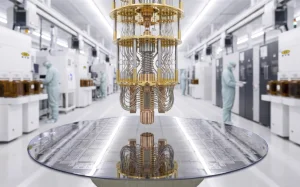
Q.ANT and IONOS Launch Pilot for Photonic Computing



Insider Brief
- Q.ANT and IONOS have launched a pilot programme that gives selected developers access to physical photonic processors through IONOS bare metal servers hosted in Germany.
- Participants can run their own AI models and computational workloads on Q.ANT‘s second-generation Native Processing Unit (NPU) to evaluate its performance on tasks involving matrix multiplication and nonlinear mathematical functions.
- The free pilot begins in November 2026 and will assess where photonic computing could offer advantages in areas such as industrial image processing, scientific simulation, time-series prediction and robotics.
PRESS RELEASE — Q.ANT, a pioneer in commercial photonic computing, today announced the launch of a joint pilot program with IONOS, the leading digitalization partner and trusted cloud enabler for small and medium-sized businesses, to bring photonic computing to commercial bare metal server environments for the first time.
The pilot program gives software developers the opportunity to test and evaluate their AI models on real photonic processors running in a bare metal infrastructure on dedicated hardware. This opens up a new way of computing: developers can build leaner AI models to run faster by making direct use of complex nonlinear mathematical functions. These efficiency gains come at a decisive moment. As AI workloads keep growing, the cost of running them is becoming a real limit on how far AI can scale. For data center operators, photonic computing promises lower energy consumption and operating costs.
The launch represents the next step toward commercial adoption of photonic computing, extending access beyond specialized research institutions. Following the launch of Q.ANT’s open-source software development kit (SDK) in September, developers who could previously build and simulate applications only on the SDK can now, for the first time, run their workloads on physical photonic processors through IONOS’s bare metal infrastructure. By making its hardware accessible through IONOS, a leading commercial server hosting provider, Q.ANT paves the way for a new developer ecosystem and a new generation of AI applications.

“Promising computing technologies from Europe need sovereign European infrastructure to make the leap into business use,” said Achim Weiss, CEO of IONOS. “In the pilot program, Q.ANT’s photonic processor runs in an IONOS data center under German jurisdiction. Users can explore processing with light on their own workloads. The results will show which applications benefit most and will feed directly into our future development work.”
“A new computing architecture only becomes commercially relevant when customers can test it against the workloads that matter to them. When we launched our SDK, developers could begin building applications for photonic computing. Now, with IONOS, they can take their work and run those applications on the real processor,” said Dr. Michael Förtsch, Founder and CEO of Q.ANT. “This matters because the conversations around AI are shifting from what the models can do to what it costs to run them. Photonic computing can make the next generation of AI models leaner: complex functions that inflate digital models can be computed with fewer data and parameters with light, resulting in less energy requirements for the same workloads.”
Through the IONOS website, approved applicants will gain access to Q.ANT’s second-generation Native Processing Unit (NPU) via a bare metal server in a German IONOS data center, where they can run and evaluate their own workloads with their own data and software. Developers can also explore new algorithms and AI architectures that use the NPU’s ability to compute complex nonlinear functions natively in light, rather than breaking them down into long sequences of digital steps as CMOS-based chips must. This can deliver comparable or better results with fewer parameters, fewer operations, and fewer resources. At the same time, the program will identify where photonic processing offers the greatest advantages, providing the real-world validation needed for broader commercial deployment.
This pilot marks the next step in the collaboration IONOS and Q.ANT announced in May 2026.
From HPC Testing to Commercial Workloads
Q.ANT’s photonic processor has already been evaluated in operational high-performance computing environments. In March 2026, the Leibniz Supercomputing Centre (LRZ) received Q.ANT’s second-generation processors for testing across HPC and artificial intelligence workloads. The research center subsequently evaluated the hardware on its performance, execution time, energy consumption, error rates, and other metrics.
Q.ANT systems are also operating at the Jülich Supercomputing Centre (JSC).
Building for Photonic Computing
The pilot program begins in November 2026 and will be available free of charge to a limited number of selected participants. Applicants must submit a concrete use case through the IONOS website and have the technical expertise required to independently administer a bare metal server.
The program is open to a broad range of AI and computational workloads. Operations such as matrix multiplication and nonlinear mathematical functions are particularly well suited to Q.ANT’s architecture. Potential areas for evaluation include industrial image processing, time-series prediction, scientific simulation, and robotics.
Participants will receive direct support from Q.ANT and IONOS throughout the program. Each engagement will include technical onboarding, project support and workload review by Q.ANT, followed by a final workshop to evaluate results and performance metrics, while IONOS supports participants on the underlying bare metal infrastructure. Feedback from participants will help form further development of Q.ANT’s processor and software stack.
The pilot systems will be hosted in Germany within IONOS infrastructure. IONOS data centers are ISO 27001 certified and provides European data residency for workloads hosted in Germany.
Applications for the pilot program are available at https://qant.com/ionos-pilot/.

Keep track of everything going on in the Quantum Technology Market. In one place.

Mohib Ur Rehman
Covering quantum and emerging technologies, Mohib explores the intersection of technology, security, and society. His work also frequently examines surveillance infrastructure and the institutions shaping the digital world. In addition to his work at The Quantum Insider, he co-runs SK NEXUS, an independent technology publication that helps readers understand the technologies shaping their lives.

Stay Ahead of Quantum
Get the latest research, company news, and market intelligence every week.