Gyeonggi Province Holds Forum on Quantum and Semiconductor Industry Cooperation


Insider Brief
- Gyeonggi Province hosted a quantum industry forum and networking event bringing together companies, researchers and government representatives to discuss industry development and commercialisation.
- Five companies presented R&D achievements in areas including quantum sensing, semiconductor inspection, quantum computer components and processing equipment.
- Gyeonggi Province is providing KRW 3 billion this year to support quantum-related companies and talent development, while linking quantum technology with its semiconductor and advanced industries.
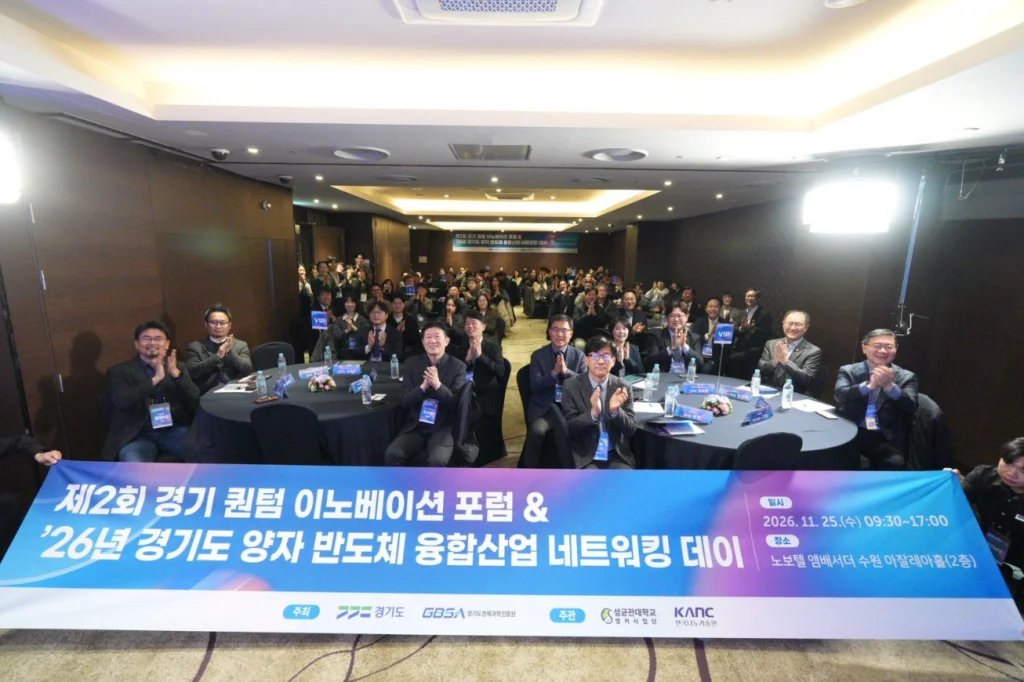
PRESS RELEASE — The ‘Gyeonggi Quantum Innovation Forum and 2026 Gyeonggi Quantum-Semiconductor Convergence Industry Networking Day’, hosted by Gyeonggi Province and the Gyeonggi Business and Science Accelerator and organised by Sungkyunkwan University’s Anchor Project Group and the Korea Nanotechnology Institute, was held on the 25th at the Novotel Ambassador Suwon.
The event brought together stakeholders from Gyeonggi Province’s quantum ecosystem to discuss cooperation and commercialisation opportunities. Attendees included Kim Tae-hyung, Chairman of the Future Science and Cooperation Committee of the Gyeonggi Provincial Council; Park Min-kyung, Director of the Semiconductor Industry Division of Gyeonggi Province; representatives from Sungkyunkwan University and the Korea Nanotechnology Institute; industry, academic and research experts; companies receiving R&D support for quantum industry projects in Gyeonggi Province; and representatives from related organisations.
In his congratulatory remarks, Kim Tae-hyung, Chairman of the Future Science and Cooperation Committee of the Gyeonggi Provincial Council, said, “Gyeonggi Province has already established a foundation for developing the quantum industry through the enactment of relevant ordinances. Quantum technology has now reached a stage where it can be applied directly to everyday life, much like the PangtaG Bus, the autonomous bus operating in Pangyo. As the quantum industry is a key driver of future growth, the Provincial Council will support the expansion of policy and institutional measures and cooperation frameworks.”
The first part of the event, the ‘Gyeonggi Quantum Innovation Forum’, featured lectures and a panel discussion under the theme ‘Future Agendas for the Next Leap of Gyeonggi Province’s Quantum Industry’. The discussions focused on three areas: industry, talent and industry-academia-research cooperation.
Kim Seong-hyeok, Executive Director at LG Electronics; Choi Man-soo, Professor at Korea University; and Ham Jae-gyun, Director at the Korea Institute of Science and Technology Information, delivered presentations on the three key areas of ‘Industry, Talent and Collaboration’.
The following panel discussion, titled ‘Gyeonggi Quantum Next’, was chaired by Jeong Yeon-wook, Director of the Q-GAIA Centre at Sungkyunkwan University. Panellists included Kwon Young-jun, Vice President at Samsung SDS; Pyo Chang-hee, Executive Director at IBM; Ye Ki-hyun, Executive Director at IonQ; Jeong Hyeong-ju, CEO of Pasqal; and Kim Yu-seok, CEO of Quandela. They discussed strategies for the future of the quantum industry.
The panellists emphasised the importance of developing industry-ready talent capable of applying and validating quantum technologies in industrial settings through integration with existing technologies such as supercomputers and artificial intelligence (AI). They also discussed project-based education using Gyeonggi Province’s semiconductor and advanced industry infrastructure, global cooperation, and expanding links between quantum chips and supply chains.
The second part of the event, the ‘Quantum-Semiconductor Convergence Industry Networking Day’, featured sessions under the theme ‘Turning Technological Achievements into Industrial Value and Networking into New Cooperation’.
Park Gwan-yeol, Senior Researcher at the Korea Nanotechnology Institute, presented an overview of Gyeonggi Province’s quantum industry support programmes and the status of quantum fabrication facility development. Ryu Ho-jun, Professor at the University of Science and Technology, presented on trends in quantum semiconductors and standardisation.
Five companies participating in the 2026 Quantum-Semiconductor Convergence R&D Support Programme then presented their achievements and case studies. These included:
- EpiSolution Co., Ltd. developed and validated SPAD epitaxial wafers for long-distance quantum sensing, secured KRW 2.5 billion in investment and completed a technology transfer.
- XDOTZ Co., Ltd. developed a non-destructive semiconductor inspection system based on quantum current sensors, received a CES 2027 Innovation Award and connected its work to field demonstrations.
- Wooshin Engineering Co., Ltd. localised the production of ultra-extreme high-vacuum (XUHV) chambers for quantum computers, filed three patent applications and entered the supply chain for a national flagship project.
- Everhen Co., Ltd. developed a quantum inertial-enhanced positioning platform for disaster response and firefighting, passed all items in accredited testing and reduced costs by 83%.
- Hot & Cool Co., Ltd. developed a high-precision heating jacket rated for temperatures up to 600°C for quantum device processing equipment and is pursuing demonstrations with prospective customers.
Throughout the event, expert consultation sessions were also held, connecting companies with specialists in technology commercialisation, intellectual property, management, legal affairs and taxation. These sessions, alongside industry-academia-research networking, were intended to support companies’ follow-up commercialisation efforts and establish further partnerships.
Meanwhile, Gyeonggi Province is working to strengthen the competitiveness of its quantum industry by combining quantum technology with the province’s advanced industrial infrastructure. The initiative covers sectors including semiconductors (quantum processing units, or QPUs), AI (hybrid quantum computers), biotechnology (drug discovery) and mobility (quantum cryptographic communications). This year, the province is providing KRW 3 billion in support for quantum-related companies and talent development, alongside efforts to advance quantum technology development and expand the industry’s reach.
Park Min-kyung, Director of the Semiconductor Industry Division of Gyeonggi Province, said, “It was a meaningful opportunity for the Provincial Council’s Future Science and Cooperation Committee and representatives from industry, academia, research institutions and government to come together and share future strategies for quantum technology and R&D achievements. We will continue to actively support the development and commercialisation of innovative technologies, talent development and infrastructure expansion to strengthen the competitiveness of Gyeonggi Province’s quantum industry.”
This article is an AI-translated version of the original press release, which was published in Korean. Minor differences in wording or terminology may occur.

Keep track of everything going on in the Quantum Technology Market. In one place.
Topics

Mohib Ur Rehman
Covering quantum and emerging technologies, Mohib explores the intersection of technology, security, and society. His work also frequently examines surveillance infrastructure and the institutions shaping the digital world. In addition to his work at The Quantum Insider, he co-runs SK NEXUS, an independent technology publication that helps readers understand the technologies shaping their lives.
Stay Ahead of Quantum
Get the latest research, company news, and market intelligence every week.
MENTIONED IN THE ARTICLE
IBM
IBM is an iconic technology pioneer founded in 1911 as the Computing-Tabulating-Recording Company and officially renamed International Business Machines Corporation in 1924. Beyond foundational computing, IBM possesses a deep legacy in aerospace and defense from building the guidance computers and Instrument Unit for NASA's historic Apollo missions to partnering with Airbus on CIMON, the first AI assistant on the ISS.
→

IonQ
IonQ is a developer in trapped ion quantum computing founded in 2015 that actively applies its technology to the aerospace and defense sectors. The company empowers satellite-based quantum networks and quantum enabled drones to improve positioning, navigation, and timing resilience in GPS denied environments, and collaborates with industry leaders like Airbus to optimize aircraft loading.
→