South Korea Launches Hangang Supercomputer, Plans Quantum Integration


Insider Brief
- South Korea has brought Hangang, its sixth national supercomputer, into full operation, with the government expecting it to rank among the world’s top 10 systems.
- Hangang has 8,496 GPUs and 9,936 CPUs, delivering 24 times the theoretical computing performance of its predecessor, Nurion, alongside improvements in storage and network capacity.
- The government plans to connect Hangang with a quantum computer in the first half of 2027 to develop a hybrid computing system combining high-performance computing and quantum processing.
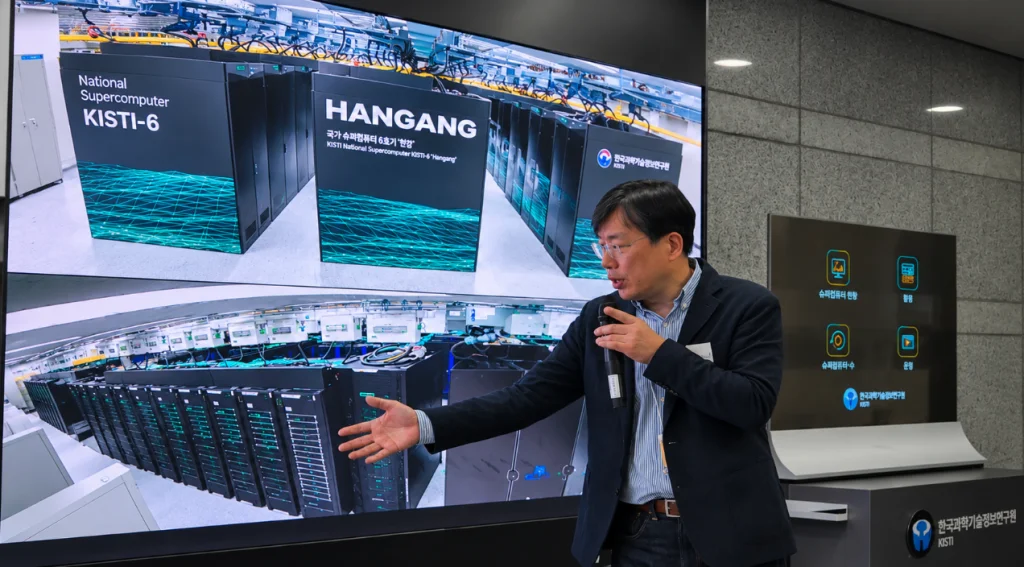
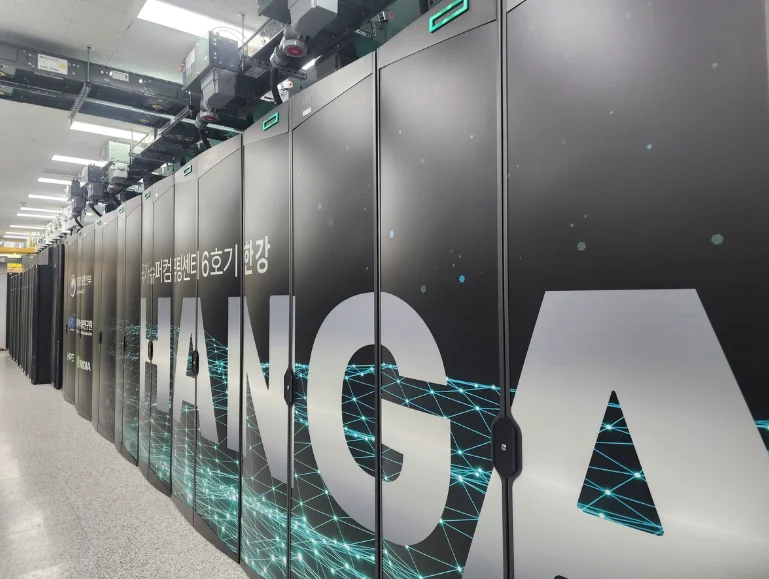
South Korea’s sixth national supercomputer, Hangang, is now fully operational, Seoul Economic Daily reported. The government expects the system to place among the world’s top 10 machines.
It also intends to pair Hangang with a quantum computer in the first half of next year, forming a hybrid system meant to speed up both calculation and optimization.
The Ministry of Science and ICT (MSIT) and the Korea Institute of Science and Technology Information (KISTI) said they held a launch ceremony on the 2nd at KISTI headquarters in Daejeon. Hangang succeeds Nurion, the fifth national supercomputer, which was introduced in 2018. The agencies said the ceremony opened a new phase for national infrastructure supporting AI-based science and technology research.

Hangang’s Specifications
According to Seoul Economic Daily, Hangang carries 8,496 of the latest GPUs, among them Nvidia’s GH200, a chip that integrates a central processing unit and a graphics processing unit. It also has 9,936 CPUs.
Compared with the fifth system, the report said:
- Theoretical computing performance is 24 times higher.
- Storage capacity has improved 10-fold.
- Network performance has improved four-fold.
The government expects Hangang to rank in the top 10 of the global supercomputer rankings due at the International Supercomputing Conference (SC2026) early this month.
Cooling and Security Upgrades
The fifth system used indirect liquid cooling, while the sixth uses direct liquid cooling. “With the fifth system, cold water circulated only as far as the back of the cabinet to absorb heat, but in the sixth system water circulates over the chips themselves, raising cooling efficiency,” said Hong Tae-young, head of KISTI’s Supercomputing Infrastructure Center.
Hong added that nearly all of the sixth machine’s equipment was built for direct liquid cooling, and that its power usage effectiveness (PUE) improved to about 1.15, down from 1.35 on the fifth system.
On security, Hong said the institute is installing top-tier security solutions on the main servers that users connect to. It has used two-factor authentication with one-time passwords since the early 2010s.
“But tightening internal security tends to reduce performance, so we will continue to work on security measures,” Hong said. KISTI President Lee Sik said the supercomputer security strategy is to block threats tightly at the entry point.
Resource Allocation and Service Schedule
As reported by Seoul Economic Daily, the government plans to divide Hangang’s resources as follows:
- 55% to research and development innovation
- 30% to national strategic projects
- 15% to industrial innovation research
Support for industrial innovation research will center on small and medium-sized enterprises, with the aim of encouraging commercialization and industrial results.
A trial service running for about two months in October and November already supports some 190 projects, including 20 grand challenge projects and 17 national strategic projects. Resources requested so far come to about 85% of the total capacity Hangang can provide. The official service begins Dec. 16.
Lee said KISTI will do its utmost to keep operations stable and provide user support, drawing on its accumulated experience running supercomputers, so that the sixth machine can underpin ambitious research by domestic scientists.
An MSIT official described the system as a core foundation for new scientific discoveries through the convergence of AI and science and technology. The official added that the government will actively support efforts to solve national challenges such as the K-Moonshot initiative, as well as innovative research by industry, academia and research institutes, to strengthen the country’s competitiveness in science and technology.
The government said it aims to connect Hangang with a quantum computer around the first half of next year to build a hybrid computing system.
“Supercomputers calculate very quickly but take a long time to optimize, or find the right path, while quantum computers are slow and error-prone in calculation but fast at optimization,” Lee said. “Connecting the two can create a hybrid computer that offsets each other’s weaknesses and brings out their strengths.”
Lee added that Japan, the United States and European countries are also moving toward similar integration strategies, and that linking supercomputers with quantum computers is expected to let South Korea play a leading role.

Keep track of everything going on in the Quantum Technology Market. In one place.
Topics

Mohib Ur Rehman
Covering quantum and emerging technologies, Mohib explores the intersection of technology, security, and society. His work also frequently examines surveillance infrastructure and the institutions shaping the digital world. In addition to his work at The Quantum Insider, he co-runs SK NEXUS, an independent technology publication that helps readers understand the technologies shaping their lives.

Stay Ahead of Quantum
Get the latest research, company news, and market intelligence every week.
MENTIONED IN THE ARTICLE