IonQ Receives $7.5 Million from AFRL for Quantum Networking


Insider Brief
- IonQ has received $7.5 million in Phase 2 funding from the Air Force Research Laboratory (AFRL) to expand a quantum network previously delivered in Rome, New York.
- The upgrades include free-space optical links, quantum frequency converters, upgraded network hardware and automated control software to support connections between different quantum systems.
- The work aims to support quantum communications across standard telecommunications infrastructure and open air, advancing AFRL’s plans for interoperable quantum networks in metropolitan and defense environments.
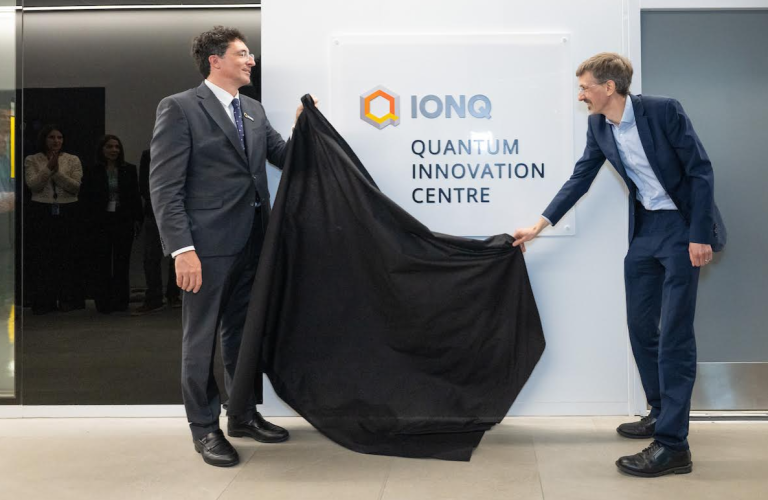
PRESS RELEASE — IonQ (NYSE: IONQ), the world’s leading full-stack quantum platform and foundry, today announced it has received $7.5 million in follow-on funding from the Air Force Research Laboratory (AFRL). The Phase 2 contract expands upon the first-generation quantum network IonQ previously delivered in Rome, New York. The collaboration explores key optical, hardware, and software layers to turn the deployment into an operational, interoperable research platform.
Phase 1 established the core physical network foundation. Phase 2 equips AFRL with additional capabilities needed to connect different types of quantum hardware across non-laboratory environments. Classical routers and fiber-optic cables allow different computers to share data across the internet. Similarly, these new full-stack enhancements allow connectivity of distinct quantum systems and route quantum communication over standard telecommunications infrastructure and open air.
“This follow-on funding from AFRL underscores the strength of our long-term partnership and validates IonQ‘s full-stack approach. We are unlocking new domains for quantum networking by going to free space optics,” said Jordan Shapiro, IonQ President, Quantum Platform. “Advanced optical hardware and automated control software are what close the gap between laboratory demonstration and field deployment. We are building quantum networking that runs on standard telecom infrastructure and through open air, and proving it on a live network.”

IonQ originally announced the $21.1 million collaboration in January 2025. This award was contemplated within the originally-announced amount and is not a supplemental award. The Phase 2 funding introduces several critical hardware and software upgrades designed for real-world metropolitan and defense networks, including:
- Free-Space Optical Links: An advanced optical system with automatic pointing, acquisition, and tracking (PAT) to establish entanglement distribution over secure, line-of-sight quantum channels within the C-band spectrum
- Quantum Frequency Converters: Two quantum frequency converter modules that deliver interoperability across heterogeneous quantum and classical hardware utilizing standard telecom wavelength infrastructure
- Automated Control Software: On-premises control-plane software upgrades supporting automated self-tests, real-time monitoring, failure handling, experiment execution, and automated results export
- Upgraded Hardware Modules: O-band-compatible network hardware, enhanced polarization controls, and upgraded quantum network interface cards (QNICs)
Together, these enhancements support AFRL’s broader roadmap for heterogeneous quantum networking, offering a practical and deployable model for future defense communications, enterprise infrastructure, and multi-node quantum networks. This builds on previous work with AFRL including our photonics interconnect milestone in April 2026 as well as deployment of an onsite IonQ quantum computing system at AFRL in Rome, New York.

Keep track of everything going on in the Quantum Technology Market. In one place.

Mohib Ur Rehman
Covering quantum and emerging technologies, Mohib explores the intersection of technology, security, and society. His work also frequently examines surveillance infrastructure and the institutions shaping the digital world. In addition to his work at The Quantum Insider, he co-runs SK NEXUS, an independent technology publication that helps readers understand the technologies shaping their lives.

Stay Ahead of Quantum
Get the latest research, company news, and market intelligence every week.