

The Insider Brief:
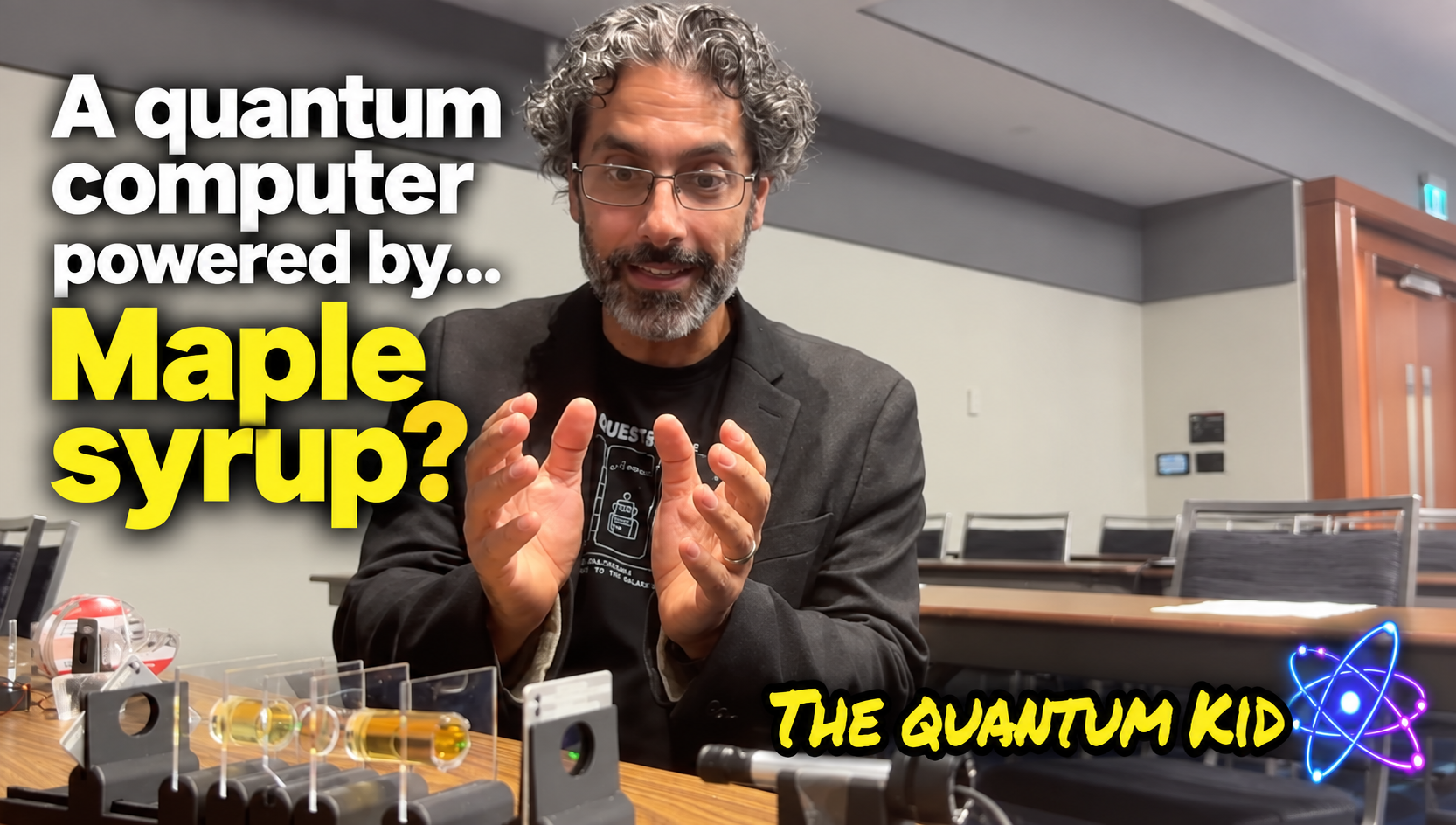
- A quantum computer, tuned with maple syrup. Institut quantique’s Ghislain Lefebvre tells The Quantum Kid’s “Kai Asks” that maple syrup, transparent tape, and agave syrup are genuinely used to manipulate qubits.
- Your sunglasses are already doing quantum physics. Lefebvre draws a direct line between polarized sunglasses and quantum polarization, turning an everyday object into an unlikely entry point for one of physics’ strangest ideas.
- No hedging on the future – the episode closes on what quantum computers have already achieved, not what they might do someday, treating the field as live and current rather than speculative.
- Watch the full episode on The Quantum Kid’s YouTube channel: https://www.youtube.com/watch?v=RAfVdbEg_So&t=11s
A quantum computer is being tuned with maple syrup. Not metaphorically – actually.
That’s the answer Ghislain Lefebvre, interim executive director of Institut quantique at Université de Sherbrooke, gives when asked the deliberately odd question that opens this episode of Kai Asks: what does maple syrup have to do with building a quantum computer? Researchers, it turns out, use maple syrup alongside transparent tape and agave syrup as physical tools to manipulate a qubit – the basic building block of quantum information. Not a metaphor for the science. The science.
It’s a strange image: some of the most advanced computing hardware on Earth, nudged into place with the same syrup sitting in most kitchen cupboards. But that collision is exactly the point. Quantum computing has a reputation for being untouchably abstract – equations, whiteboards, jargon that keeps most people at arm’s length. Maple syrup punches a hole straight through that.

The second question lands even closer to home: is quantum behavior anything like how polarized sunglasses work? Yes, actually – and this is the moment the episode earns its keep. Polarization isn’t some exotic lab phenomenon. It’s in sunglasses. It’s in camera lenses. It’s in car windshields on a bright day. Most people have handled quantum mechanics without ever being told that’s what they were doing. Lefebvre draws that line explicitly, and it lands with the particular satisfaction of a fact that was hiding in plain sight the whole time.
The episode wraps by refusing to end on a maybe – asking not what quantum computers might one day do, but what they’ve already done. That’s a small structural choice with a real effect: it stops quantum computing from sounding like science fiction and repositions it as something already underway, not a promise perpetually five years out.
None of this required the physics to be softened. Nothing here is a kid-friendly approximation standing in for the real explanation – maple syrup and polarized sunglasses are accurate, not simplified. What changes is the door, not the room behind it. Instead of starting with specialized vocabulary and hoping curiosity survives the walk there, the episode starts from objects everyone already understands and lets the real physics ride in on the back of them.
One production note worth flagging: Kai wasn’t in the room for this interview. His questions were recorded separately and matched to Lefebvre’s answers afterward – a format shift from the show’s usual live back-and-forth. The mechanics changed; the instinct behind the questions didn’t.
If there’s a lesson buried in an episode about syrup and sunglasses, it’s this: the hard part of explaining advanced science was never the science. It’s finding the object already sitting in someone’s hand.
Head to The Quantum Kid YouTube channel to watch more engaging, easy-to-understand explanations of complex quantum science: https://www.youtube.com/watch?v=RAfVdbEg_So&t=11s