


Insider Brief
- Experts at the National Space Technology Conclave 2026 highlighted AI/ML, quantum technology and inter-satellite links as technologies expected to support India’s future satellite systems and space missions.
- ISRO experts said AI/ML could enable on-board processing and edge computing, while quantum technology could strengthen security for financial, military and other sensitive communications.
- The conclave also covered satellite engineering, payload development, mission operations, space sustainability and AI-enabled space data processing.
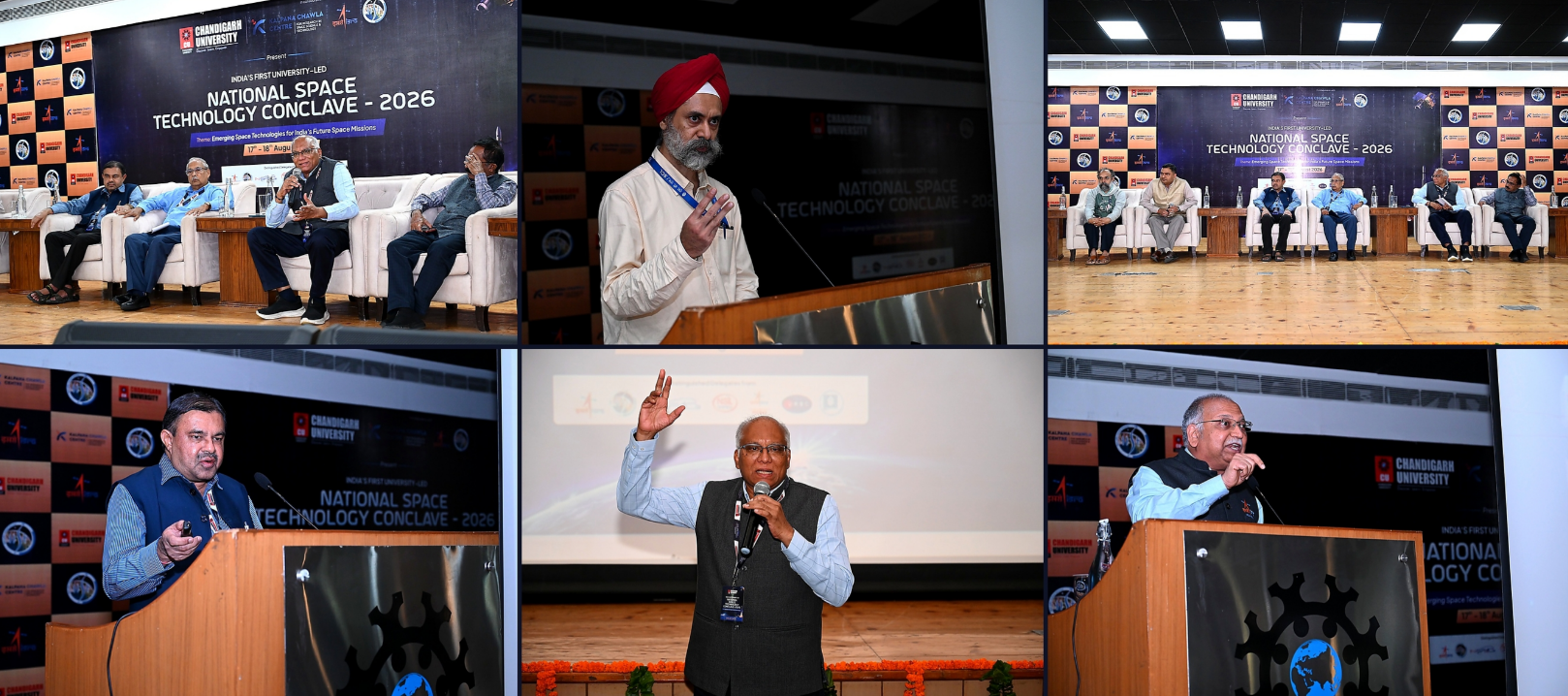
Press release – During the culminating day of the National Space Technology Conclave 2026, organised by Chandigarh University at their campus, the ISRO experts concluded their remarks deliberated during the two day Conclave. The experts in one voice presented India’s strong position in Space technologies and charted out the new policies being taken by the Government of India to make India a space and innovation hub in the time to come. “India has emerged as a global leader in the development of radar systems over the last decade and more, driven by a strong focus on indigenization and active industry involvement.
Our capabilities now span almost all major radar frequency bands which has also positioned India as an attractive partner for leading global space agencies and institutions such as NASA, JPL, France and JAXA for collaborative missions and technologies,” said Dr. Nilesh M Desai, former Director of Space Applications Centre (SAC), ISRO, during the National Space Technology Conclave 2026 at Chandigarh University on Tuesday, addressing the gathering at the campus.
With this, the two-day-long conclave concluded where renowned space scientists, mission leaders and industry giants deliberated upon India’s future space missions. The second day of the conclave focused on translating space technology priorities into education, research and mission capabilities, featuring a strategic roundtable and expert sessions on space systems and mission engineering, scientific and engineering payloads and ground segment and mission operations.

Dr. Desai further said, “Artificial Intelligence and Machine Learning, Quantum Technology and Inter-Satellite Links (ISLs) will play a transformative role in India’s upcoming satellite systems. On-board processing and edge computing through AI/ML will enable satellites to process data in space itself, supporting faster decision-making with real-time information and would be instrumental in governance, planning, policymaking and more effective disaster management.
Quantum technology will help prevent cyber frauds and enhance the security of financial transactions, banking and stock market operations, military communications and other sensitive networks. From the national-security perspective, ISRO is also strengthening secure navigation capabilities. To counter threats such as spoofing, where false signals can mislead navigation receivers and potentially divert precision-guided systems, India is enhancing its multi-layer security architecture. India’s Space-Based Surveillance (SBS) programme is another major step towards strengthening national security.”
Dr. Anil Kumar, Former Director, ISTRAC (ISRO Telemetry, Tracking and Command Network), ISRO, said, “Space sustainability has emerged as one of the most critical challenges for the future of space exploration and utilisation. As the number of satellites and other objects in orbit continues to grow, the accumulation of space debris is becoming an increasingly serious concern.
Defunct satellites, spent rocket stages and fragments from past missions remain in orbit and can pose significant risks to operational spacecraft. Even small pieces of debris travelling at extremely high velocities can cause severe damage upon collision, potentially triggering a chain of collisions and making certain orbital regions increasingly difficult to use. The challenge is not limited to space operations. Uncontrolled re-entry of space objects can also create risks on Earth, while the growing presence of satellites can affect astronomical observations and the ability to study the night sky. Ensuring the long-term sustainability of outer space, therefore, requires responsible space operations, continuous monitoring, collision avoidance, debris mitigation and stronger international cooperation.”
“India is actively contributing to this global effort by safeguarding its satellites, supporting international guidelines and participating in global forums on space sustainability. The objective must be to ensure that outer space remains a safe, secure and usable domain for future generations,” added Dr. Kumar.
Deepinder Singh Sandhu, Senior Managing Director, Chandigarh University, said, “India’s space programme, spearheaded by ISRO, has transformed the nation into a prominent power in global space exploration, navigation, science and advanced space operations.
From the historic launch of Aryabhata, India’s first satellite in 1975, the country has progressed to pioneering cost-effective satellite launches with the PSLV delivering 399 foreign satellite launches till 2026 as compared to just 35 before 2014. It shows India’s growing launch capabilities are attracting global demand. As India marked its 80th Independence Day, its space ambitions reflect a confident and self-reliant nation shaping the future of space. India’s space reforms in the last decade have created an enabling environment for private participation, investment, innovation and technology-led growth. Now there is no stopping India from becoming a leading global space power to realise the vision of a Viksit Bharat by 2047.”
The sessions on the second day also covered mission architecture, satellite and subsystem engineering, payload development and validation, ground stations, TT&C, satellite tracking, mission control, AI-enabled mission operations and space data processing. The day also featured an interactive ‘Meet the Scientists & Space Industry Leaders’ session, giving students an opportunity to engage directly with leading experts, followed by a student–space leaders conversation and the valedictory function.