DARPA Funds Qunnect to Improve Quantum Network Reliability



Insider Brief
- Qunnect has received a DARPA contract to advance its Carina quantum networking system, which distributes entanglement across deployed telecommunications fiber.
- The funding will support improvements to Carina’s polarization compensation technology, which helps maintain quantum signal quality across real-world fiber networks.
- Carina is currently being used in quantum network deployments in locations including New York, Montana, Berlin, and Albuquerque.
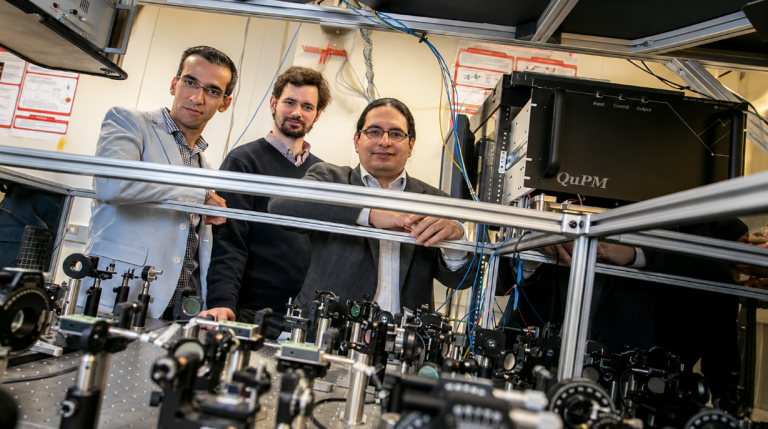
Press release – For decades, the distribution of quantum information has been confined to laboratory demonstrations because of the fragile nature of maintaining the fidelity of quantum entanglement across today’s deployed telecommunications fiber. However, today, Qunnect is the first company in the world to anchor multiple quantum networks distributing quantum information across the telecom fiber spanning some of the world’s busiest cities. Qunnect announced today the Defense Advanced Research Projects Agency has awarded the company a contract to advance Qunnect’s Carina rack–the first commercially available turnkey quantum entanglement distribution system–that addresses this issue and is currently anchoring quantum networks on two continents.
Carina is the anchor for quantum networks currently operational in New York, Bozeman (in partnership with Montana State University), Berlin (in partnership with Deutsche Telekom), and Albuquerque, New Mexico. DARPA’s award provides Qunnect with new funding to advance the next generation of Carina’s polarization compensation nodule, which is the system that continuously analyzes and corrects for the conditions that would otherwise corrupt quantum signals in transit.
“We made an early commitment to designing instruments that operate on the same infrastructure the world already uses,” said Noel Goddard, CEO of Qunnect. “For the past five years, we focused on making quantum networking practical, and we’ve validated it through deployments in cities, and through partnerships with private industry and growing support from government agencies. We know that reliability is what will separate proof-of-concept demonstrations from useful networks that enable tomorrow’s applications.”

Real-world fiber can be hostile to quantum signals. Unlike classical data, which tolerates interference, quantum information, as distributed by Qunnect‘s Carina, is carried by photons whose states are physically fragile, easily diminished by temperature and other environmental conditions present in telecommunications networks. Qunnect’s proprietary Carina platform solved the issue by acting as noise cancelling headphones, compensating for polarization drift as the entangled photons travel across deployed fiber.
“Global governments increasingly view quantum networking as critical infrastructure,” said Mehdi Namazzi, Chief Science Officer, Qunnect. “What differentiates Qunnect is that it has already moved beyond theory. The company is operating on deployed fiber in multiple cities today, giving it a significant head start as governments, telecommunications providers, and commercial organizations look for experienced partners to help build the next generation of communications infrastructure.”

Keep track of everything going on in the Quantum Technology Market. In one place.
Topics

Mohib Ur Rehman
Covering quantum and emerging technologies, Mohib explores the intersection of technology, security, and society. His work also frequently examines surveillance infrastructure and the institutions shaping the digital world. In addition to his work at The Quantum Insider, he co-runs SK NEXUS, an independent technology publication that helps readers understand the technologies shaping their lives.

Stay Ahead of Quantum
Get the latest research, company news, and market intelligence every week.
MENTIONED IN THE ARTICLE

Qunnect
Qunnect develops light-based modular devices for encryption. Core to their differentiation is their quantum memory device that operates at room temperature.
→

Defense Advanced Research Projects Agency (DARPA)
The Defense Advanced Research Projects Agency (DARPA) is an independent research and development agency within the U.S. Department of Defense (DoD) established in 1958 to prevent and create strategic technological surprises for national security. Operating with a relatively small staff of program managers who are empowered to take high-risk, high-reward approaches, DARPA functions by funding cutting-edge research in academia, industry, and government laboratories rather than conducting research in-house. Its mission focuses on creating revolutionary technologies—such as the Internet (ARPANET), stealth technology, GPS, and mRNA vaccine platforms—that transition into practical military and civilian applications. DARPA programs are typically finite in duration and demand transformational breakthroughs rather than incremental improvements, positioning the U.S. at the forefront of technological innovation.
→