Hybrid QKD and PQC Network Connects Chicago and Europe Across 8,000 km


Insider Brief
- A consortium of research and technology organisations has demonstrated an 8,000 km hybrid quantum-safe network connecting Chicago, Amsterdam and the Basque Country, combining QKD and post-quantum cryptography.
- The network uses Luxquanta’s QKD systems, Ciena’s optical encryption and the QuLore orchestration framework to manage quantum-safe keys across different technologies and network locations.
- The demonstration protects data at three levels: optical transport, network connections through IPsec tunnels, and end-to-end application encryption.
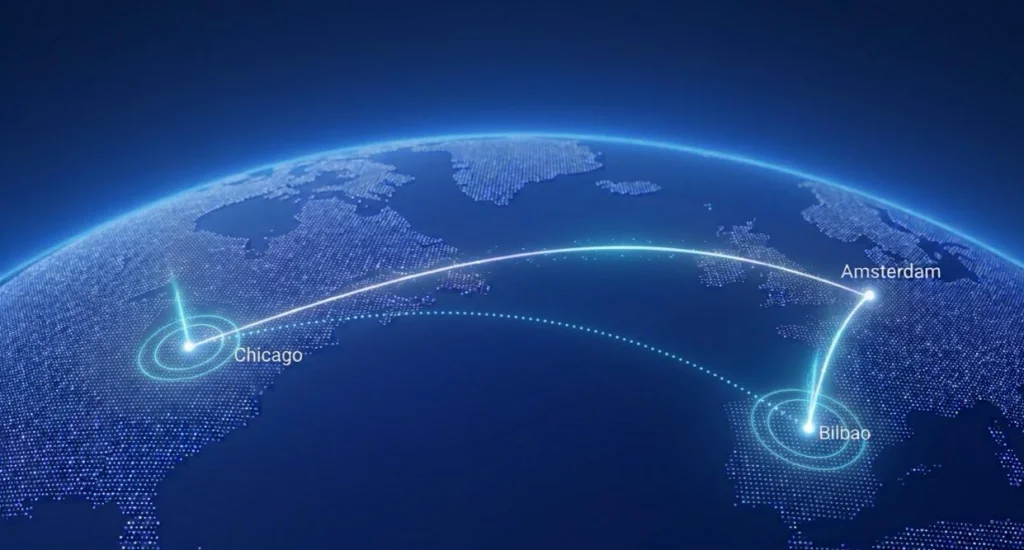
PRESS RELEASE — A group of International research, network and technology organizations has demonstrated hybrid quantum-safe networking between Chicago and Europe at SC26, the Supercomputing Conference 2026. The infrastructure that spans Bilbao, Amsterdam and Chicago extends across 8,000 km and protects data from quantum threats at three levels in a defense-in-depth approch, from optical fiber to applications, using two complementary quantum-safe technologies managed by a single framework. The demonstration is made possible with the collaboration of the University of the Basque Country (EHU), Luxquanta, Ciena, GÉANT, Poznań Supercomputing and Networking Center (PCSS), RedIRIS and SURF.
Once quantum computers reach sufficient maturity, they will be able to break widely used cryptographic systems today, compromising the networks that rely on them. A collaborative demonstration of quantum security, presented in Chicago during the Supercomputing Conference26 (SC26), showcases how transatlantic, interoperable and adaptive quantum-safe networks can protect the systems against that threat.
The demo network comprises five quantum nodes across three geographic locations, all equipped with quantum-safe technologies. In Chicago, two nodes sit at the Ciena and PCSS booths at SC26, less than 1 km apart. Amsterdam hosts a third node with SURF, and the last two are at EHU sites in Bilbao and Zamudio in Bizkaia (Spain), connected through a 25 km link.

Quantum Key Distribution (QKD), one of the two main technologies available to protect against the quantum threat, is deployed on the two short links: one between the Chicago booths and one between the two EHU sites in Bizkaia, 25 km apart. Luxquanta’s Nova lq® QKD systems, installed at the four nodes, generate encryption keys using the laws of quantum mechanics, the key’s security rests on physics and not on an attacker’s future computing power. Luxquanta’s technology is designed to coexist with classical data on the same optical fiber, and in the demonstration Ciena’s multiplexers bring the two together, combining the quantum channel, the service channel the QKD systems use to coordinate with each other and the encrypted data channel on a single fiber pair. This is made through Ciena’s high-speed optical transport platform, which encrypts it at line rate using WL6e 1.6 Tb/s line-rate optical encryption in Chicago and WL5e 800 Gb/s line-rate optical encryption in Bizkaia link. Ciena’s solution combines the QKD-derived keys from Luxquanta with post-quantum (PQC) algorithms implemented in the platform, in a hybrid approach.
Fiber optic based QKD works over limited distances better suited for metropolitan networks, roughly up to 100 km, so connecting Chicago and Bilbao calls for an alternative quantum-safe solution that covers much greater distances. From the Bilbao area to Amsterdam (about 1,200 km) and from Amsterdam to Chicago (about 7,000 km), Post-Quantum Cryptography (PQC) fills that role in this demo. PQC employs intricate mathematical algorithms designed to resist quantum computers, it runs as software over any Internet connection, at any distance. PQC would normally run end-to-end between user sites, but to demonstrate that the framework can handle different KMS (actually used for cross-continental links) it prepares the ground for these to be replaced by QKD (e.g. via satellite) once that becomes possible. Relying on new mathematical algorithms designed to resist quantum computers, it runs as software over any Internet connection, at any distance. Keys are established with ML-KEM, a standard published by the US National Institute of Standards and Technology (NIST).
QuLore, the adaptive security framework developed by EHU’s i2T research group, acts as an overarching security orchestrator, managing the whole demo. It decides between QKD and PQC for each connection, using each where it works best. When an application asks for a key, QuLore checks what the two endpoints and the network can offer, selects the strongest quantum-safe method available and coordinates the systems that manage the keys. Where two endpoints are not directly linked by QKD, as between Chicago and Bilbao, the key is relayed through intermediate sites, including SURF’s node in Amsterdam, so that both ends hold the same key. On the long links, post-quantum cryptography plays the role that QKD links would play in a future deployment. Key management systems from Luxquanta, EHU’s vKMS and SURF, whose open-source eduKMS runs in Amsterdam, work together through standard interfaces, and a live monitoring interface shows the key exchanges as they happen. Thanks to the integration with all vendors, QuLore demonstrates its practical applications to manage quantum-safe networks with different quantum-safe solutions.
This approach encrypts data at three levels, providing defense in depth. At the optical layer, Ciena’s systems encrypt the data in the fiber itself. Further up, at the network layer, secure tunnels (IPsec) protect traffic between sites on the long links. Finally, in the application layer, a modified open-source video-call application encrypts audio and video from one end to the other, with a separate key for each direction of each stream.
GÉANT, through its network development work, and RedIRIS, as technical stakeholder and observer, bring the perspective of Europe’s research and education networks.
For networks that cannot install quantum hardware (QKD) at every site, the demonstration offers a way to secure mixed networks. QuLore ‘s orchestration and the validated interoperability enable flexible hybrid quantum-safe networks that automatically select PQC or QKD keys based on what the network can offer between any two points. Key management systems from different vendors and research organizations work together through a standard interface, and protection reaches an everyday application, on top of fiber and private network connections.
Looking ahead, the demonstration points to a practical route for bringing quantum-safe protection to operational networks, where technologies, vendors and sites are rarely uniform.
Luxquanta
Luxquanta is a quantum cybersecurity company that develops and commercializes quantum-safe encryption solutions to protect global communications against current and future threats, including quantum computing. The company specializes in Continuous-Variable Quantum Key Distribution (CV-QKD), a quantum cryptography variant built entirely with carrier-grade components and designed to integrate seamlessly into existing metropolitan network infrastructure. On a mission to make quantum security accessible and compatible with existing telecom infrastructure, Luxquanta’s commercial CV-QKD system, Nova lq®, is already deployed across the telecommunications, government, data center, and critical infrastructure sectors worldwide, running over existing fiber networks. www.luxquanta.com
The University of the Basque Country (EHU)
The University of the Basque Country (Euskal Herriko Unibertsitatea, EHU) is the public university of the Basque Country. It offers undergraduate, master’s and doctoral programmes across all academic disciplines. It conducts research and innovation activities with local and international partners. The EHU’s research group in charge of the demonstration, I2T, develops and tests cybersecurity solutions for advanced communication networks, including 5G and industrial networks. The group also develops quantum-safe communication solutions that integrate quantum key distribution (QKD) and post-quantum cryptography (PQC) to protect data at the optical, network and application layers. The participants are also part of EHU Quantum Center.
Ciena
Ciena is the global leader in high-speed connectivity. With a focus on optical networking, we deliver an AI advantage built on decades of expertise and innovation shaped by customer co-creation. Our portfolio is designed to address rapidly evolving requirements with proven end-to-end capabilities across systems, interconnects, automation software, and services. We provide a reliable path forward to support AI-ready networks at scale. For updates on Ciena, follow us on LinkedIn or visit the Ciena website.
GÉANT
GÉANT is Europe’s leading collaboration on network and related infrastructure and services for the benefit of research and education, contributing to Europe’s economic growth and competitiveness. The organisation develops, delivers and promotes advanced network and associated e-infrastructure services, and supports innovation and knowledge-sharing amongst its members, partners and the wider research and education networking community. For more information, visit www.geant.org
PCSS (Poznańskie Centrum Superkomputerowo-Sieciowe)
The Poznańskie Centrum Superkomputerowo-Sieciowe (PCSS), affiliated with the Institute of Bioorganic Chemistry of the Polish Academy of Sciences (ICHB PAN), is one of the most significant research and development institutions in Poland, a key ICT hub in Europe, and a recognized partner on the international stage. For over 30 years, we have been creating and developing digital infrastructure for science, bridging the worlds of research, business, and modern technology. Today, PCSS provides world-class e-Infrastructure and actively collaborates in multiple international activities with European NRENs, GÉANT and global partners. For more information visit www.pcss.pl
RedIRIS
RedIRIS is Spain’s National Research and Education Network (NREN), providing advanced connectivity and ICT services to the country’s academic and scientific community. Established in 1988, it has played a pioneering role in the development of the Internet and digital infrastructure in Spain.Today, RedIRIS connects more than 500 universities, research centres and scientific institutions through a high-capacity fibre-optic network, enabling secure, high-speed data exchange and seamless collaboration across the research and education ecosystem.
SURF
SURF is a Dutch cooperative organization that provides IT services, primarily focusing on education and research institutions. They specialize in offering advanced and innovative IT infrastructure, including high-speed internet, cloud solutions, and data storage, aiming to facilitate top-tier research and education through cutting-edge technology. SURF actively collaborates with other European NRENs united in GÉANT and participates in global consortia like the Advanced North Atlantic (ANA) and Asia Pacific Europe Ring (AER).
NetherLight, SURF’s Global Exchange Point (GXP) dedicated to research and education data in Amsterdam connects similar GXPs and advanced high-capacity networks for scientific and educational collaboration. The NetherLight GXP plays a major and vital role in the federation of research and education networks worldwide, also known as the Global Research and Education Network (GREN).

Keep track of everything going on in the Quantum Technology Market. In one place.
Topics

Mohib Ur Rehman
Covering quantum and emerging technologies, Mohib explores the intersection of technology, security, and society. His work also frequently examines surveillance infrastructure and the institutions shaping the digital world. In addition to his work at The Quantum Insider, he co-runs SK NEXUS, an independent technology publication that helps readers understand the technologies shaping their lives.

Stay Ahead of Quantum
Get the latest research, company news, and market intelligence every week.
MENTIONED IN THE ARTICLE