Tantalum, Silicon, and a Cross-Disciplinary Bet that Paid Off


A partnership spanning chemistry, engineering, and quantum device design has yielded a millisecond-
coherent transmon, proving that smarter materials may hold the key to the next quantum leap
Insider Brief
- Researchers from Brookhaven National Laboratory’s C2QA center developed superconducting transmon qubits with coherence times reaching 1.68 milliseconds using tantalum materials and silicon substrates.
- The team improved qubit performance by reducing energy loss from material defects and interfaces through changes in fabrication materials and processing methods.
- The breakthrough demonstrates a materials-based approach to improving superconducting qubits while remaining compatible with existing quantum processor architectures.
Quantum computing emerged with a promise of mythic proportions: machines capable of solving, in seconds, problems that would take today’s supercomputers millennia to compute. The power of quantum computing relies on quantum bits, or qubits – particles that can exist in multiple states simultaneously. Unfortunately, qubits are also notoriously fragile. The slightest noise, vibrations, electric fields, cosmic rays, or even the warmth of a nearby electron can destroy the delicate coherence of qubits, causing the information held within to be lost forever.
Two-dimensional superconducting transmon qubits have been the workhorse architecture of today’s quantum computing industry. These qubits exhibit coherence times on the order of fractions of a millisecond. This is useful but still too fleeting for the large-scale, fault-tolerant quantum processors envisioned by National Laboratories, startups, and tech giants. Making qubits that hold information for long enough has remained a stubborn challenge, at least until now.
Researchers from the Co-design Center for Quantum Advantage (C2QA), a National Quantum Information Science Research Center operated for the U.S. Department of Energy (DOE) Office of Science and led by DOE’s Brookhaven National Laboratory, have built superconducting qubits that remain coherent for more than one millisecond, a threshold many believed was still years away. Demonstrating a fundamental improvement in how qubits are physically made, the breakthrough originated from a conversation between three scientists specializing in complementary disciplines: Nathalie de Leon, a quantum materials expert; Robert Cava, a renowned chemist and specialist in superconducting materials; and Andrew Houck, a leader in superconducting circuit design. All three are Princeton University professors and C2QA researchers.

From Materials Science to Quantum Hardware
A quantum computer’s power is measured by two major parameters: the total number of qubits and the number of operations each qubit can perform before errors prevail. The problem at hand was to improve the quality of individual qubits by making them last longer, which in turn would enable error correction. Qubit errors most commonly result from energy loss during a calculation. Such loss occurs predominantly via dissipation due to nearly invisible, microscopic defects at surfaces and interfaces between the layers of materials that make up qubits. In quantum computers containing many qubits, the impact of these losses multiplies.
The collaboration between Houck, de Leon, and Cava arose from curiosity about solving this problem, and in 2021, the trio introduced a tantalizing alternative. Numerous types of qubit designs have been tried over the years, each with relative strengths and weaknesses. The team of Houck and de Leon, Princeton co-conspirators in this race to develop high-performing qubits, focused on transmon qubits.
Transmons — the qubits of choice at Google and IBM — are a type of superconducting circuit that operates at extremely low temperatures. The transmon’s popularity stems from its relatively high tolerance for external interference and compatibility with current electronics manufacturing processes. Although conventional transmons are made from aluminium and niobium metals, Houck and de Leon, working with Cava, identified tantalum as a potential alternative for improving transmon qubit coherence.
Tantalum is a superconducting metal that typically has fewer defects than other metals, oxidizes differently, forms cleaner interfaces, and consequently, doesn’t leak as much energy. Cava made this fundamental insight, while de Leon and the broader team at Princeton turned this exploratory hypothesis into tested hardware.
The Breakthrough – Millisecond Transmons
From there, two complementary innovations that hinged on materials optimization paved the road to millisecond transmons: optimizing the surface processing of tantalum and replacing the sapphire substrate with silicon.
Tantalum circuits help preserve energy, and the metal’s exceptional robustness enables it to withstand the harsh cleaning required to remove contaminants during fabrication. The team demonstrated significantly improved coherence times in tantalum transmons on sapphire substrates. However, these qubits still incurred losses from the bulk substrate, and surface-interface defects remained a bottleneck. Sapphire has very few defects and impurities, but what remains is enough to limit state-of-the-art devices — each defect a tiny crack through which quantum information can be lost. A different material was required, and silicon proved effective.
The transition from sapphire to silicon substrates was not trivial because silicon behaves differently during fabrication and its surface chemistry is defined by different processes. The team had to refine deposition techniques, eliminate contamination sources, and avoid introducing new lossy interface species. The payoff was profound. By combining tantalum’s cleaner oxide with a lower-loss silicon substrate, the Princeton-based C2QA team reduced energy leakage to unprecedented levels, enabling transmons with lifetimes as long as 1.68 milliseconds — around 10 times longer than the previous state of the art.
Under the supervision of Cava, de Leon, and Houck, postdoctoral researcher Faranak Bahrami and graduate student Matthew P. Bland led these landmark studies. The C2QA team at Princeton had not only achieved a record transmon performance but also demonstrated a proof-of-concept. Their success showed that qubits are not fundamentally fragile, but that using noisy materials to build them can introduce instability — and that better materials alone can supercharge the performance of standard transmons.
From Materials to Milestone – C2QA’s Mission
When people talk about quantum computing challenges, they often jump straight to error correction or noise characterization. But at the foundation of every error-correction effort is a simple truth: If quantum information decays too quickly, nothing else matters. Longer coherence directly reduces error rates. Fewer errors mean fewer qubits devoted to correcting other qubits. Fewer correction cycles mean fewer control pulses and less noise introduced by system stabilization. This breakthrough increases quantum information’s lifetime not by clever tricks or software patches, but with root materials, the most scalable level to solve a problem.
The C2QA team at Princeton has demonstrated that a collaborative approach can influence the timeline for ultimately achieving quantum advantage. Materials design, hardware, and control systems must all come together to achieve breakthroughs. The tantalum-on-silicon milestone embodies the C2QA co-design strategy. Because the new design is compatible with existing architectures, companies already building quantum processors, such as those guided by C2QA collaborations, could adopt the new qubit design without reworking existing components.
Advances in conventional semiconductor electronics have historically been achieved by improving the constituent materials, and the same will be true for quantum computing. Fault-tolerant quantum computing still requires architectural advances and systems capable of correcting themselves in real time. But for the first time, one of the most complex problems, the sheer fragility of qubits, characterized by decoherence and error accumulation, has been materially and measurably reduced. The road to quantum advantage remains long, but by overcoming fundamental limits at the materials level, the C2QA team has cleared a challenging roadblock.
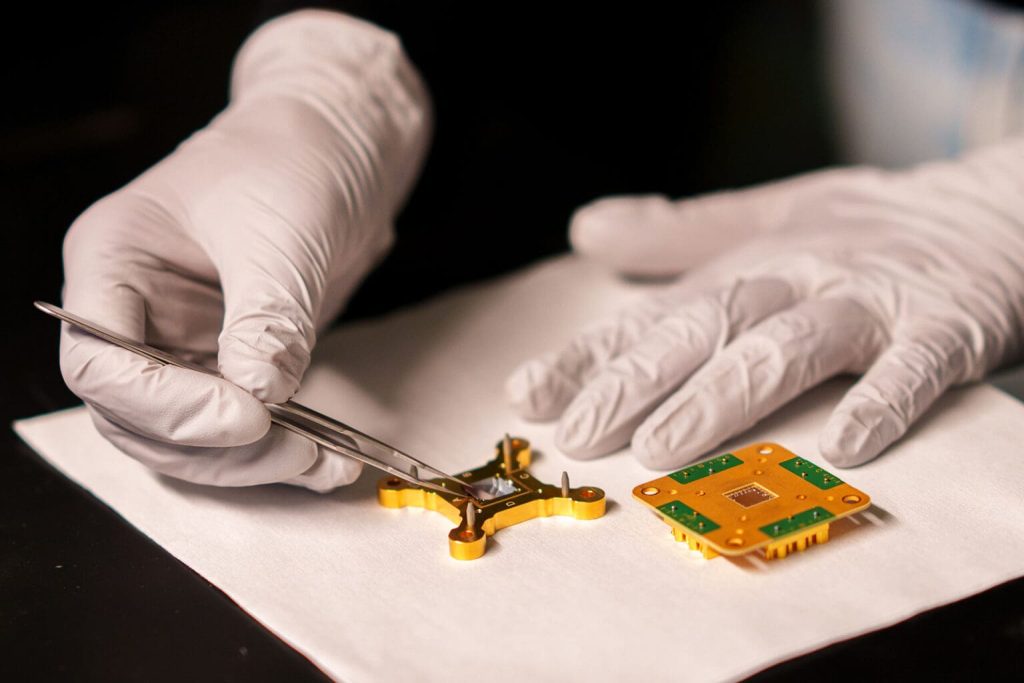
Image Credit: Matthew Raspanti, Office of Communications, Princeton University

Keep track of everything going on in the Quantum Technology Market. In one place.
Topics

Resonance
The Quantum Insider is the leading online resource dedicated exclusively to Quantum Computing. You can contact us at [email protected].

Stay Ahead of Quantum
Get the latest research, company news, and market intelligence every week.
MENTIONED IN THE ARTICLE