



Insider Brief
- ETH Zurich researchers demonstrated a new quantum computer architecture that uses mechanical vibrations as a quantum working memory, showing that superconducting qubits can process information stored in microscopic mechanical resonators.
- The architecture separates quantum processing from memory in a design modeled on classical computers, with mechanical resonators offering higher memory density, smaller size and longer storage times than conventional electromagnetic quantum memory.
- The team successfully implemented the Quantum Fourier Transform and a period-finding algorithm, providing a proof of principle that the platform can perform programmable quantum computations while supporting future efforts to scale the technology.
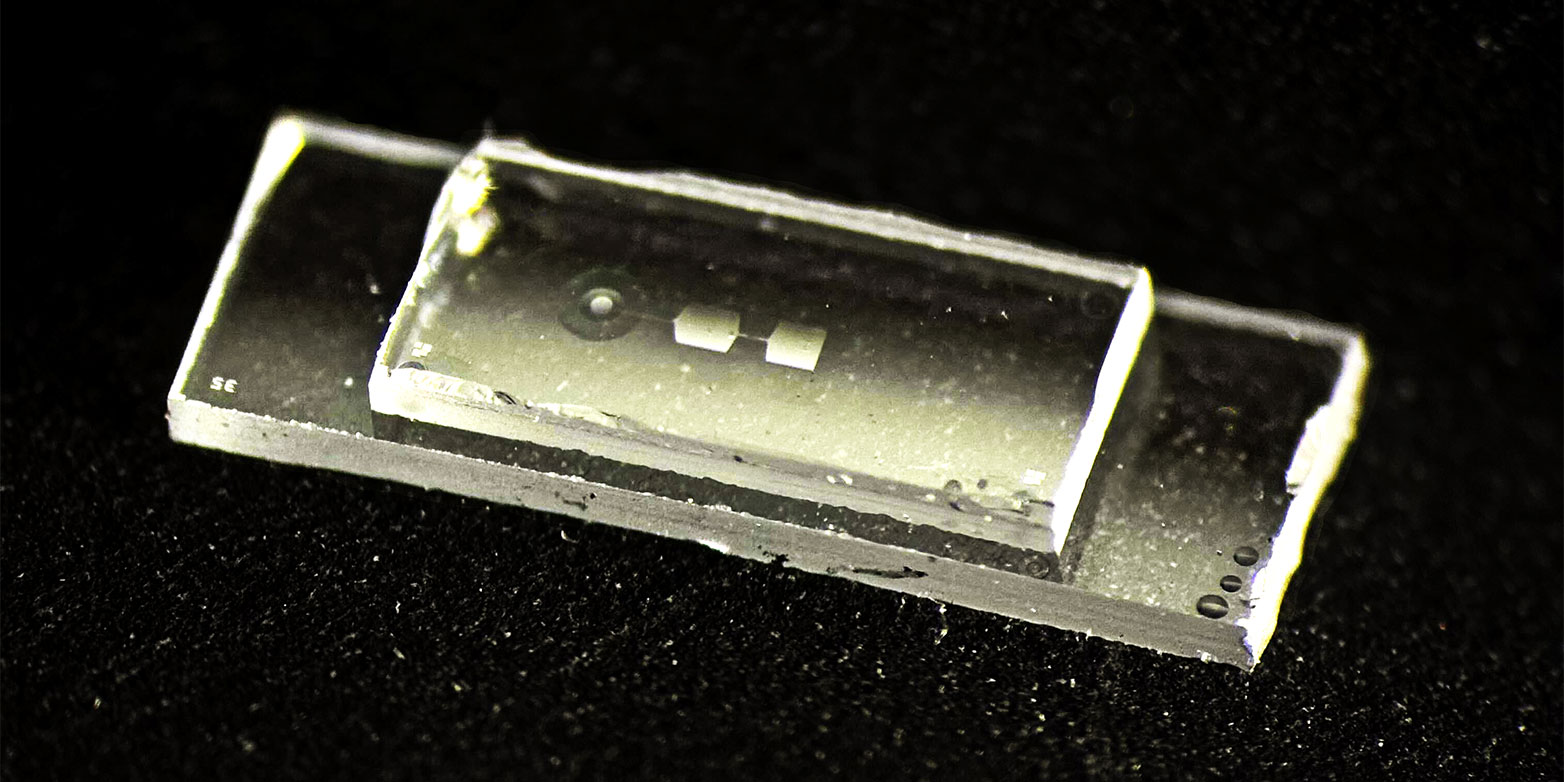
- Image: The new quantum chip developed by ETH Zurich physicist Yiwen Chu contains so-called mechanical resonators, tiny components that begin to vibrate when storing information. (Hybrid Quantum Systems Group / ETH Zurich)
A team at ETH Zurich has demonstrated a new quantum computer architecture that uses tiny mechanical vibrations as working memory, offering an alternative to conventional electromagnetic quantum memory while separating computation and storage in a design that more closely resembles a modern digital computer.
The work, published in Science, addresses a longstanding challenge in quantum computing by introducing a dedicated quantum working memory built from microscopic mechanical resonators. The researchers report that the architecture successfully performed key quantum computing operations, providing what they describe as a proof of principle that mechanical memory can be integrated with superconducting quantum processors.
While the system remains an experimental device, the study suggests that mechanical resonators could eventually help build more compact and scalable quantum computers by increasing storage density and extending the lifetime of stored quantum information, according to a university news release.

“The interaction between the quantum processor and the quantum memory provides a crucial foundation with a view to establishing quantum computers as a powerful and reliable way to perform computations that are not feasible with conventional computers,” Yiwen Chu, a professor of physics at ETH Zurich whose group led the research, said in the release.
Separating Computation From Memory
Modern digital computers divide responsibilities between a central processor and memory. A central processing unit performs calculations while random access memory temporarily stores the data needed during those calculations.
Many quantum computers, however, blur that distinction. In many existing superconducting quantum systems, processing and storage are tightly integrated, with qubits performing both roles.
Chu’s team sought to build a quantum version of the processor-and-memory model familiar from classical computing.
In the new architecture, a superconducting qubit serves as the processing and control unit. Instead of storing information electromagnetically, however, the system uses microscopic mechanical resonators that vibrate at frequencies far beyond human hearing.
The concept is similar to the strings of a guitar, although the comparison ends at the basic idea of vibration. Guitar strings obey the rules of classical physics, while the resonators inside the quantum chip operate according to quantum mechanics.
“In our quantum working memory, however, information is not stored electromagnetically – as is usually the case today – but rather in the form of mechanical vibrations,” Chu said.
To execute a calculation, the superconducting qubit retrieves information stored as a vibration, modifies that information and then writes it back into the mechanical memory.
“In concrete terms, our quantum chip contains so-called mechanical resonators, tiny components that start to vibrate when storing information,” Chu added.
Tiny Vibrations Become Quantum Memory
Each resonator can vibrate in multiple ways, known as vibrational modes. Those different modes effectively serve as separate memory locations capable of storing different pieces of quantum information.
Within each mode, the vibration itself can occupy different quantum states. Those states hold the information that the processor accesses during computation.
Unlike classical computer memory, these quantum states can exist in superposition and become entangled with one another. Superposition allows quantum information to occupy combinations of states rather than a simple binary choice between zero and one, while entanglement creates correlations between quantum states that have no classical equivalent.
Those uniquely quantum properties are central to the long-term promise of quantum computing. Researchers hope they will eventually allow quantum computers to solve selected optimization, chemistry, materials science and cryptographic problems that remain impractical for conventional computers.
The challenge is preserving those fragile quantum states long enough to perform meaningful computations.
According to the ETH Zurich team, mechanical resonators offer several potential advantages over electromagnetic memory systems that have dominated superconducting quantum computing research.
Electromagnetic memories are highly developed and allow researchers to read, manipulate and control quantum states with exceptional precision. But they also occupy significant chip area, limiting how much memory can be incorporated into future processors.
Mechanical resonators are considerably smaller, allowing more memory elements to fit onto a chip. They also support multiple vibrational modes, increasing the amount of information each resonator can hold.
The researchers further report that mechanical vibrations preserve quantum information for longer periods before the stored states decay, extending the effective storage lifetime.
Testing a New Architecture
A new memory technology is useful only if it can perform real quantum computations. To test that capability, Chu’s group implemented two benchmark quantum algorithms.
The first was the Quantum Fourier Transform, a mathematical procedure that forms the foundation of numerous quantum algorithms, including several expected to provide quantum speedups over classical approaches.
The second was a period-finding algorithm that demonstrates how the Quantum Fourier Transform can be applied in practice.
“The Quantum Fourier Transform is a fundamental computational procedure required for many quantum algorithms. The period-finding algorithm we implemented served as a demonstration of how this procedure can be used”, said Igor Kladaric, doctoral student in Chu’s team and co-author of the publication.
Successfully executing those algorithms required the processor to repeatedly retrieve, manipulate and store multiple quantum states while maintaining their coherence throughout the computation.
The team reports that the architecture completed those tasks, demonstrating that mechanical memory can support more than simple storage experiments.
The results also suggest that the platform is programmable rather than being designed for only a narrow set of specialized operations. According to the researchers, the system can perform the basic computational steps required for general-purpose quantum computing.
Scalability Remains the Next Hurdle
Like many advances in quantum computing, the work represents an important demonstration rather than an immediately deployable technology.
The prototype contains a limited number of components and must still prove that the architecture continues to function reliably as additional qubits and resonators are added.
Scalability remains one of the central challenges facing every major quantum computing platform, whether based on superconducting circuits, trapped ions, neutral atoms, photonics or other technologies.
The ETH Zurich study does not claim to have solved those broader engineering challenges. Instead, it establishes that mechanical resonators can serve as a practical quantum working memory coupled to superconducting qubits and support meaningful quantum algorithms.
If the architecture scales successfully, it could provide another design option for future quantum computers, particularly where chip area, memory density and storage lifetime become limiting factors.
Chu’s group is continuing to refine the architecture and evaluate its performance in larger systems.