
Guest Post: Why Chemistry Could Be Quantum Computing’s First Foothold


By Dr. Kris Naudts, Zeynep Koruturk and Donald Harmitt @ Firgun Ventures.
Firgun Ventures is a VC firm investing in Series A/B quantum scale-ups globally.
Among the futures promised for quantum computing, chemistry has the strongest claim to arriving first, and being the most direct line to human health. Bringing a new drug to market still takes well over a decade and consumes billions of dollars, much of it spent discovering, late and expensively, that a candidate molecule does not behave as hoped. The appeal of simulating that behaviour accurately before anything is synthesised is obvious, and it is why McKinsey estimates quantum computing could unlock $400 billion across life sciences by 2035, with a comparable range in chemicals. That sits within a far larger prize: its 2026 Quantum Technology Monitor puts the total potential economic value of quantum computing at up to $2.7 trillion globally by the same year, with the earliest gains accruing to energy, materials, pharmaceuticals and chemicals.
The deeper reason chemistry sits at the front of the queue is physical rather than commercial. Molecules are themselves quantum systems, governed by the same quantum mechanics, superposition and entanglement, a quantum computer is built to manipulate. Hence, a machine whose native language is quantum mechanics is, in principle, well suited to modelling matter that obeys it. The intuition is old and dates back to 1981 when Richard Feynman argued that because nature is not classical, any honest simulation of it had better be quantum mechanical too. What has changed is that the hardware is finally catching up to the idea.

Why Molecules Defeat Classical Machines
At root the obstacle is arithmetic, and it scales in the worst possible way. The information needed to describe a molecule’s quantum state grows exponentially with the number of interacting particles, because each electron’s behaviour is shaped by the possible behaviour of all the others. This interdependence is often referred to as strong correlation. A single caffeine molecule has just 24 atoms, yet IBM Quantum notes that simulating caffeine even with a simple basis set would require around 10⁴⁸ classical bits. That is within a few orders of magnitude of the estimated 10⁴⁹ to 10⁵⁰ atoms in Earth, which helps explain why exact molecular simulation becomes unreachable for classical computers surprisingly quickly.
Classical chemistry copes by approximating, and for decades that bargain has largely held. Workhorse methods such as density functional theory (DFT), which estimates electronic behaviour rather than computing it exactly, deliver strong results across many problems and, with high-performance computing, underpin most modern materials and drug research. However, approximation has a cost, and it becomes taxing where the chemistry is most interesting. This includes the messiest cases, where electrons interact too tightly to be teased apart, where molecules are energised rather than at rest, and where reactions are caught mid-transformation. These are the situations that drive industrial catalysts and the chemistry of living things. A quantum computer sidesteps this, because where a classical machine needs exponentially more memory for each particle added, a quantum processor needs only a roughly linear increase in qubits, representing the molecule’s states directly rather than listing them out one by one. Encodings such as the Jordan-Wigner transformation map the behaviour of electrons onto qubits, letting the machine speak the molecule’s own language. The promise is not merely speed but also fidelity, otherwise known as accuracy.
Why Chemistry Reaches The Front Of The Queue
Chemistry’s early lead comes down to a question of scale, and the contrast with the field’s grander ambitions is instructive. The headline quantum prizes, breaking RSA-style encryption through Shor’s algorithm or solving large optimisation problems, are daunting partly because cryptographically relevant factoring still demands a million or more physical qubits and very deep circuits, even though these estimates are rapidly falling. Many targeted molecular problems are argued to need far fewer logical qubits and shallower circuits, which is why chemistry is widely expected to deliver early, useful advantages. Firgun Ventures’ article diving into “How Many Qubits Does a Quantum Computer Need?”, places chemistry in the first band of commercially meaningful applications. The realistic picture is therefore a spectrum: small but valuable problems within near-term reach, and a tail of harder ones waiting on error correction to mature.
From Laboratory Algorithms To Working Hybrids
Putting the idea to work today means operating within the limits of noisy, intermediate-scale quantum (NISQ) hardware, referring to the current generation of quantum computers which lack the full error-correction capabilities required for fault-tolerance quantum computing. The dominant near-term approach is hybrid: the quantum processor handles the part of the calculation it does best while a classical supercomputer does the rest. A quantum algorithm called the variational quantum eigensolver (VQE) embodies this, using the quantum device to estimate a molecule’s lowest energy state and a classical optimiser to refine it, while another algorithm known as quantum phase estimation (QPE), promises more but awaits fault-tolerant hardware.
The work has long since moved beyond physics departments, and the past year has made that plain. In May 2025 Quantinuum demonstrated what it called the first scalable, error-corrected, end-to-end computational chemistry workflow, calculating the energy of molecular hydrogen on its trapped-ion hardware through its InQuanto platform. A month later IonQ, with AstraZeneca, AWS and NVIDIA, reported a more than 20-fold speed-up in simulating a Suzuki-Miyaura reaction, a carbon-bond-forming step common in drug synthesis, compressing an expected runtime from months to days. Fast forward to February 2026, IBM and Japan’s RIKEN coupled a quantum processor to the Fugaku supercomputer to model iron-sulfur clusters, strongly correlated molecules central to biological electron transfer. Industrial users are making headway too, as Mitsubishi Chemical has worked with PsiQuantum since 2024 on photochromic molecules for smart windows, solar energy, and other photoswitching uses.
The targets reach across the molecular economy too: modelling how a drug binds to its target protein without trial-and-error synthesis, designing solid-state batteries and catalysts for green hydrogen, and understanding enzymes such as nitrogenase well enough to rethink the energy-hungry chemistry of fertiliser. Each is a case where a better simulation translates fairly directly into lower cost, shorter timelines or a product classical methods would have struggled to find.
The Discipline Beneath The Promise
None of this erases the distance still to travel, and pretending otherwise would be its own kind of hype. The most valuable molecular problems remain out of reach of present hardware and many headline chemistry-related demonstrations today are proofs of principle rather than production tools. What makes chemistry compelling is that the gap is narrowing along a credible path, with milestones that can actually be observed and judged. The question worth holding onto is which corner of chemistry will reward patience first.
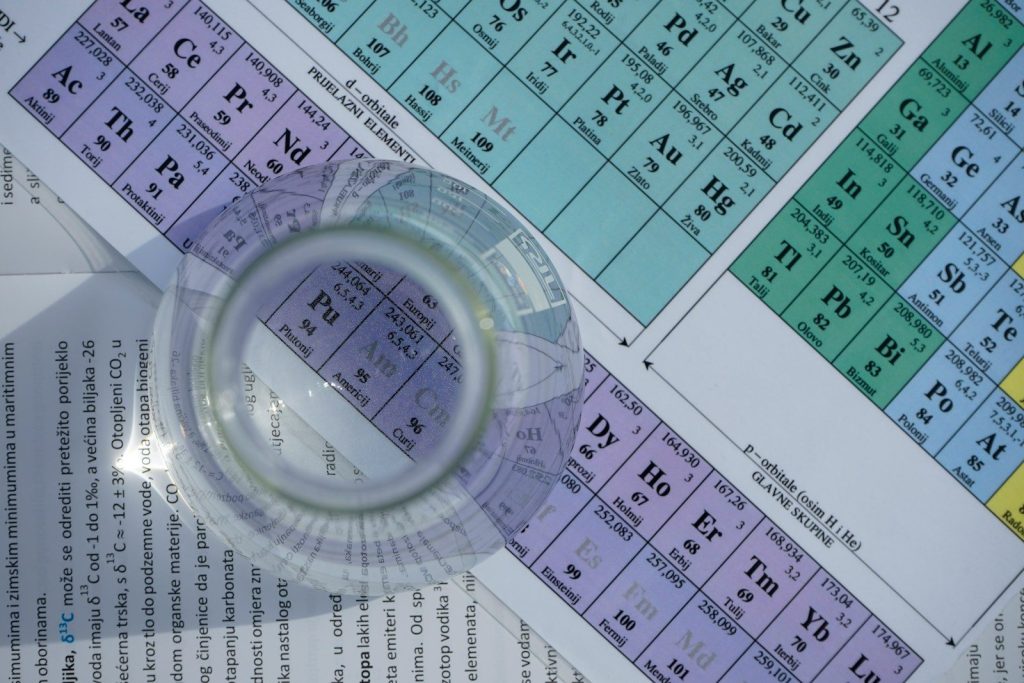
Photo by Vedrana Filipović

Keep track of everything going on in the Quantum Technology Market. In one place.
Topics

Resonance
The Quantum Insider is the leading online resource dedicated exclusively to Quantum Computing. You can contact us at [email protected].

Stay Ahead of Quantum
Get the latest research, company news, and market intelligence every week.
MENTIONED IN THE ARTICLE