
The Quantum Industry Responds to Trump Administration’s New Executive Order


Insider Brief
- The Trump administration’s new quantum executive order transitions quantum technology from a research priority into a national strategy.
- Federal agencies are ordered to update the National Quantum Strategy, support the development of a federally backed quantum computer for scientific applications, expand work on quantum sensors and networks and strengthen domestic supply chains.
- Members of the quantum industry have submitted comments on the new order.
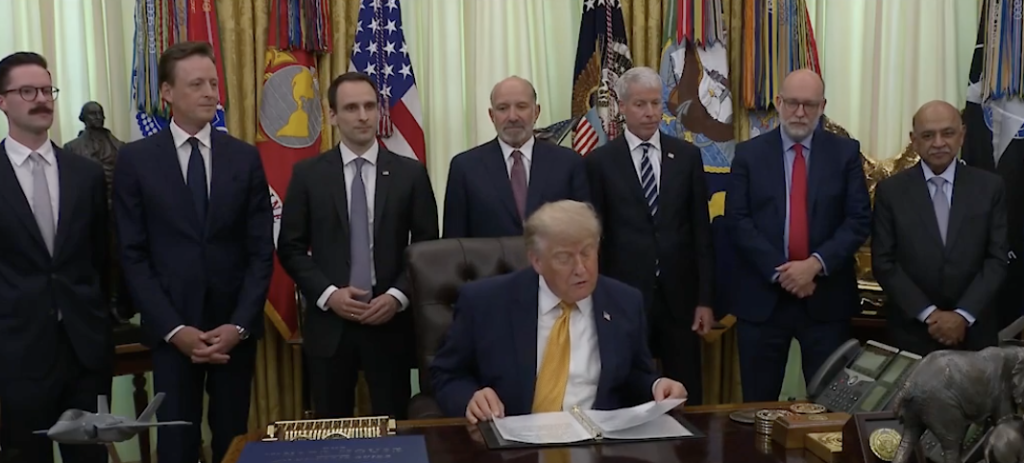
The Trump administration’s new quantum executive order marks one of the most expansive federal efforts yet to move quantum technology from a research priority into a national strategy for economic competitiveness, scientific discovery and security.
The order directs federal agencies to update the National Quantum Strategy, support the development of a federally backed quantum computer for scientific applications, expand work on quantum sensors and networks, strengthen domestic supply chains and build a larger quantum workforce. It also places new emphasis on protecting U.S. quantum research from foreign threats, directing the FBI and other agencies to expand counterintelligence coordination across government, industry and academia.
For the quantum cybersecurity community, the order also carries implications for post-quantum cryptography. It directs federal officials to assess the national security effects of increasingly powerful commercial quantum computers, including their implications for the migration to quantum-resistant encryption. That provision ties the country’s PQC transition more closely to broader intelligence assessments, technology benchmarking and commercial quantum progress.

The directive does not appropriate new funding on its own, and many of its goals will depend on agency action, congressional support and private-sector participation. But it gives federal departments a detailed set of deadlines and responsibilities. It also sends a clear signal that the administration views quantum computing, sensing, networking and enabling technologies as strategic assets that require coordinated public and private action.
The response from the quantum community is likely to be closely watched. Researchers, executives, investors and cybersecurity leaders have long called for clearer government demand, stronger supply-chain support, better benchmarking and faster movement on post-quantum security. At the same time, some in the field may be watching how the government balances security controls with the open research culture that helped build the U.S. quantum ecosystem.
Below, quantum research and business leaders respond to the executive order and what it could mean for the next phase of U.S. quantum policy, commercialization and security.
Celia Merzbacher, Executive Director, QED-C:
“The Executive Orders signed today by President Trump will help to ensure U.S. leadership through the development and application of quantum technologies for economic and national security. The quantum industry is rapidly advancing applications for quantum computing, quantum sensing and quantum networking but progress can be further accelerated by doing what it takes to get systems in the hands of researchers and innovators. The Quantum Economic Development Consortium (QED-C), established by the NQI Act which was signed by President Trump in 2018, is an industry-driven consortium that stands ready to partner with the Federal agencies to grow the quantum economy and the entire enabling ecosystem.”
Sumit Kapur, CEO, Zapata Quantum
“Today’s Executive Orders signed by President Trump demonstrate another important step towards strengthening the United States’ leadership in quantum innovation and resilience. We particularly applaud the establishment of the Quantum Computer for Application Development and Discovery Science (QC-ADDS) Effort, which recognizes that the ultimate value of quantum computing lies in the transformative, real-world applications it enables. “The primary focus in the industry has been on quantum hardware, but the QC-ADDS Effort brings much-needed emphasis to the applications layer of the stack. Realizing the full value of quantum computing will require not only more powerful machines, but also the software, algorithms, and domain-specific applications that can turn quantum capabilities into practical solutions to complex challenges in science and industry.”
Marta Estarellas, CEO, Qilimanjaro Quantum Tech
“With these two orders, President Trump’s administration treats quantum as a present-day reality, not a distant promise: one order mobilises the government to help build the technology faster, the other brings forward the deadline for quantum-resistant encryption. The United States is pairing ambition with the two things that actually move a deep-tech field: resources and direction.
“What truly impresses me is the commitment to financially back its own quantum companies, in addition to the private capital they can already raise in an ecosystem that rewards innovation and risk. They know what is at stake: a technology that could reshape the world as we know it. For Europe, this is a wake-up call. We have the science, the talent, and companies already building quantum computers on our own soil. Whether we close the gap will depend less on our world-class science and more on whether our public and private sectors choose to back it.”
“Quantum computing is a strategic technology for America. As AI, supercomputing, and quantum technologies come together, reliable quantum systems that can solve real scientific problems are getting closer. America’s leadership will depend on pairing the right computing platforms with the talent and partnerships needed to move quantum systems from the lab into practical use. We applaud the Administration’s actions toward that goal and are proud to work with industry, national labs, and the U.S. government to help America lead the next era of scientific discovery.”
Niccolo de Masi, Chairman and CEO, IonQ
“IonQ welcomes the Trump Administration’s Executive Orders on advancing U.S. leadership in quantum technology. The Executive Orders reflect the growing strategic importance of quantum technologies to U.S. economic competitiveness, scientific leadership, and national security.
As the Q-Day timeline accelerates, organizations across the public and private sectors must prepare now for the transition to post-quantum security. Post-Quantum Cryptography (PQC) is a critical first step in protecting existing infrastructure at scale. Longer-term resilience will increasingly rely on advanced quantum communications technologies, including Quantum Key Distribution (QKD). Sustained federal focus and investment across research, infrastructure, manufacturing, workforce development, and commercialization are essential to maintaining U.S. leadership and strengthening national security.
IonQ operates commercially available quantum systems built in the U.S. and works with federal agencies, national laboratories, research institutions, and industry partners to advance deployable quantum technologies. We look forward to supporting efforts that strengthen America’s quantum ecosystem, accelerate innovation and adoption, expand the nation’s quantum workforce, and ensure the U.S. remains the global leader in quantum technologies.”
Henry Young, Senior Director of Policy, BSA
“The Business Software Alliance welcomes President Trump’s new Executive Orders 14409 on Securing the Nation Against Advanced Cryptographic Attacks and EO 14411 on Ushering in the Next Frontier of Quantum Innovation, which focus on upgrading government systems to post-quantum cryptography and furthering quantum innovation as an important step toward strengthening US leadership in one of the most transformative emerging technologies.
These executive orders advance many of the priorities BSA has highlighted in its quantum policy work, including the need for a refreshed national quantum strategy, stronger public-private collaboration, greater focus on commercialization and deployment, coordinated government leadership, working with like-minded partners, enhanced protection of critical quantum research and supply chains, and the upgrade to post-quantum cryptography. The order’s direction to update the National Quantum Strategy, establish agency roadmaps, expand public-private partnerships, and reconstitute the National Quantum Initiative Advisory Committee, as well as updating the timelines for government agencies to upgrade to PQC, will help create a more coordinated framework for advancing quantum innovation as well as a safer and more secure nation.
As BSA has emphasized, governments that act now in partnership with industry will be best positioned to capture the economic, scientific, and national security benefits of quantum technologies. The executive order represents an important step toward ensuring the United States remains at the forefront of quantum innovation and competitiveness.”
Rebecca Krauthamer, CEO and co-Founder of QuSecure
“This executive order matters because it puts dates on a security transition that can no longer stay theoretical. The timeline is compressing, with Google targeting 2029 for its own post-quantum migration and AI accelerating how quickly vulnerabilities can be found and exploited. This is not a simple software patch. It is a multi-year migration of the cryptographic foundations that protect government systems, contractor networks, critical infrastructure, and the data security modern society depends on. The hard part is changing encryption across real government systems without breaking the services people depend on.”
Dr. Garfield Jones, EVP Strategy and Research at QuSecure
“This executive order sends an unambiguous signal to every organization doing business with the federal government: the clock is ticking and maybe running out for some. The 2030 deadline for key establishment is a tangible compliance deadline, and the gap between where most organizations are today and where they need to be is significant. Agencies and contractors that haven’t started a cryptographic inventory are already behind. The organizations that move now will have options. The ones that wait will find themselves managing a crisis.”
Gary Barlet, Public Sector Chief Technology Officer, Illumio
“The White House appears to be recognizing a reality that cybersecurity and national competitiveness are becoming inseparable. Quantum research is rapidly becoming a strategic asset, making it an increasingly attractive target for foreign intelligence services and nation-state adversaries.
While post-quantum cryptography remains an important long-term priority, organizations involved in quantum research cannot afford to focus solely on future encryption standards. The more immediate challenge is protecting the people, systems, research environments, and supply chains that support quantum innovation today.
Adversaries do not need a quantum computer to steal quantum breakthroughs. They only need access. That is why visibility, segmentation, and breach containment strategies remain critical. Protecting quantum research starts with assuming compromise is possible and ensuring that one successful intrusion cannot become a broader national security event.”
Bill Wright, Head of Government Affairs, Everpure
“The quantum executive orders send a clear signal that securing the nation’s data is a national security priority. It’s encouraging to see the Administration’s continued focus on accelerating quantum readiness and protecting sensitive data before threats fully materialize. Quantum is both an opportunity and an obligation, but most agencies are still planning only for the opportunity.
‘Harvest now, decrypt later’ makes quantum a today problem, not a 2030s one. Adversaries are already collecting encrypted data, betting they’ll get the chance to read it after Q-day.
The Administration’s direction builds on what the standards community has been signaling for years: encryption is table stakes. Real quantum readiness requires resilience and crypto-agility. Agencies need to know where their sensitive data lives, protect it across its lifecycle, and evolve faster than the threat does.”
Matthew Kinsella, Chief Executive Officer, Infleqtion
“Today’s Executive Order accelerates America’s leadership in one of the most consequential technology races of our time. Quantum technologies are becoming foundational to national security, scientific discovery, precision timing, advanced sensing, and future space systems. The President’s action makes American quantum leadership a national imperative.”
Jack Hidary, CEO of SandboxAQ
“This Executive Order marks a new era in America’s cyber defense posture. The United States government is drawing a clear line in the sand: We must harden our defenses against quantum threats now. SandboxAQ is committed to partnering with federal agencies, including the Department of War and NIST in the Department of Commerce, to modernize our nation’s cryptography at speed and scale, and ensure that adversaries never hold the keys to our critical infrastructure or national defense as Q-Day approaches.”
Victor Peng, CEO of PsiQuantum
“America’s quantum moment is arriving. Yesterday’s historic announcement underscores the important role that the U.S. government must thoughtfully play to help with the rapid development, deployment, and adoption of this transformational technology.”
Simon Pamplin, CTO at Certes
“This Executive Order confirms what has been treated as a forward-looking concern is now a federal mandate with fixed deadlines. Setting 2030 and 2031 timelines for high value assets removes the ambiguity that has allowed many organisations to treat post-quantum migration as a future problem rather than a present one. What stands out most is the focus on migration as a coordination challenge rather than a simple upgrade. Directing agencies to designate a dedicated PQC migration lead reflects an understanding that this cannot be solved by patching individual systems. Cryptographic dependencies are embedded across hardware, software and communications infrastructure that has often been in place for decades, and untangling that requires sustained organisational effort, not a single technical fix.
The Order’s emphasis on critical infrastructure is also significant. Power grids, water systems and transportation networks were not built with cryptographic agility in mind. Many run on legacy technology that cannot simply be replaced wholesale. That makes the approach to protection just as important as the timeline. Securing data flowing through ageing infrastructure requires controls applied to the data itself, rather than solutions that assume infrastructure can be modernised at the same pace as the threat. The harvest now, decrypt later risk is precisely why these deadlines matter today rather than closer to 2030. Data deemed sensitive now, including national security information and infrastructure operational data, can be intercepted and stored years before quantum capability matures, then decrypted retroactively. A 2030 deadline does not protect data being harvested in 2026. Federal action of this scale typically becomes the benchmark private sector organisations are measured against, particularly in regulated industries. The organisations that begin treating data protection as quantum-safe and data-centric now, rather than waiting for compliance deadlines, will be the ones positioned ahead of both the threat and the regulation.”
Dr. Christian Weedbrook, CEO and Founder, Xanadu
The White House’s executive order sends a clear signal of continued federal commitment to advancing quantum computing and maintaining leadership in the field. By accelerating investment, strengthening supply chains, and prioritizing commercialization and security, it creates the foundation needed for the industry to scale and compete globally, while reinforcing collaboration across government, academia, and the private sector. Quantum computing is moving quickly, and national efforts like this, alongside current progress in Canada, are critical to maintaining momentum and turning technical advances into real-world impact.
Matt Hartman, Chief Strategy Officer, Merlin Group
“These executive orders make clear that quantum readiness is no longer a future problem. Organizations need to begin their transition to post-quantum cryptography now, especially as adversaries continue to pursue ‘harvest now, decrypt later’ strategies against sensitive data. Equally important is the Administration’s focus on identifying high-value assets and high-impact systems, because agencies cannot effectively prioritize quantum risk without first understanding where their most critical data resides. The emphasis on shared procurement, cloud modernization, centralized technical support, and workforce development also recognizes that successful PQC migration requires a coordinated, cost-effective approach rather than thousands of organizations solving the same challenge independently.”
Darren Guccione, CEO and Co-Founder, Keeper Security
“The two quantum executive orders signed on June 22 do something quantum security policy has avoided for years: they set hard deadlines and attach consequences to them. The cryptography order mandates that high-value federal assets migrate to post-quantum cryptography for key establishment by December 31, 2030, and for digital signatures by the following year. It mandates cryptographic inventories at the agency level, designates migration leads and extends compliance requirements to federal contractors through changes to the Federal Acquisition Regulation. The National Institute of Standards and Technology (NIST) has spent years developing and approving quantum-resistant algorithms. This order makes that work enforceable.
The innovation order is the necessary counterpart. You cannot build quantum-resistant defenses while ceding ground on quantum computing capability itself. Establishing a national quantum computing effort, expanding counterintelligence protection for domestic quantum infrastructure and investing in supply chain and workforce development signals that the United States is treating this technology seriously on both sides of the equation – as something to build and something to defend against.
What both orders get right is that the threat is not waiting. “Harvest now, decrypt later” attacks are already underway. Adversaries are capturing encrypted data today with the expectation of decrypting it once quantum computing matures. Most organizations do not know which of their systems are exposed to that risk right now, because they have never conducted a serious cryptographic asset inventory. That is the uncomfortable starting point.
Cryptographic dependencies are embedded across identity systems, cloud platforms, databases and software supply chains in ways that accumulated quietly over decades. Migration is not a single upgrade. It means mapping every environment where public-key algorithms are in use, identifying which data carries long-term sensitivity, sequencing changes across interconnected systems and verifying that vendors throughout the supply chain can meet the same standard. That work takes years under the best conditions. For most enterprises, 2030 is not a comfortable horizon. It is a hard deadline against a backlog they have not yet measured.
Federal mandates cascade. The contractors, critical infrastructure operators and technology vendors supporting government environments will face these requirements, and the enterprises that wait for procurement cycles to force action will find themselves compressed between compliance deadlines and the reality that quantum-safe migration cannot be rushed. The time to understand your cryptographic exposure is now, not when the deadline is six months out and every implementation partner is oversubscribed. The organizations best positioned for 2030 are the ones that have already made quantum-resistant cryptography an architectural decision, not a future line item.”
Louis Eichenbaum, Federal CTO at ColorTokens
“The cybersecurity community cannot afford to treat quantum computing the way it treated ransomware or supply chain attacks. Something we knew was coming but didn’t fully prepare for until it became a crisis. The threat is not that a quantum computer suddenly appears tomorrow and breaks encryption overnight. The threat is that adversaries are collecting sensitive data today that may be decrypted years from now. Organizations should use these executive orders as a catalyst to inventory cryptographic assets, identify high-value data, and begin their post-quantum migration plans immediately. By the time quantum computing becomes a mainstream threat, it will be too late to start preparing”

Keep track of everything going on in the Quantum Technology Market. In one place.
Topics

Matt Swayne
With a several-decades long background in journalism and communications, Matt Swayne has worked as a science communicator for an R1 university for more than 12 years, specializing in translating high tech and deep tech for the general audience. He has served as a writer, editor and analyst at The Quantum Insider since its inception. In addition to his service as a science communicator, Matt also develops courses to improve the media and communications skills of scientists and has taught courses.
[email protected]

Stay Ahead of Quantum
Get the latest research, company news, and market intelligence every week.
MENTIONED IN THE ARTICLE

QED-C
The mission of QED-C is to enable and grow a robust commercial quantum-based industry and associated supply chain in the United States.
→

IonQ
IonQ is a developer in trapped ion quantum computing founded in 2015 that actively applies its technology to the aerospace and defense sectors. The company empowers satellite-based quantum networks and quantum enabled drones to improve positioning, navigation, and timing resilience in GPS denied environments, and collaborates with industry leaders like Airbus to optimize aircraft loading.
→

SandboxAQ
SandboxAQ is an enterprise company merging AI and quantum physics founded in 2016 at Alphabet and launched independently in 2022. It developed AQNav, a satellite free navigation platform used by the U.S. Air Force, Boeing, and Airbus that uses quantum sensors to guide aircraft via Earth's magnetic field without relying on vulnerable GPS.
→

Department of War
The United States Department of War is the largest government agency in the United States, responsible for providing the military forces needed to deter war and ensure national security. It oversees the Army, Marine Corps, Navy, Air Force, Space Force, Coast Guard, and National Guard, as well as 11 combatant commands. Headquartered at the Pentagon in Washington, DC, the Department employs over 1.3 million active duty personnel and 742,000 civilians, making it the nation's largest employer. Its mission includes defending the homeland, deterring adversaries, and projecting U.S. influence globally in cooperation with allies and partners.
→

Department of Commerce
The U.S. Department of Commerce is a federal executive department responsible for creating the conditions for economic growth and opportunity in the United States. Through its 13 bureaus, it drives U.S. economic competitiveness, strengthens domestic industry, and supports job growth. The Department fosters innovation in emerging technologies, including quantum computing and artificial intelligence, and provides research and development resources through agencies such as NIST and NTIA.
→
National Institute of Standards and Technology
The National Institute of Standards and Technology is a physical sciences laboratory and non-regulatory agency of the United States Department of Commerce.
→