
Insider Brief
- This article examines the leading quantum programming languages and software frameworks used for quantum computing development in 2026, from hardware-specific tools to cross-platform SDKs.
- The piece highlights major frameworks including Qiskit, PennyLane, Cirq, Q#, CUDA-Q, and Amazon Braket, outlining their use cases, hardware support, and ecosystem roles.
- It also explains how quantum programming differs from classical software development and how the modern quantum software stack is structured.
The majority of the conversations about quantum computing focus on hardware and the software side gets less attention, but it is where most people who work with quantum computers actually spend their time.
Quantum programming is the practice of writing algorithms and applications for quantum computers or quantum simulators. It draws on quantum mechanical phenomena such as superposition, entanglement, and interference – to encode and process information in ways that classical computing cannot. A quantum program specifies a sequence of gate operations applied to qubits, measurement operations, and classical post-processing logic.
The ecosystem has matured significantly and the field has settled on Python as its common language, with a range of frameworks sitting on top of it targeting different hardware platforms and use cases. Understanding what those frameworks do – and why they differ – matters for anyone building with quantum computers today.

How Quantum Programming Differs from Classical Programming
Classical programming is deterministic – input goes in, output comes out. Quantum programming, by contrast, is probabilistic – algorithms must be designed to amplify correct answers through quantum interference while suppressing incorrect ones.
The constraint that shapes everything else is measurement. Classical code can inspect any variable at any point. Quantum code can only extract information by measuring qubits – and measurement collapses the quantum state, destroying it. Quantum programmers cannot use print statements or step-through debuggers on quantum variables. Algorithms need to be mathematically verified before testing, with validation relying on statistical error rates rather than deterministic checks.
Resource constraints are also more severe. Classical programs run on billions of transistors. Current quantum programs must fit within 50 to a few hundred qubits on production hardware, with strict limits on circuit depth before errors accumulate. This makes quantum programming closer in spirit to embedded systems or Field-programmable gate array (FPGA) design than to standard software engineering.
Types of Quantum Programming Languages
The ecosystem divides into three layers.
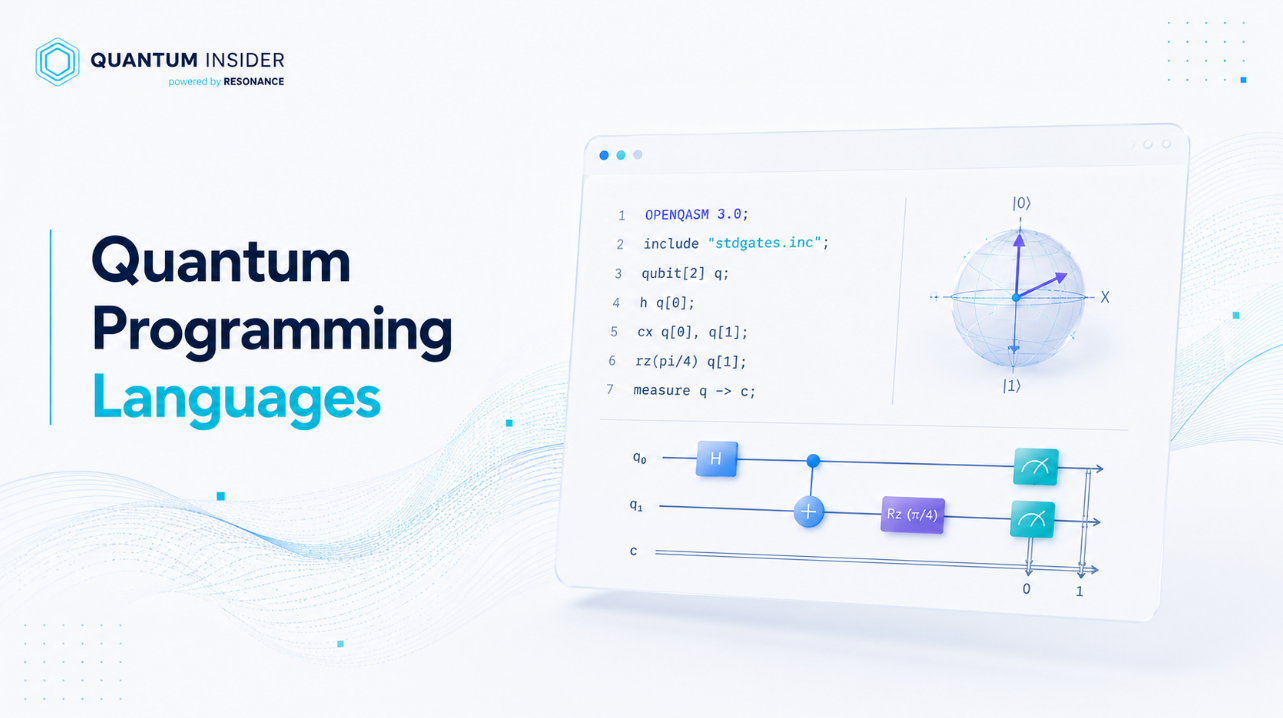
1. Instruction-set languages (OpenQASM, Quil) sit close to the hardware, providing low-level gate sequences that quantum processors can execute directly. Powerful, but requiring deep knowledge of quantum gate design.
2. High-level SDKs (Qiskit, Cirq, Q#, PennyLane) provides Python-based frameworks with abstractions for circuit construction, noise modeling, and optimization. These are what most developers use.
3. Domain-specific languages (Bloqade for neutral atoms) target specific hardware platforms or problem types, trading generality for specialization.
Quantum Programming Frameworks
The following is a non-exhaustive selection. The landscape is broad and evolving rapidly, and the inclusion or omission of any entry should not be interpreted as a ranking or endorsement.
Qiskit (IBM)
Qiskit is the most widely used quantum programming framework, maintained by IBM with a large global developer community. The v1.4 series received security support until March 2026, with full support now on v2.x+. The v2.x series introduced a C++ interface powered by a C-API, enabling HPC-accelerated error mitigation; v2.2 completed end-to-end C++ workflow support with the addition of a transpiler function. A 24% accuracy improvement in dynamic circuits at 100+ qubit scale was confirmed at IBM’s Quantum Developer Conference in November 2025.
Qiskit Functions, expanded in 2025, provides pre-built quantum services across chemistry, optimization, and machine learning. The framework covers educational use, research prototyping, and production application development, and carries the widest ecosystem and largest hiring premium across quantum industry roles.
Cirq (Google)
Cirq is Google‘s open-source quantum framework, optimized for superconducting qubit architecture. It emphasizes simulation fidelity, parameterized circuits, and variational quantum algorithms, with integration into Google’s quantum processor cloud and TensorFlow for hybrid quantum-classical workflows. Cirq is primarily a research and algorithm prototyping tool.
PennyLane (Xanadu)
PennyLane is the primary framework for quantum machine learning, providing automatic differentiation of quantum circuits and integration with PyTorch, TensorFlow, and NumPy. According to Xanadu‘s published benchmarks, Lightning simulators scale to 1,000+ AMD GPUs with strong scaling via Kokkos, demonstrated on Oak Ridge’s Frontier supercomputer.
PennyLane supports hardware from IonQ (via Qiskit/Cirq plugins), Rigetti, D-Wave, AWS Braket, and IQM through hardware-agnostic APIs. In 2025, PennyLane’s Catalyst compiler integrated with Open Quantum Design’s trapped-ion hardware control signals, enabling quantum frontends to compile directly to hardware instructions – described by Xanadu and Open Quantum Design as the first fully open-source quantum computing stack from software to hardware.
Q# (Microsoft)
Q# is Microsoft‘s dedicated quantum programming language for Azure Quantum integration. Its syntax draws from C# and Python, with an emphasis on type safety and quantum resource management. Compiler features cover qubit allocation, gate optimization, and resource estimation – particularly useful for evaluating what a quantum program will actually require on real hardware.
Amazon Braket SDK
Amazon Braket SDK is a Python framework for quantum circuits on AWS quantum processors and simulators, supporting hardware from IonQ, Rigetti, D-Wave, and AWS’s own systems through unified APIs. The SDK integrates with SageMaker and Lambda for hybrid classical-quantum workflows, making it a practical choice for organizations already operating in AWS environments.
CUDA-Q (NVIDIA)
CUDA-Q is NVIDIA‘s QPU-agnostic platform for accelerated quantum-classical computing, released as open-source in 2023. It supports both Python and C++ and integrates with 75% of publicly available QPUs, including IonQ, Quantinuum, and Pasqal – using MLIR/LLVM/QIR compilation with GPU-accelerated simulators.
In 2026, Classiq integrated CUDA-Q for accelerated hybrid workflows, reducing circuit synthesis and execution of a 31-qubit circuit from 67 minutes to 2.5 minutes on a single NVIDIA A100 GPU. Similarly, QCentroid also combined its QuantumOps platform with CUDA-Q, giving enterprise users access through an AI copilot layer.
Bloqade (QuEra)
Bloqade is QuEra’s specialized SDK for neutral-atom quantum computing, supporting both digital and analog quantum computing paradigms. Bloqade-analog handles analog/Hamiltonian simulation on neutral atoms; Bloqade handles gate-based digital circuit execution. Version 0.26+ provides fine-grained control over atom positioning, mid-circuit measurements, and real-time feedback.
Stim (Google)
Stim is Google‘s specialized library for quantum error correction simulation and stabilizer codes. It can analyze a distance 100 surface code circuit in 15 seconds and then sample shots at kilohertz rates, making it the primary tool for researchers designing fault-tolerant quantum computers. Not a general programming framework – purpose-built for error correction work.
PyQuil (Rigetti)
PyQuil is Rigetti‘s Python framework for superconducting quantum processors, built around the Quil language and quantum-classical virtual machines. Rigetti’s focus on hybrid algorithms makes PyQuil relevant for applications requiring tight integration between classical and quantum processing.
OpenQASM (Open Standard)
OpenQASM is an open-source hardware-agnostic quantum instruction language maintained by IBM and the quantum community. QASM 3.0 introduced classical control structures, function definitions, and classical variable integration. Most quantum compilers target OpenQASM as an intermediate representation – it is infrastructure rather than a user-facing framework.
Quipper (Academic)
Quipper is an academic quantum programming language from Dalhousie University, written in Haskell with strong typing, circuit templating, and scalable parameterized circuits. Not widely used in industry, but valued in research settings for exploring quantum programming language theory.
PyTKET (Quantinuum)
PyTKET is Quantinuum’s compiler framework for quantum circuit optimization and hardware compilation across IBM, Google, IonQ, and other backends. it works as a post-compilation optimization layer that improves fidelity on noisy hardware.
Qmod (Classiq)
Qmod is a quantum modeling language developed by Classiq that operates at a higher level of abstraction than gate-level frameworks like Qiskit or Cirq. Rather than specifying individual gates and qubit operations, a developer describes the functional intent of an algorithm in Qmod and the Classiq synthesis engine generates an optimized, hardware-aware circuit automatically. Qmod also supports both a native syntax and a Python SDK embedding, making it accessible to developers already working in Python. The language integrates with IBM, IonQ, AWS Braket, Azure Quantum, and NVIDIA backends.
QURI SDK (QunaSys)
QURI SDK is an open-source quantum software development kit from QunaSys, a Japanese quantum software company focused on algorithm development for chemistry and materials science. The SDK consists of three components: QURI Parts, a hardware-agnostic building block library for constructing quantum algorithms; QURI VM, a tool for evaluating and simulating algorithm performance across early fault-tolerant quantum computing (EFTQC) architectures including circuit transpilation and resource estimation; and QURI Algo, a library for platform-independent algorithm development prepackaged with early FTQC algorithms.
The SDK is designed for use by HPC centers and research institutions, and sits at a different point in the stack from general-purpose frameworks – it supports NISQ, early FTQC, and full FTQC development, with particular emphasis on teams working toward fault-tolerant quantum computing.
Framework Overview
| Framework | Maintainer | Primary Hardware | Open Source |
|---|---|---|---|
| Qiskit | IBM | IBM Quantum | Yes |
| Cirq | Google Quantum AI | Yes | |
| PennyLane | Xanadu | Multi-platform | Yes |
| Q# | Microsoft | Azure Quantum | Yes |
| Braket SDK | Amazon | AWS quantum | Yes |
| CUDA-Q | NVIDIA | Multi-platform | Yes |
| Qmod | Classiq | Multi-platform | No |
| Bloqade | QuEra | Neutral atoms | Yes |
| Stim | Error correction | Yes | |
| PyQuil | Rigetti | Rigetti systems | Yes |
| OpenQASM | Community | Hardware-agnostic | Yes |
| Quipper | Academic | Research | Yes |
| PyTKET | Quantinuum | Multi-platform | Yes |
| QURI SDK | QunaSys | Multi-platform | Yes |
Which Framework to Learn First
For most people starting out, Qiskit is the practical choice. It has the largest community, the most documentation, free access to real quantum hardware through IBM Quantum, and the widest career relevance. Most university programs that cover quantum computing use Qiskit.
The choice changes based on goals. Quantum machine learning research points toward PennyLane, which is built around automatic differentiation and integrates directly with PyTorch and TensorFlow. Azure-based organizations may prefer Q#. Error correction researchers need Stim. Neutral-atom work requires Bloqade.
Most working quantum programmers eventually use two or three frameworks. The underlying concepts such as circuit construction, gate application, measurement, parameterization – transfer between them. The quantum field is small enough that multi-framework fluency is increasingly expected at senior levels. Start with Qiskit, then add a second framework based on where your work is actually going.
The Quantum Software Stack
The quantum software ecosystem operates in distinct layers. Modeling languages like Qmod allow developers to describe algorithmic intent without specifying gate-level implementation, with a synthesis engine compiling the model into an optimized circuit. High-level frameworks (Qiskit, Cirq, PennyLane) provide abstractions for circuit construction and algorithm development. Mid-level compilation and optimization (PyTKET, Qiskit transpilers) handles hardware-specific constraints and error mitigation. Low-level instruction languages (OpenQASM, Quil) abstract hardware for processor manufacturers. Bottom-layer control software manages quantum processor operation at the microsecond timescale.
Most developers work at the top layer and rarely engage with the layers below, but understanding the full stack matters for production work. A deployed quantum application describes an algorithm in Qmod or writes circuit-level code in Qiskit, compiles to OpenQASM, gets optimized by PyTKET or Qiskit transpilers, executes on hardware, and returns statistical results. Debugging happens through circuit visualization, statistical analysis, and noise simulation instead of step-through inspection.
Furthermore, quantum programmers rely heavily on mathematical verification and statistical validation rather than the tools that classical developers take for granted.
For a deeper look at the companies building the hardware these frameworks run on, see TQI’s coverage of quantum chip companies in 2026, quantum computing jobs and salaries, and quantum computing use cases across industries.
Frequently Asked Questions
Can I run the same quantum code on different hardware platforms?
Mostly, with caveats. OpenQASM provides a hardware-agnostic standard, and frameworks like PennyLane and Amazon Braket support multiple backends with automatic compilation. However, different platforms have different native gate sets, qubit connectivity, and performance characteristics. A circuit optimized for IBM’s architecture may perform poorly on IonQ or Rigetti. Production quantum programs are typically tuned for specific hardware rather than written once and run anywhere.
Which quantum programming language has the most job opportunities?
Qiskit appears most frequently in quantum engineering job listings, reflecting IBM’s broad presence across industry and academia. PennyLane skills are increasingly relevant in quantum machine learning roles. Q# is worth learning for roles within Microsoft‘s ecosystem. For most people entering the field, Qiskit is the practical starting point – add a second framework once the first is solid.
Is learning quantum programming hard? What’s the prerequisite knowledge?
The learning curve is steep. Solid Python skills are the baseline requirement, and foundational quantum mechanics knowledge – what qubits are, how superposition and entanglement work – helps significantly. A physics or computer science background is useful but not required. Free resources including the Qiskit learning platform and MIT OpenCourseWare cover the fundamentals. Expect several months of dedicated study before writing non-trivial programs. Modern frameworks abstract away most hardware complexity, but the underlying concepts require genuine effort to internalize.
How do I test and debug my quantum code?
Quantum debugging works differently from classical debugging because measuring a qubit collapses its state. The standard approach is to test on simulators first – which model ideal quantum hardware – then move to real devices with error mitigation. Most frameworks provide circuit visualization and statistical validation tools. Because quantum results are probabilistic, correctness is validated by running the same algorithm many times and analyzing the output distribution rather than checking a single deterministic result.
Do quantum frameworks integrate with classical machine learning libraries?
Yes. PennyLane provides native PyTorch and TensorFlow integration for quantum machine learning. Qiskit works with NumPy and scikit-learn. CUDA-Q enables GPU-accelerated hybrid quantum-classical workflows. Most practical quantum applications are hybrid – combining classical preprocessing and post-processing with quantum computation – and framework integration with classical ML tooling reflects that reality.