


Insider Brief
- Researchers at ETH Zurich demonstrated a method to generate mathematically certifiable perfect randomness using entangled quantum bits and an advanced Bell test, addressing a long-standing challenge in cryptography and digital security.
- The team used two superconducting qubits connected by a 30-meter cryogenic link and combined imperfect random inputs with quantum measurements and specialized algorithms to amplify weak randomness into fully random sequences.
- The researchers said the work could support future applications in encryption, quantum-secure communications, blockchain systems, lotteries, and other digital infrastructure that depends on highly reliable random number generation.
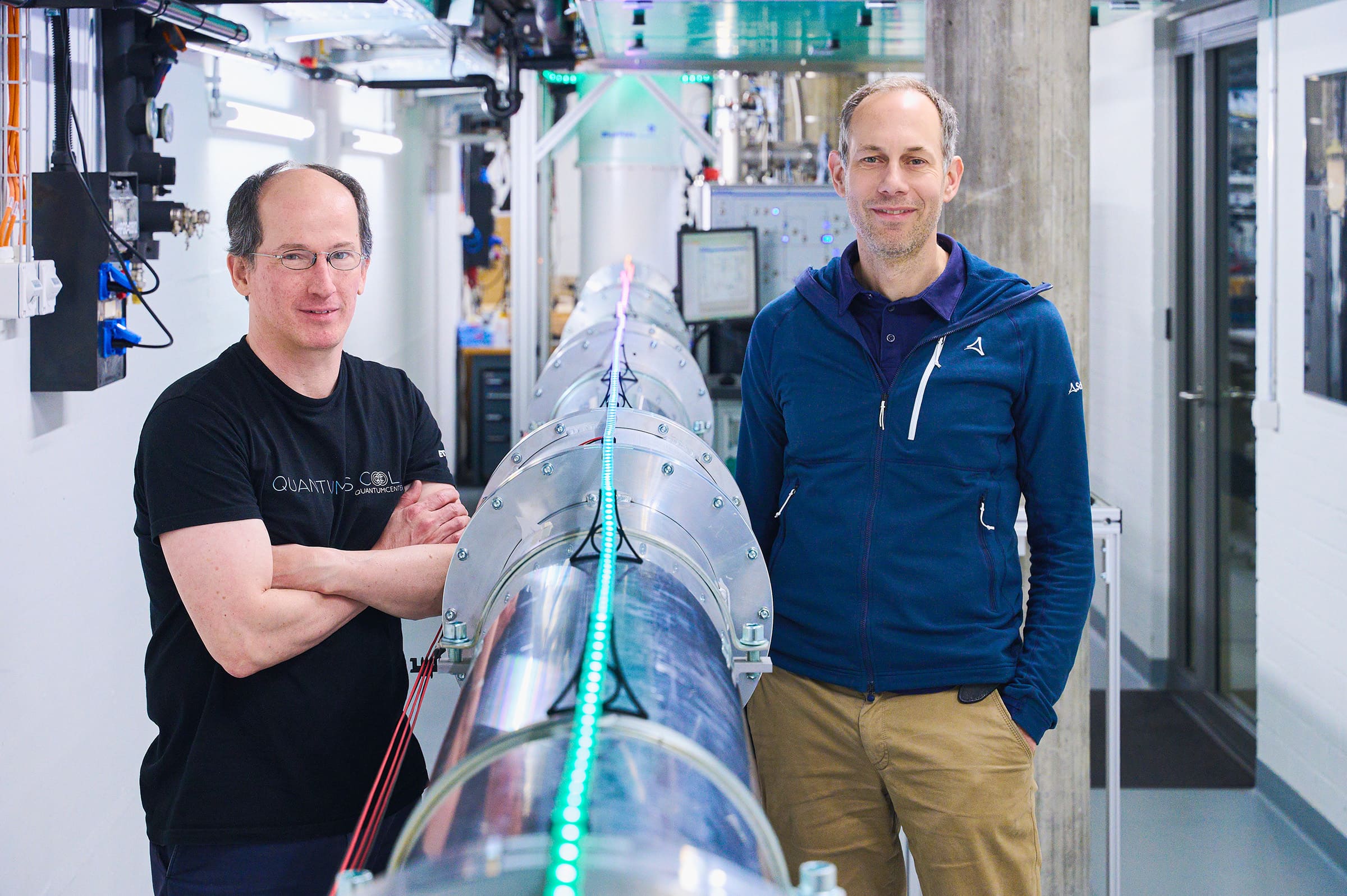
- Andreas Wallraff and Renato Renner (f.l.t.r.) next to the 30-meter link connecting two quantum chips. Using this experiment, ETH researchers generated certified perfect randomness for the first time. (Kilian Kessler / ETH Zurich)
PRESS RELEASE — Creating perfect randomness is surprisingly difficult. Even modern random number generators never generate completely ideal random numbers: small systematic errors can result in some numbers appearing slightly more frequently than others. For many applications, this does not matter. In cryptography, however, even the tiniest deviations can be problematic.
Now, researchers at ETH Zurich led by Renato Renner and Andreas Wallraff in the Department of Physics have demonstrated how perfect randomness can actually be created using quantum physics. Their results, which they have just published in the scientific journal Nature, represent a milestone in this area of research.
Amplification of randomness through quantum measurements
“It may seem strange, but it is almost impossible to create a perfect coin or a perfect die”, says Renner. No matter how symmetric and smooth a die is made, after a roll one of its six faces will always point upwards slightly more often. “Even modern random number generators, which are based on quantum mechanical effects like the reflection of photons from beam splitters, are not entirely immune to such a systematic error or ‘bias’”, adds Wallraff. But now Wallraff’s and Renner’s teams have found a way to take imperfect randomness and still extract perfectly random numbers from it. They call their method randomness amplification.

“This was made possible by an improved so-called Bell-Test with simultaneously high quality and high data rate”, says Wallraff. He and his coworkers use a complex setup that consists of two superconducting chips, which they cool down to very low temperatures close to absolute zero. Each chip represents a quantum bit or qubit, which can take on the states “0” or “1” or any arbitrary superposition of these states. A 30-meter-long tube, which is also cooled down, connects the two chips. Microwave photons can fly back and forth between them, thus creating quantum mechanical entanglement. This means that a quantum measurement on one qubit, which randomly yields the values “0” or “1”, influences automatically and at a distance whether “0” or “1” is measured on the second qubit. The separation of 30 meters ensures that, during the measurement, even at the speed of light no information can be exchanged between the qubits. This would disturb the perfect randomness.
Random for all eternity
Wallraff and his team made the choice of the exact type of measurement (or “measurement basis” in technical jargon) on the two qubits depend on an imperfect random number generator. Renner’s coworkers could then amplify the randomness of the measurement results further using a special algorithm. “The resulting sequence of zeros and ones is now really perfectly random, and we can even certify that”, says Renner. He likens this result to crossing a ridge: “The technical improvements allowed us, for the first time, to create random numbers that will remain perfectly random for all eternity – no matter what analytical methods are used to assess their randomness.”
An atomic clock for randomness
In the long term, this work could play a similar role in digital security as atomic clocks do for timekeeping: a physically certified source of randomness that other systems can rely on. Possible applications range from the encryption of sensitive communications and digital identities to public randomness services for lotteries and blockchain applications.
Such methods could also become crucial for quantum-secure communications systems. This is because even the strongest cryptographic methods are only as secure as the random numbers on which they are based: the better the randomness, the more robust the encryption – if it is weak, the entire system becomes vulnerable.