

Insider Brief
- PsiQuantum signed a Letter of Intent with the U.S. Department of Commerce for $100 million in proposed CHIPS Act incentives to support domestic manufacturing and scaling of photonic quantum computing technologies.
- The proposed funding would support development of key quantum and semiconductor components, including barium titanate optical switches, high-temperature single-photon detectors, and advanced packaging technologies designed for utility-scale fault-tolerant quantum systems.
- GlobalFoundries said it is continuing its long-running partnership with PsiQuantum on silicon photonics and advanced packaging, as the company expands U.S. quantum infrastructure projects and collaborations with agencies including DARPA and the Air Force Research Laboratory.
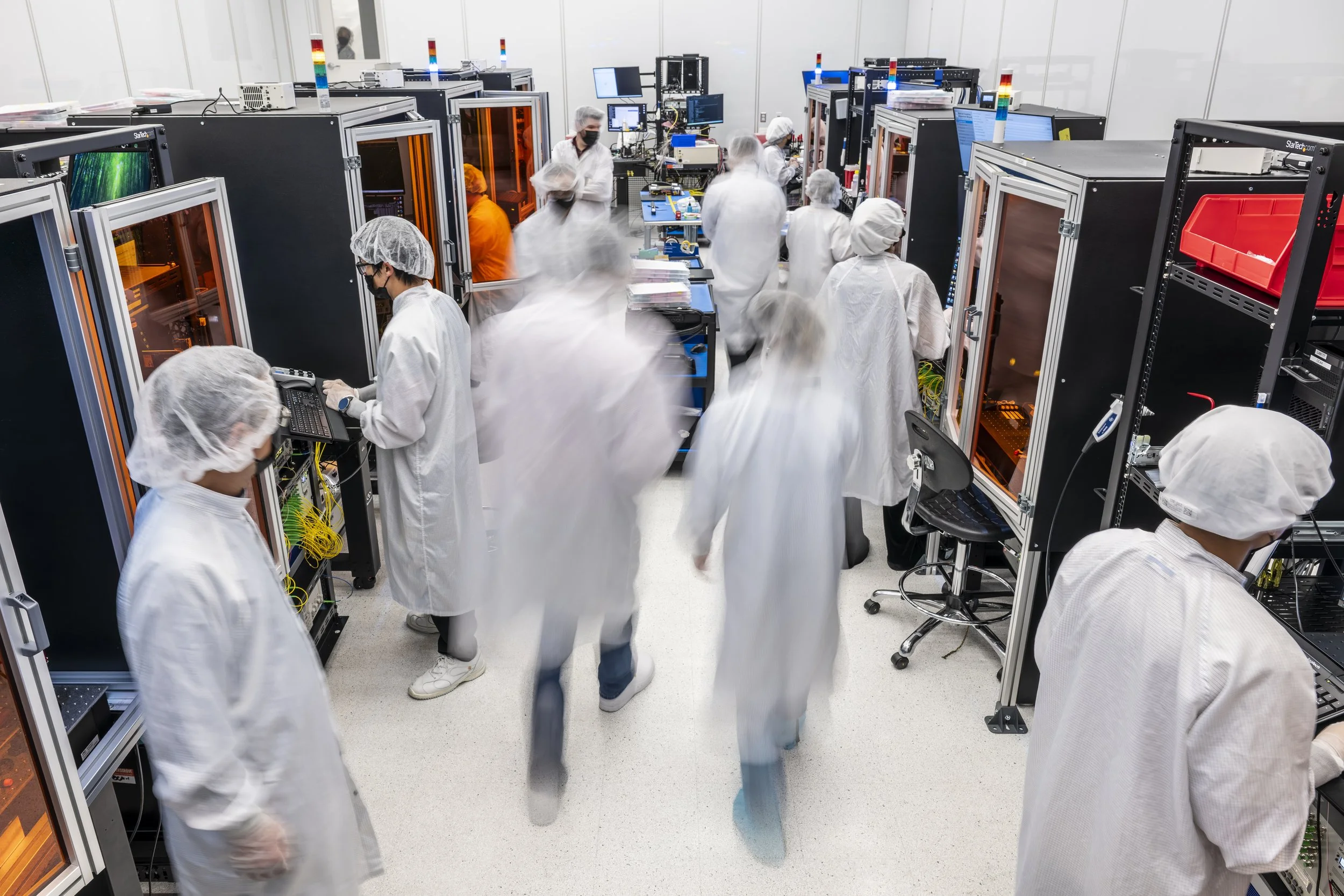
- Image: PsiQuantum personnel inside the fiber attach assembly facility at PsiFactory in Milpitas, California. PsiQuantum’s chip-to-fiber coupling technology performs beyond-state-of-the-art, and the company’s future partnership with the Department of Commerce will enable the company to accelerate its advanced packaging technology. (Credit: PsiQuantum)
PRESS RELEASE — PsiQuantum announced today that the company has signed a Letter of Intent with the U.S. Department of Commerce for $100 million in proposed federal incentives under the CHIPS and Science Act to advance American quantum computing and semiconductor leadership.
With these potential incentives, combined with co-investment by the company, PsiQuantum will accelerate the domestic manufacturability and performance of critical components for utility-scale quantum computing and the American semiconductor industry, including Barium Titanate (BTO) for higher-performance optical switches, high-temperature single-photon detectors, and advanced packaging approaches.
“Strong technology supply chains are essential for American security and prosperity,” said Victor Peng, Interim Chief Executive Officer of PsiQuantum. “PsiQuantum’s world-leading capability in photonics will help write the next chapter in the history of computing. Thanks to bold action from Washington, our company will continue to invest in manufacturing these cutting-edge components right here in the United States.”

“With today’s CHIPS Research and Development investments in quantum computing, the Trump administration is leading the world into a new era of American innovation,” said Secretary of Commerce Howard Lutnick. “These strategic quantum technology investments will build on our domestic industry, creating thousands of high-paying American jobs while advancing American quantum capabilities.”
“The Department of Commerce’s incentives strengthen and accelerate U.S. quantum leadership and technological resilience,” said Bill Frauenhofer, Executive Director of Semiconductor Investment and Innovation. “Quantum computing has significant implications for national defense, advanced materials and biopharmaceutical discovery, financial modeling and energy systems.”
Scaling PsiQuantum Innovations for the Semiconductor and Computing Industries
PsiQuantum’s new engagement with the Department of Commerce reflects the transformative potential of the company’s innovations in high-performance optical switching, photon detection, and advanced packaging for the American technology stack. The company’s approach to building fault-tolerant quantum computers leverages existing semiconductor manufacturing to rapidly scale its silicon photonics platform, resulting in new breakthroughs that will also strengthen the American semiconductor industry.
“The semiconductor industry helped make PsiQuantum’s path to fault-tolerant quantum computing possible, and now PsiQuantum’s scalable breakthroughs in silicon photonics will in turn create new possibilities for the future of computing,” said Dr. Pete Shadbolt, Co-Founder and Chief Scientific Officer of PsiQuantum. “Our new engagement with the Commerce Department builds on years of collaboration across the U.S. government, and Washington is playing an historically consequential role in helping deliver this emerging technology.”
Investing and Building in America, Partnering Closely with Washington
New potential incentives from the U.S. government would augment PsiQuantum’s major existing investments in America’s quantum and semiconductor supply chains. PsiQuantum’s supply chain is anchored in the United States, and in 2025 the company invested approximately $200 million with hundreds of American suppliers and vendors across 38 states. Leading semiconductor manufacturer GlobalFoundries has partnered with the company on scaling PsiQuantum’s quantum photonic chipset production since 2019.
“GlobalFoundries is excited to partner with PsiQuantum to accelerate photonic quantum computing. Building on our long-standing collaboration, GF’s capabilities in silicon photonics, advanced packaging and system-level integration, combined with PsiQuantum’s proven leadership in photonic architectures, will accelerate the scalable semiconductor foundation needed to enable next-generation quantum systems,” said Tim Breen, Chief Executive Officer of GlobalFoundries.
Today’s announcement comes as PsiQuantum partners closely with the U.S. government to validate the company’s path to utility-scale quantum computing, advance potential quantum applications across a range of critical industries, develop utility-scale quantum infrastructure, and leverage cutting-edge technology dividends. In 2025, the company advanced to the final stage of the Defense Advanced Research Projects Agency’s (DARPA) Quantum Benchmarking Initiative (QBI) and broke ground on America’s largest quantum computing infrastructure project at the Illinois Quantum and Microelectronics Park in Chicago. Since 2022, PsiQuantum has partnered with the Air Force Research Laboratory (AFRL) in Rome, New York, and the latest phase of their partnership will integrate the company’s high-performance BTO electro-switch material into AFRL-designed optical circuits.





.png)