Nord Quantique Reaches $1.4 Billion Valuation in Fidelity-Backed Financing



Insider Brief
- Nord Quantique reportedly raised $30 million in a Fidelity-led financing that valued the Canadian quantum computing company at about $1.4 billion, according to The Globe and Mail.
- The financing makes Nord Quantique one of several Canadian-founded quantum companies to achieve a billion-dollar valuation alongside D-Wave Quantum, Xanadu and Photonic.
- Nord Quantique is pursuing a hardware-level quantum error correction approach designed to reduce the size, complexity and energy demands of quantum computing systems.
Another Canadian Q-unicorn has been spotted.
Canadian quantum startup Nord Quantique has reached a valuation of roughly US$1.4 billion after a quiet financing round led by investment giant Fidelity Investments, according to a report by The Globe and Mail. It’s yet another morsel for the growing investor appetite for companies working to build commercially useful quantum computers.
The Globe and Mail reported that the Sherbrooke, Que.-based company raised US$30 million in March in a deal led by Fidelity, with sources telling the newspaper the investment could eventually become the anchor for a larger financing round.

The newspaper reported that the financing places Nord Quantique among a small but growing group of Canadian-founded quantum companies to surpass billion-dollar valuations. The list includes D-Wave Quantum, Xanadu and Photonic. According to The Globe and Mail, Photonic this week announced the closing of a US$200 million financing that valued the company at US$2 billion, while Xanadu entered public markets earlier this year through a merger with a special purpose acquisition company, or SPAC.
The report highlights Canada’s increasingly visible role in the global quantum computing race. Quantum computers aim to solve certain classes of problems beyond the reach of classical machines by exploiting the unusual behavior of subatomic particles. Researchers and companies say the technology could eventually improve areas such as financial modeling, artificial intelligence, logistics optimization, drug development and advanced materials research.
Commercially viable quantum computing, however, remains elusive.
Quantum systems rely on quantum bits, or qubits, which can exist in multiple states at the same time. That property could allow quantum machines to process some calculations far more efficiently than today’s computers. But qubits are notoriously unstable and highly sensitive to noise, vibration and heat. The Globe and Mail reported that most systems require large cryogenic setups operating at temperatures colder than outer space to maintain stability.
One of the industry’s largest technical hurdles is error correction. Quantum errors occur frequently because qubits can lose their fragile quantum state during computation. Many quantum architectures attempt to solve this problem by using large numbers of physical qubits to create smaller numbers of more reliable “logical” qubits.
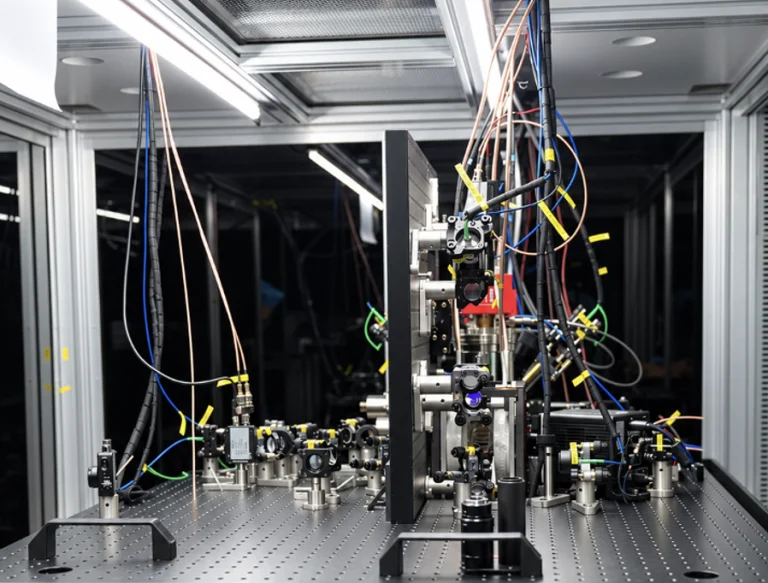
According to The Globe and Mail, Nord Quantique is pursuing a different approach by correcting errors directly at the hardware level using a system that manipulates microwaves inside a supercooled cavity.
The newspaper reported that the approach could reduce the total number of qubits and supporting hardware needed to operate a machine. If successful, the system could make quantum computers smaller, cheaper and more energy efficient than competing architectures. According to the report, the company has also argued that its machines could fit more easily inside conventional data centers rather than requiring massive specialized infrastructure.
Nord Quantique emerged from Université de Sherbrooke’s Institut Quantique in 2020 under the leadership of physicist Julien Camirand Lemyre. The Globe and Mail reported that Sherbrooke has become one of Canada’s main quantum technology hubs, helped by academic research programs and a nearby semiconductor manufacturing corridor. The region has also produced other quantum startups, including SBQuantum and Qubic Technologies.
The financing comes as governments increase support for quantum technologies amid both economic and national security concerns.
According to The Globe and Mail, Nord Quantique is among 11 companies selected for the second phase of a competition run by the U.S. Defense Advanced Research Projects Agency, or DARPA, which aims to accelerate development of a utility-scale quantum computer by 2033. The newspaper reported that participants advancing through the program could ultimately receive as much as US$300 million from DARPA.
The Globe and Mail also reported that Canada has pledged up to $23 million for each Canadian participant in the DARPA effort, matching funding already secured through the U.S. program.
Governments and financial institutions are also increasingly concerned about the cybersecurity implications of quantum computing. According to the newspaper, large-scale quantum systems could eventually break widely used encryption standards that currently secure banking systems, communications networks and government infrastructure. That possibility has accelerated efforts to develop quantum-safe cryptography.
Fidelity has previously backed several quantum ventures, including investments tied to D-Wave and a major financing round for Quantinuum, the Honeywell spinout focused on trapped-ion quantum systems.
Despite its new valuation, Nord Quantique has raised comparatively modest amounts of capital versus many rivals. According to The Globe and Mail, the company has secured less than US$100 million in total financing to date, while several competitors have raised hundreds of millions of dollars.

Keep track of everything going on in the Quantum Technology Market. In one place.
Topics

Matt Swayne
With a several-decades long background in journalism and communications, Matt Swayne has worked as a science communicator for an R1 university for more than 12 years, specializing in translating high tech and deep tech for the general audience. He has served as a writer, editor and analyst at The Quantum Insider since its inception. In addition to his service as a science communicator, Matt also develops courses to improve the media and communications skills of scientists and has taught courses.
[email protected]

Stay Ahead of Quantum
Get the latest research, company news, and market intelligence every week.
MENTIONED IN THE ARTICLE

Nord Quantique
Nord Quantique develops superconducting circuits that can mitigate errors on every individual qubit. The company aims to provide a faster pathway to fault-tolerant quantum computing.
→

D-Wave Quantum
D-Wave Quantum is a pioneering dual-platform quantum computing company that partners with aerospace organizations to solve complex logistical, defense, and satellite challenges. Founded in 1999, the company’s quantum annealing technology is utilized by industry leaders like Lockheed Martin to optimize aircraft networks, improve manufacturing efficiencies, and support critical national security initiatives.
→

Xanadu
Xanadu is a Canadian photonic quantum computing company founded in 2016 that is building fault tolerant systems utilizing light. The company collaborates with defense and hardware partners like AMD and Lockheed Martin to accelerate computational fluid dynamics simulations and train an aerospace engineering workforce.
→

SBQuantum
SBQuantum is a Sherbrooke-based company founded in 2017 that develops ultra-sensitive quantum diamond magnetometers tailored for space applications and GNSS-denied navigation. The company collaborates with agencies including NASA and the European Space Agency to deploy these sensors on satellites and high-altitude platforms for magnetic field mapping.
→

Qubic Technologies
Qubic Technologies develops microwave signal processors with superconducting quantum circuits for ultra-low-noise transmitters and receivers. Its systems support applications such as remote sensing, drone detection, and covert communications in challenging environments.
→

Defense Advanced Research Projects Agency (DARPA)
The Defense Advanced Research Projects Agency (DARPA) is an independent research and development agency within the U.S. Department of Defense (DoD) established in 1958 to prevent and create strategic technological surprises for national security. Operating with a relatively small staff of program managers who are empowered to take high-risk, high-reward approaches, DARPA functions by funding cutting-edge research in academia, industry, and government laboratories rather than conducting research in-house. Its mission focuses on creating revolutionary technologies—such as the Internet (ARPANET), stealth technology, GPS, and mRNA vaccine platforms—that transition into practical military and civilian applications. DARPA programs are typically finite in duration and demand transformational breakthroughs rather than incremental improvements, positioning the U.S. at the forefront of technological innovation.
→

Quantinuum
Quantinuum builds full-stack quantum computing solutions for practical deployment. Leveraging proprietary enhancements to trapped-ion QCCD architecture, the company has launched multiple commercial hardware generations that deliver leading two-qubit gate fidelity and industry-topping accuracy.
→

Honeywell
Honeywell Aerospace, founded in 1906, is a global company focused on aviation technology, with hardware and avionics utilized on nearly all commercial and military aircraft. The division specializes in designing and manufacturing advanced aircraft engines, flight decks, satellite communications, and auxiliary power systems.
→