

Insider Brief
- University of Vienna-led researchers extended magnon lifetimes to 18 microseconds—about 100 times longer than previous limits—significantly improving their viability for quantum computing and metrology.
- The team showed that magnon lifetimes are constrained by material purity rather than fundamental physics, with ultra-pure yttrium iron garnet and low temperatures enabling the improvement.
- The results position magnons as potential long-lived quantum information carriers that could act as on-chip quantum buses and connectors in hybrid quantum systems.
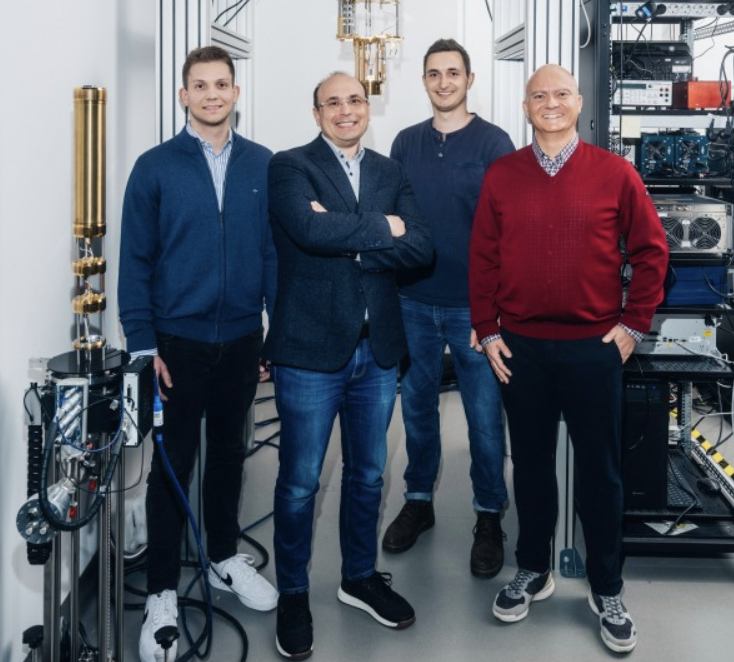
PRESS RELEASE — Magnons are tiny waves in magnetisation and ideal building blocks for hybrid quantum systems and quantum metrology. However, their previously too-short lifetime of at most a few hundred nanoseconds has been a hurdle. An international team of physicists led by Andrii Chumak from the University of Vienna has now succeeded in extending this lifetime a hundredfold to up to 18 microseconds – paving the way for a quantum computer the size of a 1-cent coin. The scientists have also made the crucial discovery that it is not a fundamental law of physics that governs the lifetime of magnons, but rather a question of materials. The study has recently been published in the prestigious journal Science Advances.
Magnons are tiny waves in magnetisation that travel through solid magnetic materials, much like the ripples that spread across a pond when a stone is thrown into it. Unlike photons, which travel through empty space or optical fibres, magnons propagate within a magnetic solid. Their wavelengths can be reduced to the nanometre range, meaning that magnonic circuits could, in principle, fit onto a chip no larger than those found in today’s smartphones. Furthermore, as an excitation of a solid, a magnon naturally couples to numerous other fundamental quasi-particles – phonons, photons and others – making it an ideal building block for hybrid quantum systems and quantum metrology.
Until now, there has been one major obstacle: magnons had a very short lifetime. This lifetime – the period during which they can reliably carry quantum information – was limited to a few hundred nanoseconds at best. Far too short for any practical quantum computation. The team led by Wiener has now achieved a breakthrough: The physicists were able to measure magnon lifetimes of up to 18 microseconds – almost a hundred times longer than any value observed to date. In this state, magnons are no longer fleeting signals, but become long-lived, reliable carriers of quantum information, comparable to the superconducting qubits used in today’s leading quantum processors.

The key to this breakthrough was a combination of two ideas. Firstly, instead of conventional uniform magnons, the team excited short-wavelength magnons, which are inherently insensitive to surface defects in the crystal – precisely the defects that had limited the lifetimes in all previous experiments. Secondly, the researchers cooled ultra-pure spheres of yttrium iron garnet (YIG) in a mixed-phase cryostat to just 30 millikelvin – a fraction of a degree above absolute zero. At this extreme cold, all thermal processes that typically destroy magnons effectively freeze.
Crucially, the team was able to show that the remaining limit on the magnon lifetime is not determined by a fundamental law of nature, but by minute trace impurities in the crystal. Three spheres of varying purity were tested, and the result was clear: the purer the material, the longer the magnon survives. Even the least pure sample surpassed all previous records. This means that further progress is a matter of materials science – not the discovery of new physics – and the path ahead is wide open.
What this means for quantum technology
With lifetimes of 18 microseconds, magnons transform from lossy intermediate links into robust quantum memories and low-loss communication links on a chip. They could connect hundreds of qubits along a shared path – a long-awaited ‘quantum bus’ that would be a missing building block for scalable quantum computers. Because magnons reside in a solid state and couple to many different quantum systems, they could serve as universal translators in hybrid quantum architectures, linking technologies that would otherwise be unable to communicate with one another.
The study is based on an experiment conducted by Rostyslav Serha as part of his doctoral thesis. The study was carried out under the leadership of the University of Vienna in collaboration with the University of Colorado, Colorado Springs, and institutions in Germany, the USA and Ukraine. The work of author Kaitlin McAllister was made possible by the Vienna Doctoral School in Physics, which offers internships to outstanding Master’s students from around the world.