

Insider Brief
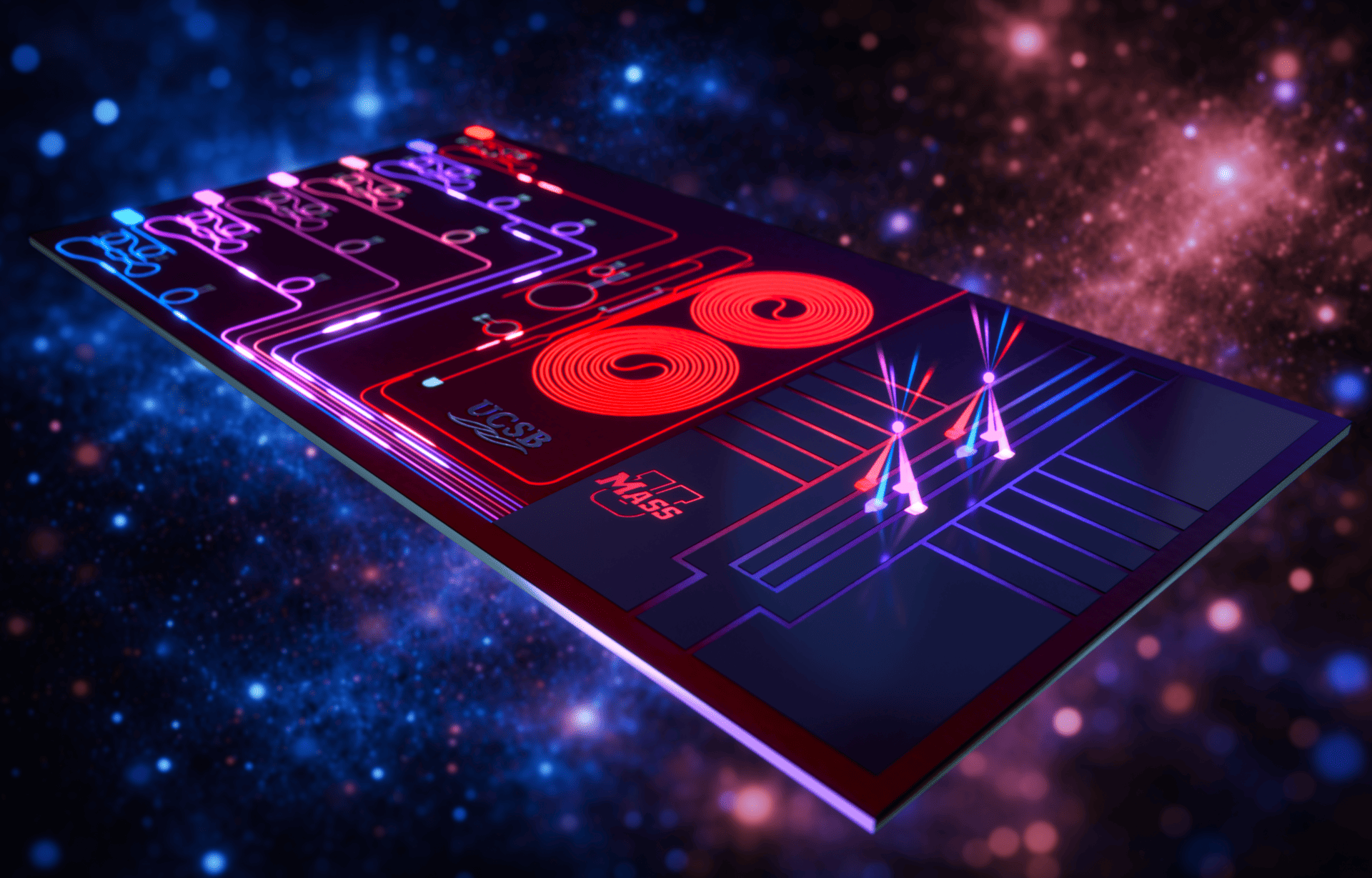
- Researchers at the University of Massachusetts Amherst and the University of California Santa Barbara demonstrated chip-scale laser and ion-trap components that could significantly shrink quantum computing hardware.
- The study shows that large, complex optical systems used to control trapped-ion qubits can be replaced with integrated photonic chips while maintaining high-fidelity operations.
- The work marks an early step toward scalable and portable quantum systems, with future efforts aimed at fully integrating all components into a single chip.
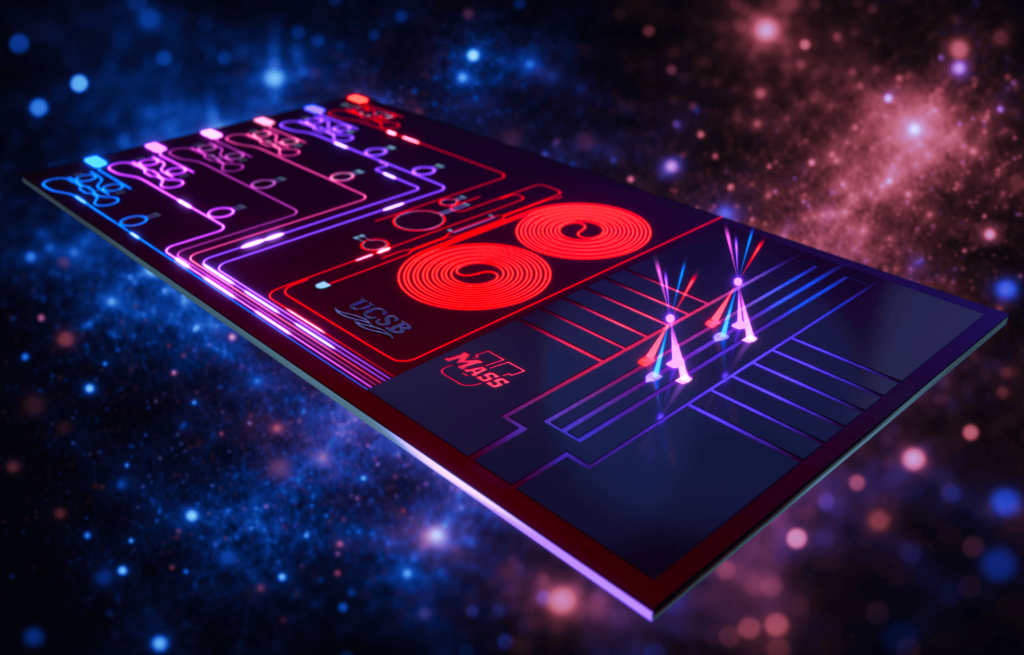
- Image: UMass Amherst
PRESS RELEASE — Scientists in the Riccio College of Engineering at the University of Massachusetts Amherst and the University of California Santa Barbara have demonstrated key laser and ion trap components necessary to help drastically shrink the size of quantum computers, an achievement aligned with the shrinking of integrated microprocessors in the 1970s, 80s and 90s that allowed computers to move from room-sized behemoths to today’s ultrathin smartphones.
The current state-of-the-art technology for quantum computing is too large and complex to scale and too sensitive and bulky to be portable. The largest and most sensitive components of these quantum systems are the optics, which include multiple lasers and vibration-isolated, temperature-controlled vacuum chambers that contain ultrastable optical cavities. These cavities stabilize the lasers to extremely high precision in order to control trapped ions for quantum computing and optical clocks.
In a new paper, the researchers demonstrate key stabilized laser pieces necessary for an integrated quantum computing system-on-a-chip with the potential to shrink portions of quantum computing hardware from the size of a room to the chip-scale the size of a deck of cards. This is a critical first step towards the scalability of quantum computing and an opportunity to make optical clocks (which are based on the same trapped-ion technology) portable.

“If you want scalability or portability with quantum technology, you need the laser systems to all be on chip too,” says Robert Niffenegger, assistant professor of electrical and computer engineering. “We could have millions of qubits on one chip in a way that is not possible if you needed rooms full of lasers and optics. If you’re serious about getting to that scale, you have to look at how traditional computers have scaled through integration. That’s the vision we’re following.”
In quantum computers, these trapped ion systems serve as “qubits,” which perform the analogous function to traditional computing bits of storing and processing data, but do so based on the rules of quantum physics, not binary 0’s and 1s. Optical clocks keep time by counting oscillations of visible light and verifying that frequency with the atomic transitions of trapped ions, resulting in unprecedented precision for applications such as mapping Earth’s gravitational field to centimeter-level accuracy and enhancing deep space navigation and GPS systems.
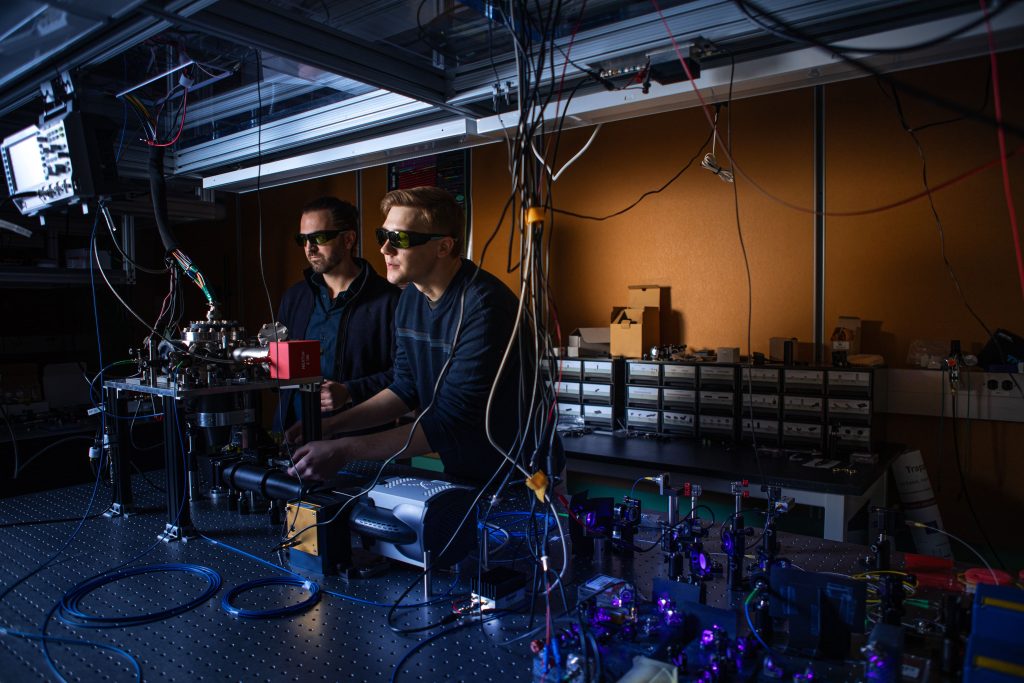
Working with collaborators at the University of California Santa Barbara led by Professor Daniel Blumenthal, the team demonstrated, for the first time, that these large precision lasers can be replaced with small photonic chips. They show that this new photonic technology can be used to control trapped ions to perform qubit and clock operations.
They tested how their design performs key quantum operations, including preparing a qubit’s quantum state. Their results show the system already achieves the high-fidelity qubit state preparation and measurement required for quantum computing, while further improvements will enable applications in quantum sensing. Their full findings are published in Nature Communications.
“We haven’t matched state-of-the-art clock performance yet, but we really went pretty far in the very first go and have made even more progress since,” Niffenegger adds.
Long-term, he says this design is a critical first step for creating functional large-scale quantum computers capable of solving problems too complex for today’s supercomputers, such as deciphering the encryption that secures much of the world’s sensitive data. Many experts estimate that such applications could require millions of qubits.
“To build something truly useful, something beyond what a traditional supercomputer can do, you’re going to need an integrated quantum system on a chip,” Niffenegger says. “You can’t have football fields full of lasers and optics. It’s just not going to work. Integration is the only viable path.”
In the near term, Niffenegger sees this new technology as an opportunity to push forward the portability of optical clocks. By shrinking the laser and cavity onto photonic chips, optical clocks could become far more compact and robust, enabling them to go to places they’ve never gone before, like outer space.
“This is really the only way to get a precision optical clock into space,” Niffenegger says. “It could allow new tests of fundamental physics.”
For instance, he imagines testing the fundamental constants of nature by having an optical clock do an elliptical orbit around the sun to see if there is any variation at different distances. “Right now, because our system is smaller and more robust to vibrations, it would already be the best optical clock that you could put it in space,” he adds.
A major technical challenge was maintaining laser stability without the bulky isolation systems used in conventional optical cavities. “We don’t have that luxury when we’re using this chip,” says Niffenegger. “And that’s by design. If we were going to say this is a portable, integrated solution, it has to be rugged. It’s still temperature-controlled, but it’s not in a vacuum.” Instead, they developed a method to actively compensate for drift by intertwining calibrations with experiments.
“It did feel like wrangling a bull,” he adds. “The clock is just running away, and you’re trying to catch it with a very, very precise atomic clock, and then to not only catch it, but keep it locked as it’s moving away.”
The next goal is full integration, combining the ion trap chip, the laser chip, the optical cavity chip, and other photonics onto a single chip. “Now that we’ve shown precision quantum operations are possible with integrated photonics,” Niffenegger says,” the next step is bringing everything together into one unified quantum system-on-a-chip.”
This work was funded by a CAREER Award to Niffenegger from the U.S. National Science Foundation.