


Insider Brief
- Researchers led by Simon Cornish at Durham University will lead a UK research program to develop advanced quantum simulators using ultracold polar molecules.
- The project will involve collaborations with University of Birmingham, Imperial College London, and King’s College London to study complex quantum many-body phenomena that are difficult for classical computers to model.
- The £9.99 million program will build experimental platforms including optical tweezer arrays, quantum-gas microscopy systems, and molecular Bose–Einstein condensate experiments to explore new quantum materials and interactions.
PRESS RELEASE — The national programme, led by Professor Simon Cornish from the Department of Physics, will allow UK scientists to build some of the world’s most advanced quantum simulators. These devices will be capable of explaining some of the greatest mysteries in modern physics.
Controlling quantum matter molecule by molecule
Professor Cornish, working alongside fellow researchers at Durham and collaborators at Birmingham University, Imperial College London and King’s College London, will develop and study systems of ultracold polar molecules. These are a special type of quantum matter that exhibits long-range interactions between the constituents.
They will build artificial materials by arranging the molecules into ordered arrays, controlling every single element of the experiment, including the quantum state of each molecule and how strongly molecules interact with one another.

Using these materials, the researchers will study the novel quantum properties that emerge when many molecules are made to interact.
Such quantum many-body phenomena play an important role in many areas of science, from materials and nuclear physics to chemistry and even biological processes. Yet they remain poorly understood because their behaviour is too complex for classical computers to model.
A multi‑platform quantum research programme
The funding will support several cutting-edge experimental platforms, allowing the team to explore quantum science in new and powerful ways.
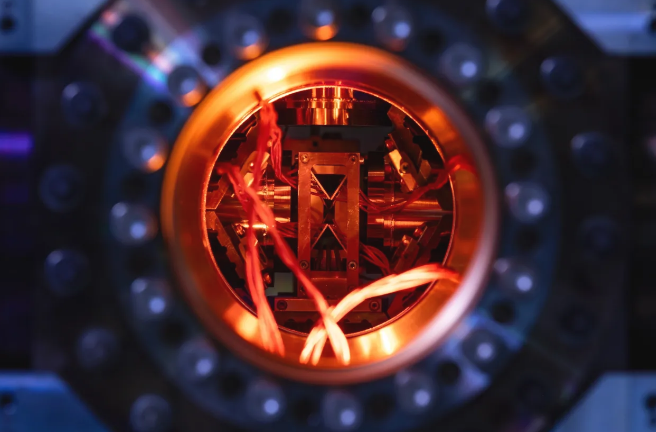
The team will build arrays of ‘optical tweezers’ – beams of light that hold and move single molecules. These tweezers allow researchers to arrange molecules into custom shapes and study their behaviour with fine detail.
The researchers will also create larger molecular systems confined in lattice structures engineered using laser light. Here they will use ‘quantum-gas microscopy’ to look at individual molecules inside the lattice. This technology, only recently extended to molecules, will allow scientists to watch the quantum processes unfold in real time.
The funding will also support the creation of molecular Bose–Einstein condensates with strong dipolar interactions – novel quantum fluids that are only just beginning to be understood.
A quantum leap for the UK
With the £9,987,529 funding package, the team will develop some of the most capable and versatile quantum simulation platforms in the world.
These new systems will act as highly advanced quantum laboratories, helping researchers explore phenomena far beyond the reach of classical computing.
The research programme is more than support for a single project – it opens entirely new ways to explore the universe at its deepest quantum level.