



Insider Brief
- Researchers at Quantinuum and collaborators demonstrated quantum computations using up to 94 protected logical qubits, showing that encoded qubits can outperform unprotected hardware operations on a trapped-ion quantum processor.
- The study reports logical gate error rates of roughly one error in ten thousand operations, significantly lower than the processor’s raw hardware gate errors.
- The team also used the encoded qubits to run benchmark tests including large entangled states and a simulation of a quantum magnetic system, illustrating how error-protected qubits could enable larger and more reliable quantum computations.
- Photo by Merlin Lightpainting on Pexels
Quantum computers must eventually learn to correct their own errors before they can tackle practical problems. A new study on the pre-print server arXiv reports a significant step toward the goal of performing quantum computations using dozens of error-protected logical qubits that outperform operations on unprotected hardware.
In experiments on a trapped-ion quantum processor, Quantinuum researchers demonstrated quantum calculations involving up to 94 logical qubits — or, units of quantum information protected by error-detection codes. According to the study, the encoded computations achieved “beyond break-even” performance, meaning that protecting the qubits improved the accuracy of the computation instead of making it worse.
The work suggests that modern quantum hardware is beginning to reach a point where error-corrected quantum computing can scale beyond small laboratory demonstrations.

“In our latest paper, we’ve taken a big step toward large scale fault-tolerant quantum computing, squeezing up to 94 error-detected qubits (and 48 error-corrected qubits) out of just 98 physical qubits, a low-fat encoding that cuts overhead to the bone,” the researchers report in a blog post. “With 64 of our logical qubits, we were able to simulate quantum magnetism at a scale that can be exceedingly difficult for classical computers.”
Quantum computers promise to solve certain problems that overwhelm conventional computers, including simulations of complex molecules and materials. They rely on qubits — quantum bits — that can exist in superpositions of states and become entangled with one another.
But these fragile quantum states are easily disrupted. Interactions with the environment, imperfect hardware, and stray electromagnetic noise can introduce errors that quickly accumulate during a calculation.
To address this, researchers use quantum error correction, a technique that spreads the information of a logical qubit across multiple physical qubits. If some of those qubits experience errors, the system can detect and sometimes correct the mistake without destroying the quantum information.
The problem is that error correction itself introduces overhead. Encoding qubits requires additional operations and extra hardware, which can create more opportunities for errors.
“An unofficial law of physics is ‘there’s no such thing as a free lunch’,” the researchers write in a blog post. “Creating high quality, low error-rate logical qubits often costs many physical qubits, thus reducing the size of calculations you can run, despite your new, lower-than-ever error rates.”
Most early experiments with quantum error correction, in fact, produced worse results than running the same circuits without protection. However, the new study reports experiments that cross that threshold.
According to the researchers, their encoded operations produced better performance than the underlying physical hardware, a milestone that scientists typically refer to as break-even or beyond break-even performance.
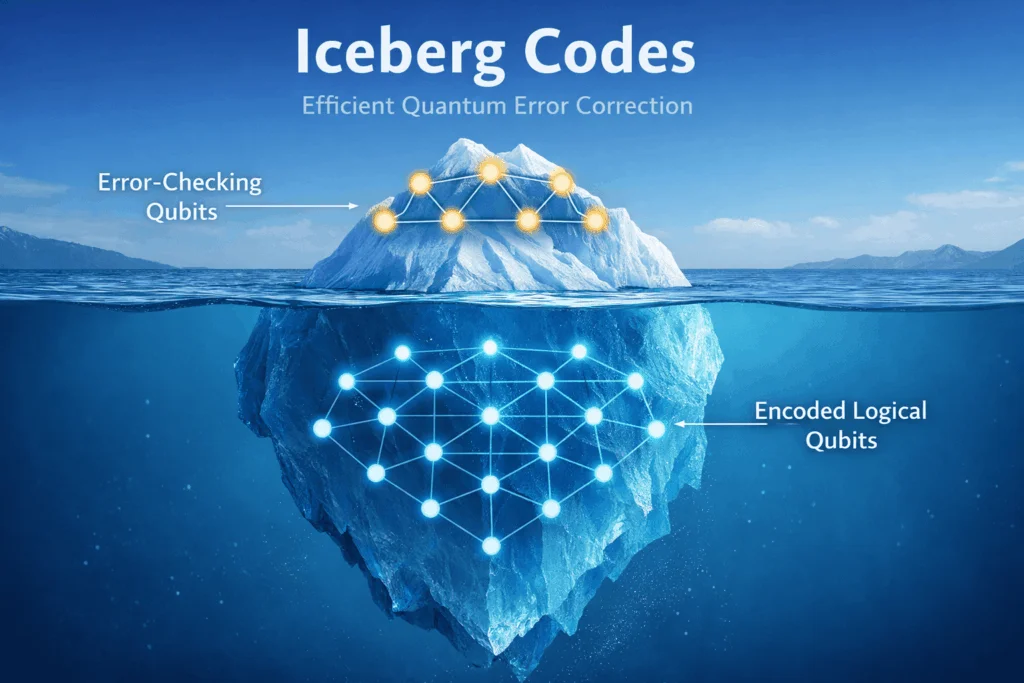
What Are Iceberg Codes and How Do They Work?
The team implemented a family of error-detection and error-correction schemes known as iceberg codes.
Iceberg codes are named for their structure, where many logical qubits sit beneath a small error-checking layer, just like most of an iceberg is hidden below the waterline. These codes are designed to be efficient. In many traditional quantum error-correcting codes, each logical qubit may require dozens or even hundreds of physical qubits. Iceberg codes take a different approach, allowing many logical qubits to be encoded using only a small number of additional physical qubits.
In its simplest form, the method protects many qubits using only two additional qubits that monitor the system for errors.
The researchers also used a technique called concatenation, which stacks multiple codes on top of one another. Doing so increases the code’s ability to detect and correct errors.
Using these techniques on Quantinuum’s Helios trapped-ion quantum processor, the team carried out experiments with:
- up to 94 logical qubits using error-detection codes
- up to 48 logical qubits using concatenated error-correction codes
According to the study, several benchmarks showed that encoded logical operations were more reliable than their unencoded physical counterparts.
One key test involved preparing and measuring quantum states. The researchers report that logical states created using the encoded system had error rates at least an order of magnitude lower than the corresponding operations performed directly on physical qubits.
Benchmarking Logical Quantum Qates
Preparing quantum states is only one part of a useful quantum computer. The system must also apply gates — or, operations that manipulate qubits during a computation.
The researchers therefore tested the reliability of logical gates acting on the encoded qubits.
To measure performance, the team used a technique called cycle benchmarking, which repeatedly applies a sequence of gates and tracks how quickly errors accumulate.
According to the study, the resulting logical gate error rates were about about one error in ten thousand operations, significantly lower than the error rates of the physical two-qubit gates used by the processor. In other words, the encoded logical gates performed more accurately than the hardware gates that implemented them.
The team also tested the system’s ability to generate large entangled states known as GHZ states, which link many qubits into a single quantum state. GHZ states are widely used in quantum algorithms and error-correction protocols.
In experiments involving up to 94 logical qubits, the researchers observed logical GHZ states with fidelities of roughly 95 percent, indicating that large-scale entanglement could be preserved across the encoded system.
In some tests using those concatenated error-correction codes, the researchers report that no logical errors were observed across thousands of experimental runs.
To test whether the encoded qubits could support real computational tasks, the researchers performed a quantum simulation of a magnetic material.
The experiment modeled a system described by the XY model, a well-known mathematical description of interacting quantum spins that appears in condensed-matter physics.
The system represented a three-dimensional lattice of interacting spins, encoded into a block of logical qubits.
To measure accuracy, the researchers used a protocol known as mirror benchmarking, which runs a quantum circuit forward and then backward in time. If the system returns to its original state, the computation was accurate.
According to the study, encoding the system using iceberg codes reduced the effective error rate of two-qubit gates by roughly 30 percent compared with unencoded circuits.
The researchers report that simulations of large quantum spin systems can be difficult for classical computers, particularly when the systems involve many interacting particles and complex entanglement patterns.
Remaining Hurdles
Despite the promising results, the work does not yet represent fully fault-tolerant quantum computing.
Some of the techniques demonstrated fall into a category known as partially fault-tolerant computing. These methods improve performance on current hardware but may not scale indefinitely for very large circuits.
Th experiments also relied in part on postselection, meaning that runs in which errors were detected were discarded. While this approach is common in quantum experiments, it increases the number of repetitions required to obtain results.
Another limitation is hardware scale. When many of those qubits must be used for encoding and error detection, that leaves fewer logical qubits available for computation.
Nevertheless, the researchers said that the results show how error-corrected quantum computing could become practical even on near-term devices.
What Does Scalable Logical Quantum Computing Mean?
The study suggests several directions for future work.
One approach is to increase the distance of the error-correction codes — essentially making them stronger — by concatenating additional layers of encoding. Higher-distance codes can detect and correct more complex errors.
The researchers also point to opportunities to improve decoding algorithms, which determine how detected errors should be corrected.
Finally, they suggest that architectures with flexible connectivity — such as trapped-ion and neutral-atom systems — may be particularly well suited to codes like iceberg codes, which rely on interactions among widely separated qubits.
According to the researchers, advances in hardware, coding techniques, and control systems are rapidly bringing the field closer to fault-tolerant quantum computation, where large quantum algorithms could run reliably despite the inherent fragility of quantum systems.
“This is just the beginning: we are officially entering the era of large-scale logical computing,” the write. “The path to fault-tolerance is no longer just theoretical—it is being built, gate by gate, on Helios.”
Frequently Asked Questions
What did Quantinuum achieve in this quantum error correction experiment?
Quantinuum researchers demonstrated quantum computations using up to 94 error-protected logical qubits on a trapped-ion processor, achieving “beyond break-even” performance where encoded qubits outperformed unprotected hardware operations. Logical gate error rates reached approximately one error in ten thousand operations, significantly better than the processor’s raw physical gate errors.
What are iceberg codes and why are they significant for quantum error correction?
Iceberg codes are an efficient family of error-detection schemes where many logical qubits are protected using only a small number of additional monitoring qubits – in the simplest form, just two extra qubits monitor the entire system. Unlike traditional error-correcting codes that may require dozens or hundreds of physical qubits per logical qubit, this approach dramatically reduces overhead while still improving computation accuracy.
Why is “beyond break-even” performance considered a milestone in quantum computing?
Most early quantum error correction experiments actually produced worse results than running circuits without any protection, because the additional operations required for encoding introduced more errors than they fixed. Crossing the break-even threshold means error correction is now genuinely improving computation accuracy rather than degrading it, a prerequisite for scaling toward practical fault-tolerant quantum computing.
What real computational task did the researchers demonstrate with their logical qubits?
The team simulated a quantum magnetic material described by the XY model — a mathematical description of interacting quantum spins relevant to condensed-matter physics — using a three-dimensional lattice encoded in logical qubits. Using iceberg codes reduced the effective two-qubit gate error rate by roughly 30 percent compared to unencoded circuits for this task.
Does this research mean fault-tolerant quantum computing has been achieved?
No – while the results are significant, the work represents partially fault-tolerant computing rather than full fault tolerance. Key limitations include reliance on postselection that discards error-detected runs, hardware scale constraints, and encoding techniques that may not scale indefinitely for very large circuits.