


Insider Brief
- Researchers from Tohoku University, the Nara Institute of Science and Technology, and Vietnam National University developed a new method called compilation-based quantum process tomography (CQPT) to more efficiently characterize how quantum devices actually perform operations.
- The approach reconstructs unknown quantum processes by starting with a known input state, applying a trainable process after the unknown operation, and optimizing the system so the output returns to the original input using only a single measurement outcome per input state.
- The study, published in Advanced Quantum Technologies, demonstrates through theoretical analysis and simulations that CQPT could offer a scalable alternative to conventional quantum process tomography, with future work focused on experimental implementation and improved hardware robustness.
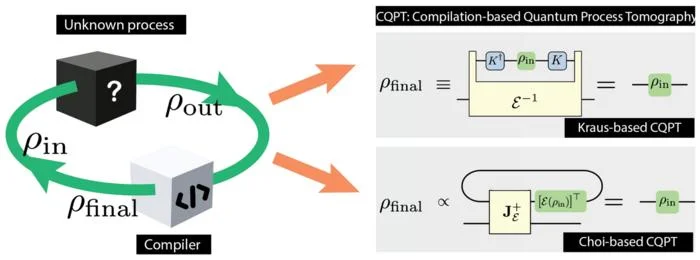
- Overview of compilation-based quantum process tomography (CQPT). (Le Bin Ho et al.)
PRESS RELEASE — Quantum computers work by applying quantum operations, such as quantum gates, to delicate quantum states. Ideally, quantum computers can solve complex equations at staggeringly fast speeds that vastly outpace regular computers. In real hardware, the operations of quantum computers often deviate from the ideal behavior because of device imperfections and unwanted noise from the environment. To build reliable quantum machines, researchers need a way to accurately determine what a quantum device is actually doing.
Quantum process tomography (QPT) is a standard method for this. However, traditional QPT becomes very costly as the system grows, because the number of required measurements and calculations increases rapidly with the number of qubits.
To address this challenge, a research team from Tohoku University, the Nara Institute of Science and Technology (NAIST), and the University of Information Technology (Vietnam National University, Ho Chi Minh City) has introduced a new framework called compilation-based quantum process tomography (CQPT).

The central idea of CQPT is simple. The method starts with a known input quantum state, applies a trainable process following the unknown process, and then works backwards to evaluate how well the final output returns to the original input. The “return-to-input” model is optimized to reconstruct the underlying quantum processes that make up the steps in-between the input and output. Importantly, the framework is designed so that optimization can conveniently be performed using only a single measurement outcome per input state.
The researchers developed two complementary versions of the CQPT: one based on Kraus operators, and one based on the Choi matrix. Together, these two approaches allow CQPT to handle a wide range of quantum operations and noisy processes relevant to modern quantum devices.
“Efficient and scalable methods for characterizing quantum processes are important for the future of quantum computing and quantum sensing,” Dr. Le Bin Ho said. “We need such methods to check whether quantum gates and circuits work correctly, identify hardware errors, calibrate devices, and support quantum error correction.”
Dr. Le believes that CQPT could become a practical alternative to standard quantum process tomography, especially for larger quantum systems where full tomography is no longer realistic due to high costs.
The current study demonstrates that CQPT is feasible through sound theoretical analysis and numerical simulations. The framework offers a promising way to make quantum tomography more efficient. Next steps will involve tackling the challenge of implementing it in real experiments. The researchers plan to focus on developing hardware-ready versions of the method and improving its robustness.
The findings were published in Advanced Quantum Technologies on February 26, 2026.