

Insider Brief
- Quantum Elements and collaborators report in Nature Communications a new method combining quantum error detection and dynamical decoupling that achieved record fidelities for entangled logical qubits on a superconducting quantum processor.
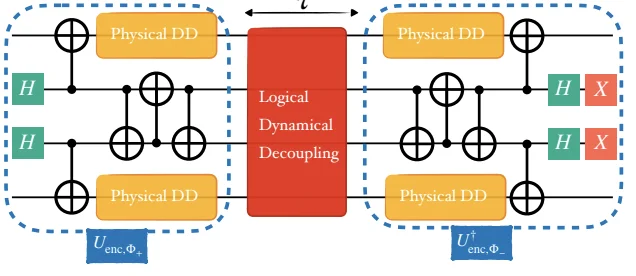
- The approach applies logical-level dynamical decoupling pulses within an error-detecting code, enabling suppression of both physical and logical errors and allowing encoded Bell states to outperform unencoded physical states on the same 127-qubit IBM device.
- Experiments produced logical Bell-state fidelities of 91–94% over the full measurement window and up to 98% for post-selected encoded states while using minimal additional hardware overhead.
PRESS RELEASE — Quantum Elements, a quantum software start-up based in Los Angeles, today announced the publication of research in Nature Communications demonstrating the highest fidelity of entangled, logical qubits on a superconducting quantum computer ever achieved with a new error detection and suppression approach.
In the peer-reviewed paper, Demonstration of high-fidelity entangled logical qubits using transmons,, researchers use a hybrid technique combining quantum error detection (QED) with a new form of dynamical decoupling. By using the normalizer elements of a standard QED code as logical-level decoupling pulses, the method directly identifies and suppresses both logical and physical errors, significantly boosting the fidelity of entangled logical qubits on a 127-qubit IBM superconducting processor.
Co-authors of the paper include scientists from Quantum Elements, USC’s Center for Quantum Information Science & Technology, IBM, and the Institute for Quantum Information of RWTH Aachen University in Germany.

“By integrating code-based dynamical decoupling directly into the logical layer, the research shows that we can suppress errors significantly more effectively than with physical techniques alone,” said co-author Daniel Lidar, holder of the Viterbi Professorship of Engineering at USC and co-founder and Chief Scientific Officer for Quantum Elements. “The method allows us to protect a pair of entangled logical qubits at record high fidelities on superconducting hardware, a potentially valuable step on the path to more reliable quantum computation at the error-corrected, logical level.”
A breakdown of key achievements from the research includes:
- First-ever experimental suppression of logical errors in a quantum error-detecting code using logical dynamical decoupling (LDD), a new technique applying carefully chosen logical-level operations to reduce error channels inaccessible to standard codes.
- ‘Beyond breakeven’ performance: Encoded logical Bell states maintain significantly higher fidelity over time than the best physical (unencoded) Bell pairs on the same hardware, even subject to physical-level dynamical decoupling.
- Long-duration high-fidelity logical entanglement: Average logical Bell state fidelities reach 91–94% over the full time window of each experiment.
- Record-setting encoded-state preparation: Post-selected encoded Bell-state fidelities reach 98%, exceeding previous transmon-based demonstrations (typically 79–93%).
- Hardware-efficient overhead: LDD uses a small, fixed set of logical pulse generators, enabling error suppression without adding qubits.
- Path toward scalable fault tolerance: Demonstrates a low-cost strategy for extending code performance without increasing code distance — keeping hardware overhead minimal while raising logical-qubit quality.
“We are very proud of this ground-breaking work by all the scientists involved in this research,” said Izhar Medalsy, co-founder and CEO of Quantum Elements. “We intend to fully integrate these new techniques into our existing software solutions to accelerate the development of fault-tolerant quantum computing for our customers and partners.”