


Insider Brief
- Quantcore, a spin-out from the University of Glasgow, has raised £2.5 million in seed funding to develop domestic manufacturing capacity for superconducting quantum hardware in the UK.
- The company manufactures niobium-based quantum components, operating from the James Watt Nanofabrication Centre, and supplies processors, resonators, and sensors to customers including UK national laboratories.
- The funding round was co-led by PXN Ventures, Blackfinch Ventures and Scottish Enterprise, with additional backing from Quantum Exponential and STAC, and will support team expansion and scaling of manufacturing capabilities.
PRESS RELEASE — Quantcore, a University of Glasgow spin-out, has raised £2.5m in seed funding to create a sovereign supply chain for quantum hardware, as the UK races to build domestic capacity in technologies critical to national security and economic competitiveness. The round was co-led by PXN Ventures, Blackfinch Ventures and Scottish Enterprise, with investment also coming from Quantum Exponential and STAC.
Quantcore is the only company in the UK manufacturing niobium-based components. One benefit of niobium is it can operate at higher temperatures than aluminium, which is one of the most common materials used by Quantcore’s global competitors.
Thanks to the use of niobium, Quantcore is helping its customers, which include UK national laboratories, to save energy and do more with its quantum components at a more scalable rate.

Operating from the University of Glasgow’s James Watt Nanofabrication Centre, the company designs, manufactures and tests the superconducting processors, resonators and sensors that form the core of quantum computers and advanced sensing systems.
Beyond computing applications, Quantcore’s quantum sensors enable secure communications and unprecedented accuracy in medical imaging that classical technology cannot achieve, which could lead to breakthroughs in areas such as neuroscience, early disease detection, secure infrastructure, and fundamental physics.
Following the investment, Quantcore plans to grow its team from four to 12 employees over the next 18 months, with engineering roles across design, manufacturing and cryogenic testing as well as non-technical positions to aid its commercial strategy.
Dr Jack Brennan, CEO and co-founder of Quantcore, said: “This technology is extremely powerful. One of the main features of quantum computers is that they will be really good at cracking codes. So, as a country, you have to ask: do you want to wait until other countries have this capability, or do you want to get there first?
“The world is not what it was. If you want this technology, which you do, you need to be able to manufacture it domestically so you can control every part of it. That’s what we’re building from Scotland. Classical computers are hitting a plateau as silicon reaches its limits. We’re entering a new paradigm based on fundamental physics, and it’s coming whether we like it or not. There’s no reason all the advanced tech in the UK has to be in London, Cambridge, and Oxford. Why not build it here?”
The investment comes at a time of geopolitical uncertainty and follows the UK government’s pledge to invest £670m into quantum computing as part of its 10-year modern industrial strategy, with the global quantum computing market projected to reach $20.2 billion by 2030.
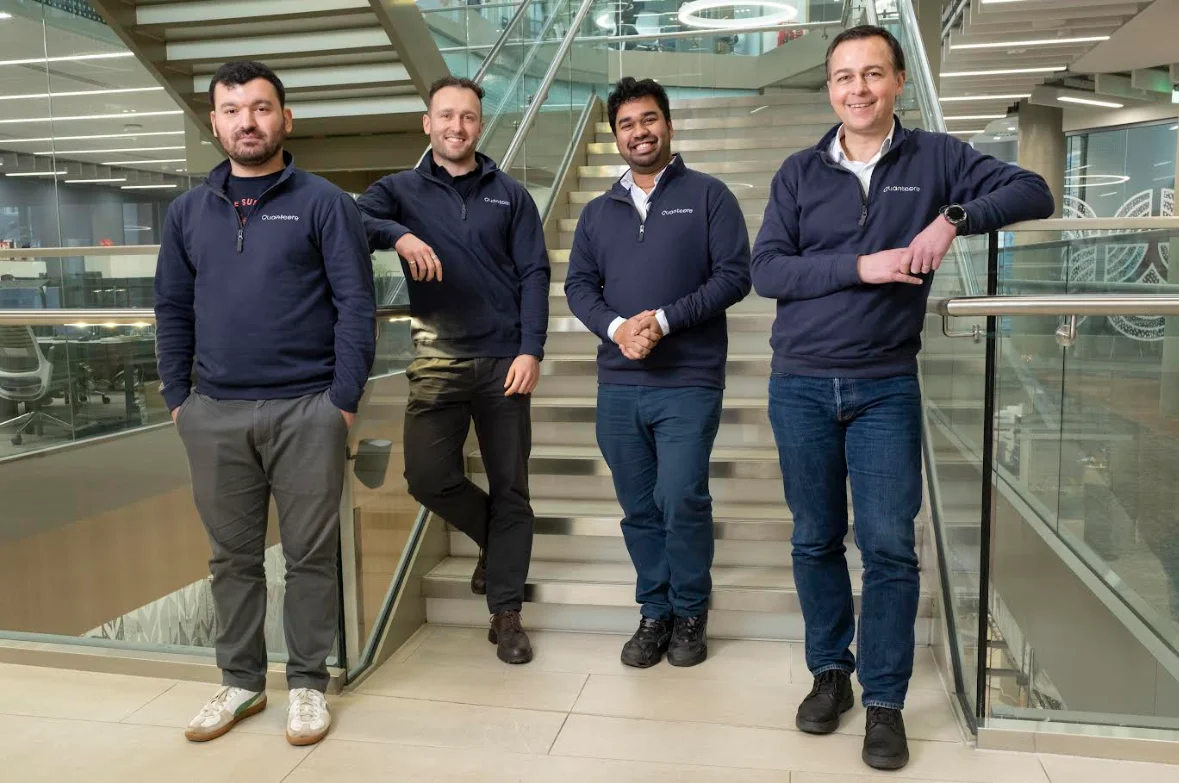
Quantcore was founded by Dr Jack Brennan, Dr Valentino Seferai, Wridhdhisom Karar, and Prof Martin Weides in August 2025 and has recently spun out from the University of Glasgow. The company was also part of the first cohort of deep tech startups to take part in the university’s Infinity G accelerator programme, led by STAC.