

Insider Brief
- Officials, investors, manufacturers and researchers met in Phoenix to assess how the region could build a manufacturing-centered quantum ecosystem, signaling a shift in focus from research breakthroughs to long-term system production.
- Discussions highlighted Arizona’s expanding semiconductor and advanced materials base — including epitaxial wafer manufacturing and photonic chip fabrication at ASU Research Park — as foundational infrastructure for future quantum hardware supply chains.
- Participants framed Phoenix as entering a preparatory phase similar to early aerospace and semiconductor hubs, positioning the region to support large-scale deployment and trusted manufacturing once quantum technologies mature.
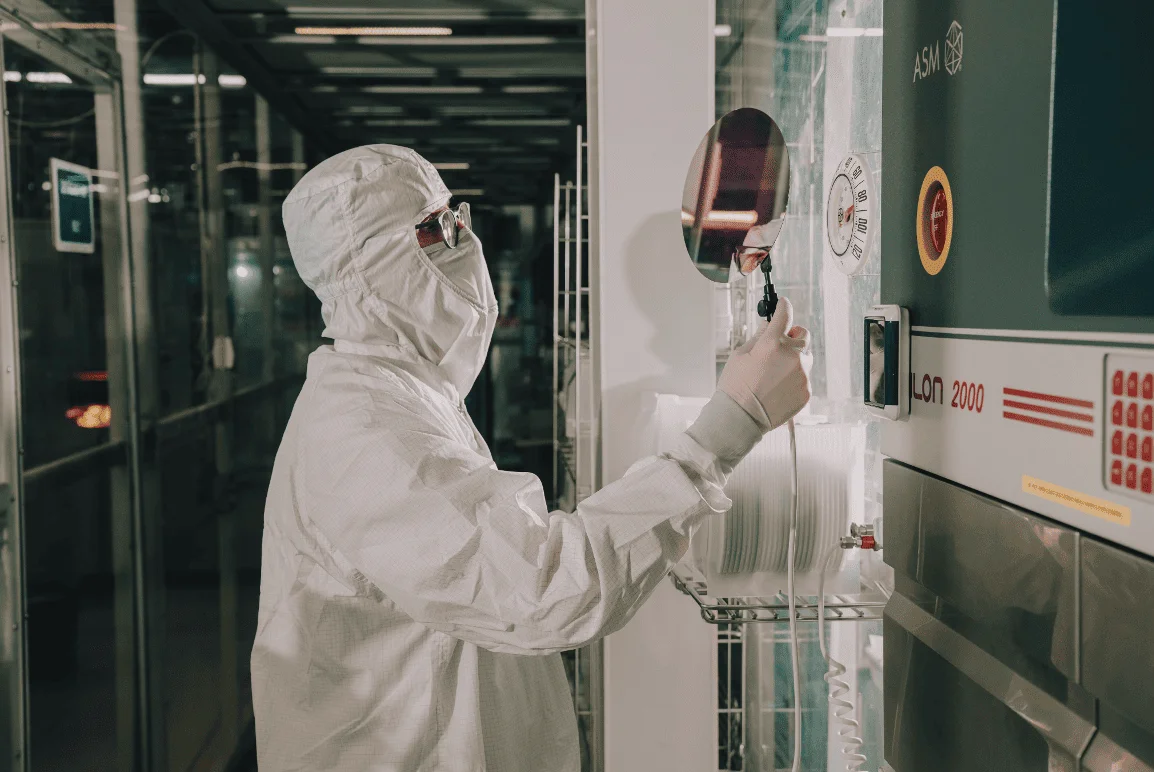
- Image: Lawrence Semiconductor process engineer inspecting an isotopically enriched silicon-28 epitaxial wafer produced at the company’s Tempe, Arizona facility. The company’s capabilities support low-defect, spin-coherent materials platforms for silicon spin-qubit research and quantum device development.
Over two days in Phoenix this week, local officials, manufacturers, researchers, international partners and representatives from the U.S. Air Force met across a series of roundtables and meetings to discuss what it would take to build a regional quantum ecosystem. The visit, led by Matt Cimaglia, founder and managing partner of Quantum Coast Capital, and senior advisor Dan Hart, included discussions at the Greater Phoenix Economic Council and concluded with remarks at the Phoenix Sister Cities annual Global Links Business Luncheon. The conversations frequently returned to a comparison that has begun surfacing in policy circles: the early space industry and the emerging quantum technology sector may follow similar geographic patterns.

The implication is less about where breakthroughs happen and more about where systems are ultimately built.
For decades, advanced technology in the U.S. has separated research from production. Quantum technology, however, depends heavily on precision manufacturing — specialized materials, photonics integration and device fabrication — closer to semiconductor engineering than software development. That distinction is quietly reshaping which regions may matter most.

Arizona has been assembling those capabilities at unusual speed.
The state’s semiconductor expansion now includes large-scale fabrication as well as a growing layer of specialty suppliers and materials firms. Among them is Lawrence Semiconductor, a Greater Phoenix-based advanced materials and epitaxial wafer manufacturing company producing engineered structures used in photonics, sensing and quantum-relevant devices. Epitaxy — the atomic-level growth of crystalline layers — determines performance in many emerging quantum hardware approaches, placing companies operating at this layer directly within the future supply chain rather than at the application edge.
Around this manufacturing base sits an expanding research and workforce infrastructure anchored by Arizona State University. At ASU Research Park in Tempe, a quantum photonic chip facility is producing thin-film lithium-niobate optical devices intended for sensing and communications architectures expected to accompany future quantum systems. The location was chosen in part because semiconductor fabrication, packaging expertise and trained engineering talent already exist in proximity.
Taken together, the pattern resembles earlier industrial transitions. Aerospace development concentrated in regions that could sustain long-term production rather than those that produced initial prototypes. Semiconductor manufacturing later followed a similar trajectory.
Participants in the Phoenix meetings described the city as potentially entering that preparatory stage. Rather than positioning itself as a center of theoretical research, Phoenix is examining how infrastructure, workforce training and international partnerships could support deployment once the technology matures.
Mayor Kate Gallego described Phoenix as preparing to welcome the next generation of advanced industries, signaling the city expects to play a role in the emerging quantum economy.
Next will be translating momentum into execution — aligning industry, universities and government around workforce pipelines and trusted deployment pathways for quantum technologies.
The shift reflects a broader change in how quantum competition is being discussed. Public attention has focused largely on which organization will reach technical milestones first. Increasingly, policymakers and industry planners are asking a different question — who will manufacture the systems once they become practical.
That question favors regions built for operational continuity rather than startup density.
Phoenix, long associated with aerospace assembly and now semiconductor fabrication, appears to be positioning itself accordingly. If quantum technology follows the historical path of other strategic industries, the places that reliably build the hardware may ultimately matter as much as those that first invent it.
The desert has played that role before. It may again.