


Insider Brief
- Researchers at the Department of Energy’s Oak Ridge National Laboratory discovered that a specially engineered tantalum–tungsten–selenium crystal self-organizes into stable atomic clusters that trigger magnetism at low temperatures, revealing new potential for spin-based electronics and quantum materials.
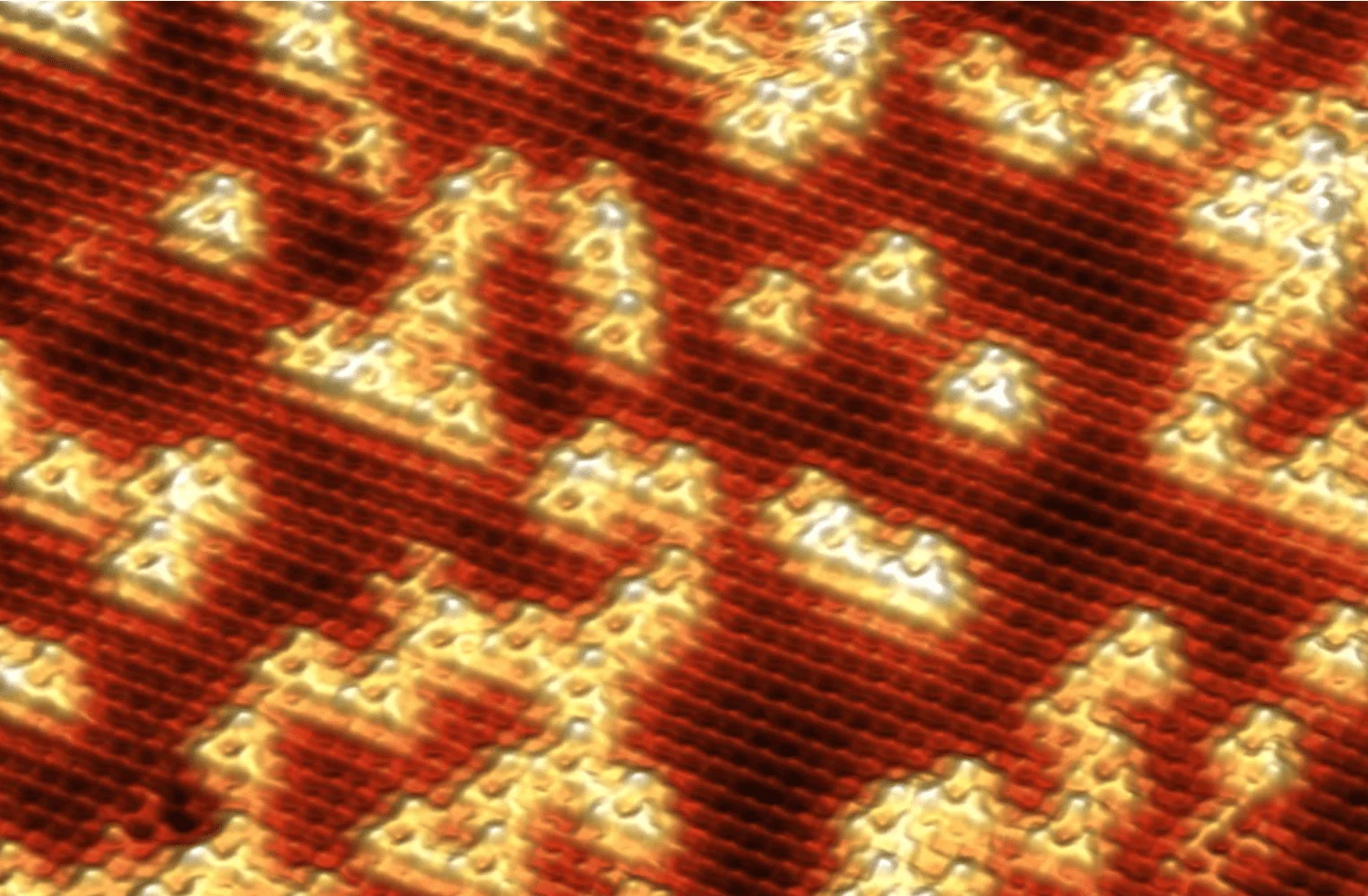
- Atomic-scale analysis at ORNL’s Center for Nanophase Materials Sciences showed that tantalum atoms form unusual triangular clusters of 10 atoms rather than dispersing randomly, minimizing energy and enhancing structural stability.
- When cooled below 50 kelvin, strain at the corners of these clusters initiates a magnetic transition, linking atomic self-organization to emergent magnetic behavior relevant to future spintronics and advanced computing applications.
- Image: Clusters of 10 tantalum atoms, arranged in triangles, create stress in the crystal’s structure. This stress unlocks unique magnetic properties, essential for future technologies such as quantum computing. (Jewook Park/ORNL, U.S. Dept. of Energy)
PRESS RELEASE — Researchers at the Department of Energy’s Oak Ridge National Laboratory, working with international partners, have uncovered surprising behavior in a specially engineered crystal. Composed of tantalum, tungsten and selenium — elements often studied for their potential in advanced electronics — the crystal demonstrates an unexpected atomic arrangement that hints at novel applications in spin-based electronics and quantum materials. Researchers revealed that the interplay between atomic self-organization and magnetism may lay the groundwork for significant advances.
At ORNL’s Center for Nanophase Materials Sciences (CNMS), where scientists study materials at scales millions of times smaller than a human hair, the team conducted detailed atomic-scale investigations. They anticipated that the tantalum atoms would be randomly distributed in the material, as is typical in many systems. Instead, the atoms self-organized into unusual triangular clusters of 10 atoms, with each cluster arranged to minimize the material’s overall energy and enhance its stability, a key factor for the reliability of quantum systems.
When the crystal was cooled to extremely low temperatures, below 50 kelvin (about minus 223 degrees Celsius), a small strain developed at the corners of these clusters. This strain initiated a magnetic transition, meaning that the material began to exhibit magnetism in specific regions. In simple terms, the ordered atomic arrangement not only stabilizes the material but also gives rise to distinctive properties when cooled sufficiently.

Spin-based electronics, also known as spintronics, exploits the intrinsic spin of electrons in addition to their charge. This innovative approach promises a viable alternative to conventional electronics by enabling faster and more energy-efficient operations. It is part of a broader field known as quantum materials, a class of substances in which quantum mechanical effects govern behavior and give rise to phenomena such as superconductivity and unusual magnetic properties. A deeper understanding and precise control of these atomic-scale interactions could lead to transformative advances in computing, data storage and other critical areas.
“Atomic-level engineering is redefining how we tailor materials,” said Jewook Park of CNMS. “These advances promise a future where we harness their properties with unparalleled precision.”
More details about this research can be found in the study’s paper published in the journal Advanced Functional Materials.
UT-Battelle manages ORNL for DOE’s Office of Science, the single largest supporter of basic research in the physical sciences in the United States. The Office of Science is working to address some of the most pressing challenges of our time. For more information, please visit energy.gov/science.