

Insider Brief
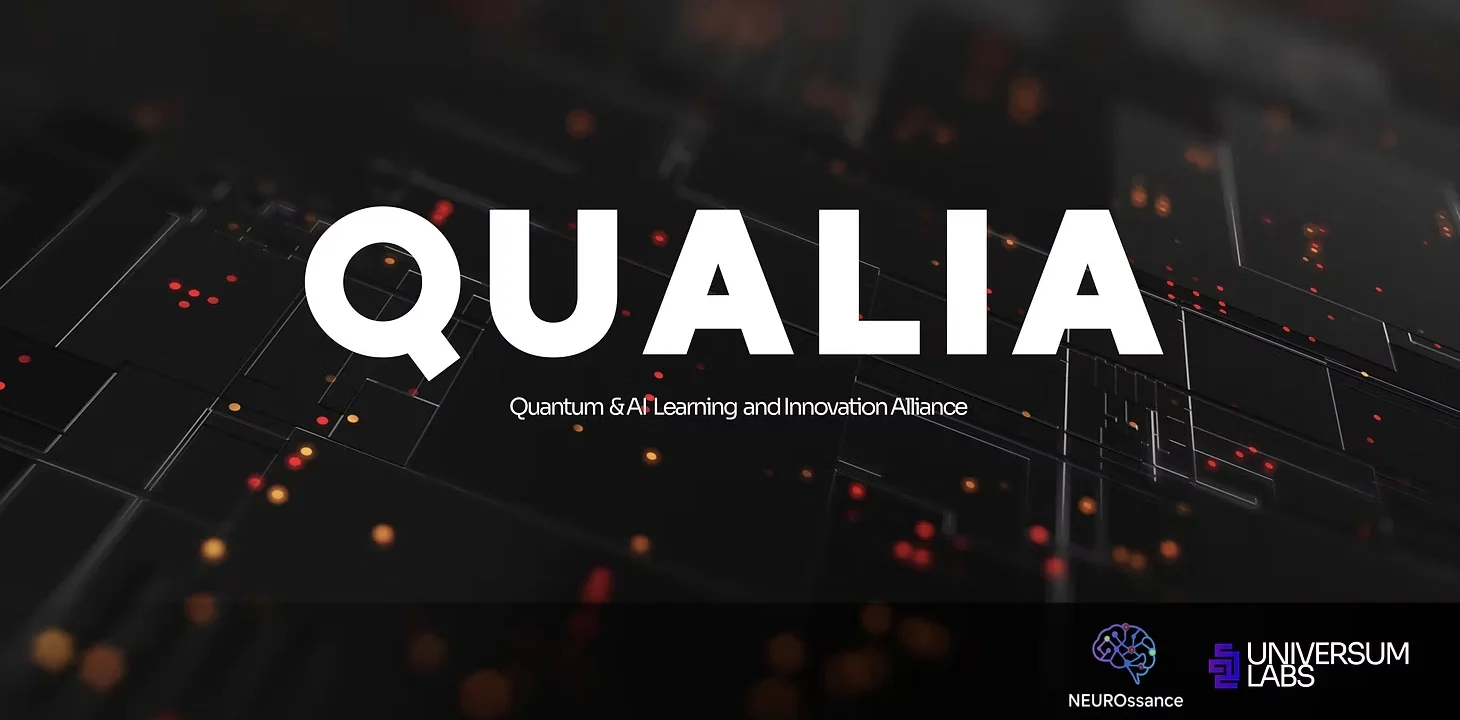
- Universum Labs and NEUROssance signed an MoU to co-found the Quantum & AI Learning and Innovation Alliance (QUALIA), an international consortium focused on building research-grounded cognitive infrastructure for quantum and AI education.
- QUALIA will operate as a non-competitive, collaborative education platform spanning quantum information science, artificial intelligence, neuroscience, and cognitive science, emphasizing empirically tested learning tools, neurodiversity-aware design, and equitable access to understanding rather than mere access to technology.
- The consortium plans to conduct cognitive research experiments, host design-led working groups and immersive learning programs, and coordinate international initiatives to address workforce readiness, public trust, and the widening gap between rapidly advancing intelligence technologies and human learning capacity.
PRESS RELEASE — Universum Labs and NEUROssance have formally signed a Memorandum of Understanding (MoU) to co-found the Quantum & AI Learning and Innovation Alliance (QUALIA), an international initiative dedicated to advancing tools and methods through which frontier technologies are learned, developed, and responsibly integrated into society.
The Consortium positions intelligence tech initially piloted through quantum and AI fields as a focal domain for educational innovation because these fields represent some of the most complex frontiers of human discovery and clearly challenge human cognition in several ways, making them ideal testbeds for identifying where existing educational models fall short and where new learning tools are required.
Designed as a non-competitive and collaborative education infrastructure, the Consortium will gradually open collaborations to complement the work of existing universities, research institutes, and professional training programs. Its scope spans quantum information sciences and technologies (QIST), artificial intelligence, neuroscience, cognitive science, and emerging tech, with a strong emphasis on biologically, cognitively, and artificially aligned, research-grounded learning models that promote broad, equitable access while maintaining scientific and ethical rigor through evidence-based programs.

The agreement establishes a shared framework for long-term collaboration across research translation, pedagogical innovation, and institutional coordination, providing a trusted platform for multi-stakeholder initiatives, public funding pathways, and international partnerships.
A New Layer of Educational Infrastructure
The Consortium addresses a missing layer in today’s innovation ecosystem: cognitive infrastructure. While society has invested heavily in digital infrastructure (networks and platforms), scientific infrastructure (laboratories, universities), and regulatory infrastructure (standards, ethics frameworks, and governance bodies), there is no shared infrastructure designed to support how humans understand, reason about, and learn frontier intelligence technologies.
As quantum and AI systems advance in complexity, this gap has become increasingly consequential. The Consortium is designed to operate at this intersection by providing research-grounded tools, methods, and frameworks that help bridge rapidly advancing technologies and human cognitive capacity.
The consortium is founded on the principle of equity at the level of cognition, not simply access. Most institutions talk about access to technology, but we address access to understanding. Quantum in Pictures is one example of this cognitive scaffolding, now naturally implemented in 12 countries. This work reflects years of experience grounded in education, physics, and learning science. With this consortium, we now aim to join our forces, ensuring that
- Intelligence technologies don’t quietly privilege only high-functioning cognitive profiles
- Neurodiversity, developmental differences, and cultural variation are built into the design of learning tools for emerging tech
For this reason, we launch only empirically grounded tools and methods after testing how humans actually learn, reason, and misunderstand tech topics. We collect evidence for the kinds of explanations, work, abstractions, and representations that actually work.
While big tech focuses on building smarter machines or training people to catch up, what we focus on is watching the evolution of human learning and intervening in it to evolve the learning itself in parallel with artificially enhanced intelligent tech
Planned activities include:
- Innovation through experimentation: conducting scientifically grounded cognitive and learning experiments to study how different populations engage with core concepts across visual, symbolic, narrative, and formal modes of explanation.
- Design-led salons and working groups that prototype alternative learning models informed by cognitive science and publish reports and frameworks to guide curricula, institutional design, and regional initiatives.
- Serve as the organizing body for the 3rd Causal Cognition in Humans and Machines Conference, expanding its focus to quantum–AI education and cognitive infrastructure.
- Immersive learning formats, including workshops, hackathons, retreats, summits, and experimental educational environments
The Consortium provides a formal research and experimentation space for evaluating alternative educational structures that extend beyond conventional academic pathways, grounded in learning science and observed failures in current models.
Why This Consortium
Frontier technologies such as QIST and AI advanced at a pace that far exceeds our collective capability to learn, reason about, and govern them meaningfully.
The challenge society now faces is no longer limited to building more powerful systems or expanding access to technology, but to ensuring that humans can understand these systems well enough to use them responsibly, equitably, and intelligently.
Existing educational structures are not designed for this level of complexity.
The Quantum & AI Learning and Innovation Alliance invests heavily in shared cognitive infrastructure. This gap is no longer academic, but wider. There is currently no coordinated effort to address workforce readiness, public trust, the proliferation of pop-corn Quantum and AI courses, or questions about who gets involved in shaping intelligence tech. This consortium is dedicated to the idea that human learning and reasoning must evolve in parallel with intelligence tech before it’s too late.
Why Now
- We now have the tools to intervene: Advances in learning science, cognitive neuroscience, and pedagogical design.
- The cognitive limits are now visible
- The cost of misunderstanding is rising: From policy errors to workforce bottlenecks and public mistrust, the consequences of shallow understanding are becoming structural.