

Insider Brief
- Global Board Advisors Corp and BoardroomEducation.com launched Quantum Strategic Intelligence (QSI) at the World Economic Forum, introducing an open Sovereignty Standard that links quantum and agentic-AI risks to boardroom governance and national policy.
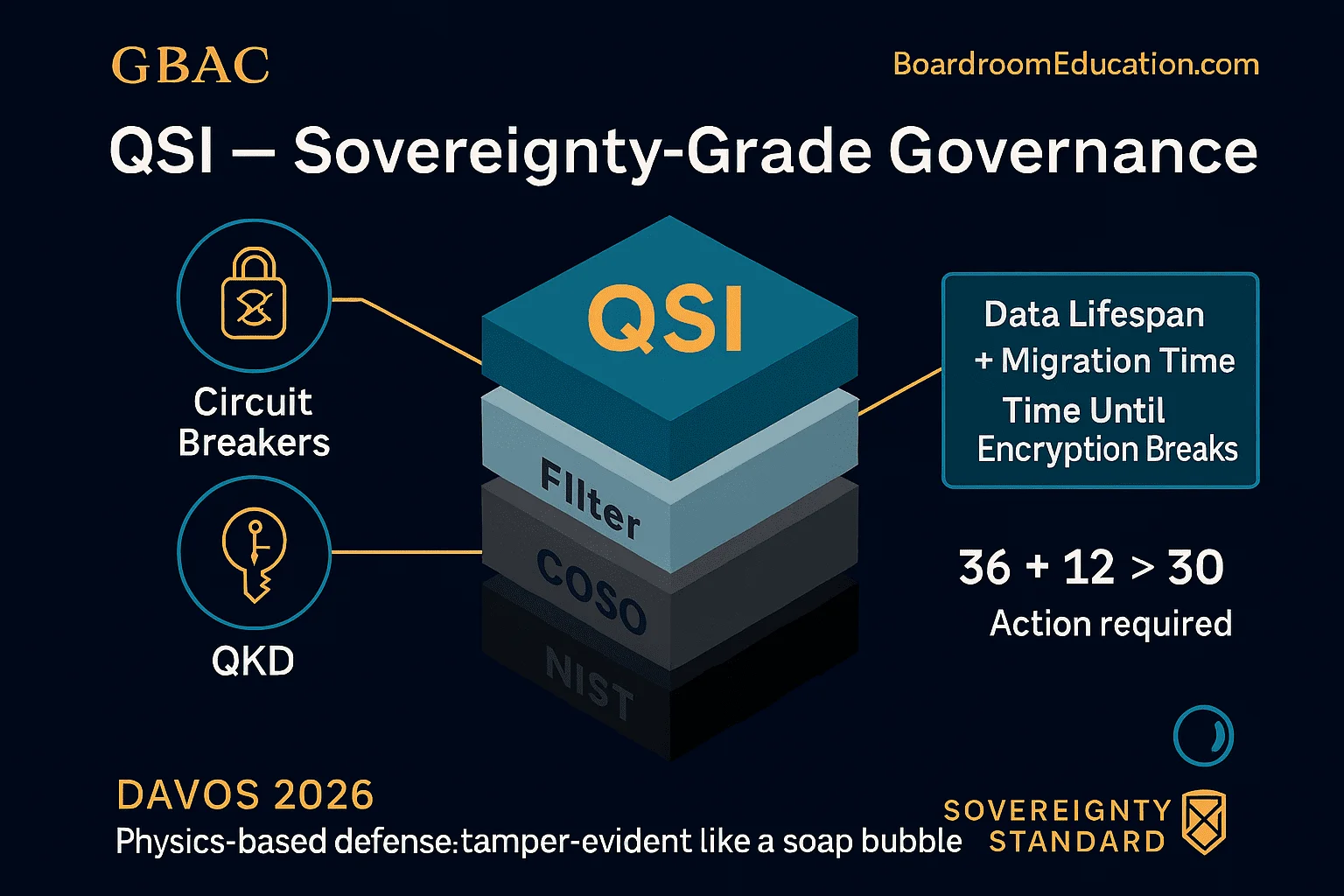
- QSI is designed to complement and interoperate with established frameworks such as COSO, COBIT, and NIST by adding physics-based security, quantum-era risk metrics, and auditable governance controls.
- The framework provides layered tools for governments, executives, auditors, and technology partners, including quantum-safe risk assessments, crypto-agility guidance, agentic-AI circuit breakers, and sovereignty-focused supply-chain stress testing.
PRESS RELEASE — Global Board Advisors Corp (GBAC), a U.S.‑based governance advisory firm, and BoardroomEducation.com today launched Quantum Strategic Intelligence (QSI) at the World Economic Forum in Davos. Framed as a Sovereignty Standard, QSI is an open governance architecture that translates quantum physics and agentic‑AI risk into boardroom decisions and national policy. QSI is designed to extend and interoperate with existing risk frameworks including COSO, COBIT, and NIST.
“Risk is shifting fast from math to quantum physics. QSI lets boards and sovereigns add a sovereignty‑grade governance layer to existing ERM—fast, auditable, and non‑disruptive.” — Prof. Yusuf Azizullah, GBAC; CEO, BoardroomEducation.com
Completing the Governance Picture

For decades, COSO and COBIT have anchored enterprise integrity. Those frameworks were built for a classical, process‑centric world. QSI does not replace them; it completes them by adding the policy, physics, and sovereignty dimensions required for the Quantum‑AI age. QSI provides a clear path from boardroom strategy to auditable controls and national policy.
From Math‑Based to Physics‑Based Security
Classical encryption depends on mathematical hardness. Quantum computing will make many of those assumptions obsolete, creating a “Harvest Now, Decrypt Later (HNDL)” threat where data exfiltrated today can be decrypted tomorrow. QSI promotes Physics‑Based Defense, including Quantum Key Distribution (QKD), which uses quantum states to detect interception and preserve secrecy in ways mathematics alone cannot.
A Layered, Audience‑Targeted Architecture
QSI is published as an open standard with multiple constructs so organizations and states can adopt the level of rigor they require:
Sovereignty Standard for Governments and Central Banks
Mandates geopatriation of critical compute and data, supply‑chain audits for quantum inputs, and legal/regulatory guardrails to preserve national autonomy. Treats compute and data as national infrastructure—digital food security for the 21st century.
Strategic Layer for Ministers and C‑Suite
Executive playbooks, scenario planning, and the Mosca Metric to convert quantum risk into solvency‑grade decisions. Analogy: adding a strategic weather radar to a ship’s navigation system.
QSI Overlay for Executives and Advisors
Non‑disruptive policy and control mappings that sit on top of COSO, COBIT, and NIST to surface quantum and agentic‑AI exposures without replacing existing ERM investments.
Governance Module for Audit Committees and Implementers
Auditable controls, circuit‑breaker specifications, and compliance templates that integrate with board reporting and audit cycles.
Risk Adapter for Tech Partners and Integrators
Vendor‑neutral APIs, crypto‑agility playbooks, and integration patterns for cloud and vendor ecosystems to enable rapid, low‑risk transitions.
Operational Addendum for Practitioners and Auditors
Runbooks, test plans, and implementation guidance for QKD, agentic‑AI governance, and supply‑chain resilience.
Practical Board Tools
Circuit Breakers for Agentic AI — Physical and procedural disconnects that stop autonomous agents when they exceed predefined thresholds, preventing runaway actions and systemic cascades.
Mosca Metric — Board‑Ready Exposure Check — A solvency check that compares data lifespan plus migration time against time until current encryption is expected to be vulnerable. If the sum of data lifespan and migration time exceeds the time until encryption breaks, the dataset is exposed and remediation is required. (See Note to Editors for a clear, step‑by‑step example.)
Crypto‑Agility Playbook — Procedures to swap encryption standards with minimal downtime and operational risk.
Sovereign Resilience and Supply Chain Stress Testing
QSI’s Sovereignty Standard prescribes the “Wassenaar Minus One” Audit, a stress test for national supply chains that evaluates resilience against export controls on critical quantum inputs (for example, isotopes and dilution refrigerators). The framework ensures national programs can survive geopolitical friction and maintain operational sovereignty.
GBAC invites a cross‑sector coalition to operationalize QSI. Standards bodies (ISO, NIST, WEF), national regulators and central banks, the Big 4 audit firms, major cloud and technology providers, security vendors, and industry consortia are asked to join a QSI Adoption Pact to run pilots, validate interoperability, and harmonize policy within a 6–9 month window. GBAC will coordinate pilot playbooks, interoperability tests, and a public‑private roadmap to scale the Sovereignty Standard globally.