

- Universidad Politécnica de Madrid and Q*Bird have deployed Spain’s first operational multi-node Measurement-Device-Independent Quantum Key Distribution (MDI-QKD) network across high-security government sites in Madrid.
- The hub-and-spoke network connects three end nodes over 30–50 km fiber links without trusted nodes, enabling scalable and detector-secure quantum key distribution.
- The deployment supports real-world evaluation of metropolitan-scale quantum communications and contributes to Spain’s role in Europe’s EuroQCI quantum infrastructure efforts.
PRESS RELEASE — Universidad Politécnica de Madrid (also referred to as UPM), through the Quantum Information and Computing Research Group, in collaboration with Q*Bird, has deployed Spain’s first Measurement-Device-Independent Quantum Key Distribution (MDI-QKD) network, connecting 3 end nodes, marking a significant milestone in Europe’s quantum communication infrastructure.
The system is deployed in high-security operational environments, with installations spanning two sites of the Instituto Nacional de Técnica Aeroespacial (INTA) and one site of the Ministerio del Interior, Secretaría General de Sistemas de Información y Comunicaciones para la Seguridad (SGSICS), all located in Madrid. This development is part of UPM’s ongoing efforts to enhance the security and scalability of quantum communication networks through excellent research and development.
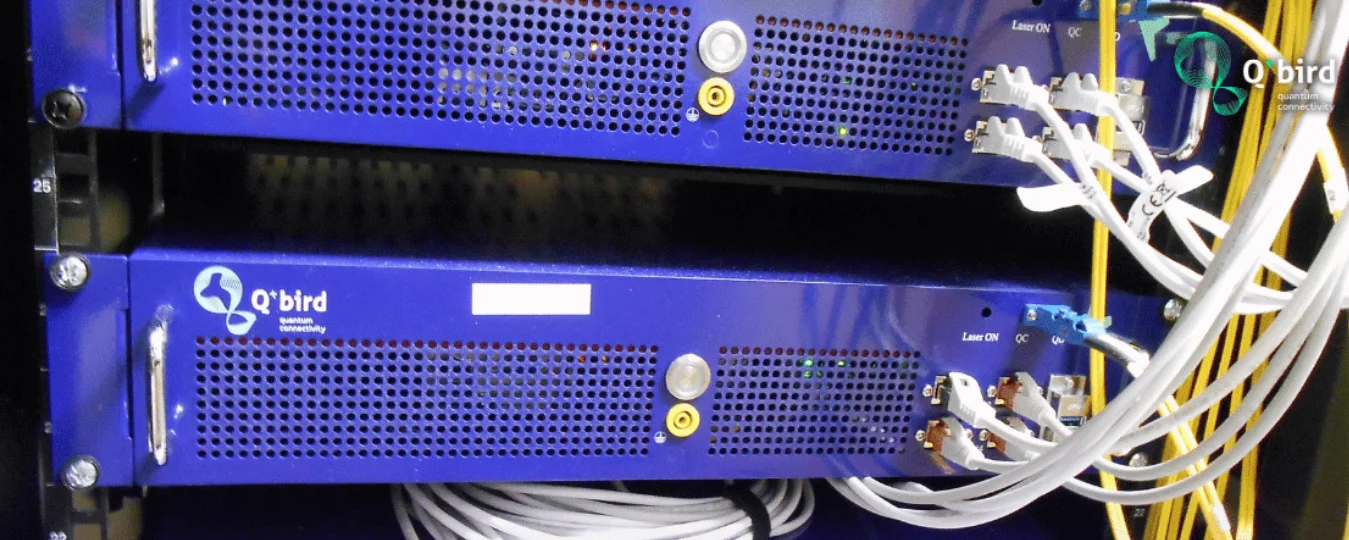
The network follows a hub-and-spoke topology, consisting of Q*Bird’s Falqon® Series’ three end nodes, one center hub and a quantum optical switch, with fiber distances ranging between 30 and 50 kilometers from the center hub to each of the user end nodes. This architecture enables multi-node quantum key distribution (QKD) in a fully connected mesh network, without trusted nodes, even at the central hub, offering high scalability, making it suitable for metropolitan-scale deployments.
Why MDI-QKD?
Classical cryptography relies on computational complexity for security, leaving sensitive data fundamentally vulnerable to future quantum attacks. Even traditional QKD systems, while inherently quantum-secure, are limited by vulnerabilities at the measurement stage as detectors can be exploited by advanced attacks, potentially compromising key and system integrity. MDI overcomes this limitation by ensuring that all detectors exist at the center hub, which does not handle keys or other secrets at any point, and never has access to any keys, enabling highly secure, scalable multi-node networks.

“A multi-node MDI-QKD network enables our researchers to evaluate key performance metrics and optimise network configurations for high-security scalable deployments,” said Laura Ortiz, Researcher at UPM. “Having the center hub on UPM premises facilitates maintenance and experimentation while reducing costs, but it also allows us to provide cryptographic services to third parties within the high-security ecosystem with effective trust management.”
The Technology Behind the Network
At the core of the live network deployment is Q*Bird’s Falqon® Series:
- The MQX4000 center hub serves as the quantum connecting station, establishing quantum links between multiple nodes.
- The MQS4000 optical switch manages the optical transport layer, enabling dynamic distribution of QKD keys across the network.
- The MQT4000 user nodes act as quantum information transmitters, providing interfaces to secure cryptography key from the QKD protocol.
This combination allows researchers at UPM to study key generation rates, latency, loss tolerance and interoperability under realistic metropolitan fiber conditions, creating a valuable platform for advancing future quantum communication standards.
“The MadQCI ecosystem is more than a quantum network. It is a hub that attracts stakeholders seeking performance, interoperability and scalability solutions that are critical for a Europe-wide quantum infrastructure. Q*Bird’s MDI-QKD system is ideal for powering this all.” said Alberto Sebastián-Lombraña, Researcher at UPM.
Building a Quantum-Resilient Future
The UPM deployment demonstrates that operational MDI-QKD networks are technically feasible, resilient and scalable. The network provides secure multi-node cryptographic quantum key distribution, supporting the development of advanced quantum key management systems and federated quantum network architectures.
“By combining Q*Bird’s MDI-QKD Falqon® Series with UPM’s infrastructure, we are addressing the immediate threats posed by quantum computing while establishing a secure, scalable platform for future digital connectivity,” shares Dr. Joshua Slater, CTO of Q*Bird. “Trust and security are at the core of this deployment and every node, every link is designed to ensure that the quantum cryptographic keys exchanged cannot be compromised, even by the measurement devices themselves. This is a critical step toward building networks that customers can genuinely rely on.”
Spain at the European Quantum Frontier
UPM’s deployment of Q*Bird’s MDI-QKD Falqon® Series signals Madrid and Spain’s growing role as a hub for quantum innovation in Southern Europe, with potential economic and technological benefits. It is not just a research achievement, it is a foundation for a quantum-secure digital society.
Q*Bird’s MDI-QKD Falqon® Series seamlessly integrates with UPM’s existing quantum infrastructure, including their ongoing Madrid Quantum Communication Infrastructure (MadQCI) initiative.
As Spain’s first operational MDI-QKD network, this deployment lays the groundwork for interoperable quantum communication systems and contributes directly to the EuroQCI initiative, reinforcing Europe’s broader push toward a federated quantum internet.
“By deploying yet another fully operational, multi-node MDI-QKD network, we are demonstrating that secure, scalable quantum communications are achievable today. We are thrilled to undertake this deployment in close partnership with UPM, who have been pioneers in QKD deployments and leaders in addressing the real-world challenges of integrating quantum security into existing network infrastructure. Working side by side with UPM on these complex challenges is an exciting milestone, and it reinforces the progress we are making toward building interoperable, industrial-grade quantum networks,” added Dr. Joshua Slater. “This is a benchmark for future continental networks and a tangible step toward a quantum-secure Europe.”
“With this network, Spain is not just participating in Europe’s quantum future, it is helping define it,” added Vicente Martín, Principal Investigator of the Quantum Information and Computing Research Group. “We are creating a trusted foundation for secure, multi-node quantum networks that will underpin Europe’s digital sovereignty and research community. This assures and guarantees that the data moving through these trusted networks is truly secure.”
UPM and Q*Bird’s collaboration strengthens Spain’s role in developing scalable, operational quantum networks, positioning the country as a key player in Europe’s quantum communications leadership. And this collaboration between UPM and Q*Bird sets a precedent for future initiatives aimed at integrating quantum technologies into critical communication networks. As the field progresses, such partnerships will be instrumental in building resilient systems capable of safeguarding sensitive information in the quantum era!