

Insider Brief
- Chile has launched national biotechnology and quantum technology strategies for 2025–2035 to shift its economy toward a knowledge-based development model, according to Ministry of Science, Technology, Knowledge and Innovation (MinCiencia).
- The strategies were developed through a multi-year participatory process and focus on translating scientific research into economic growth, high-quality jobs and regional opportunities.
- Biotechnology efforts target sectors such as health, agriculture and mining, while the quantum strategy outlines a roadmap for building national capabilities in computing, sensing, secure communications and materials simulation.
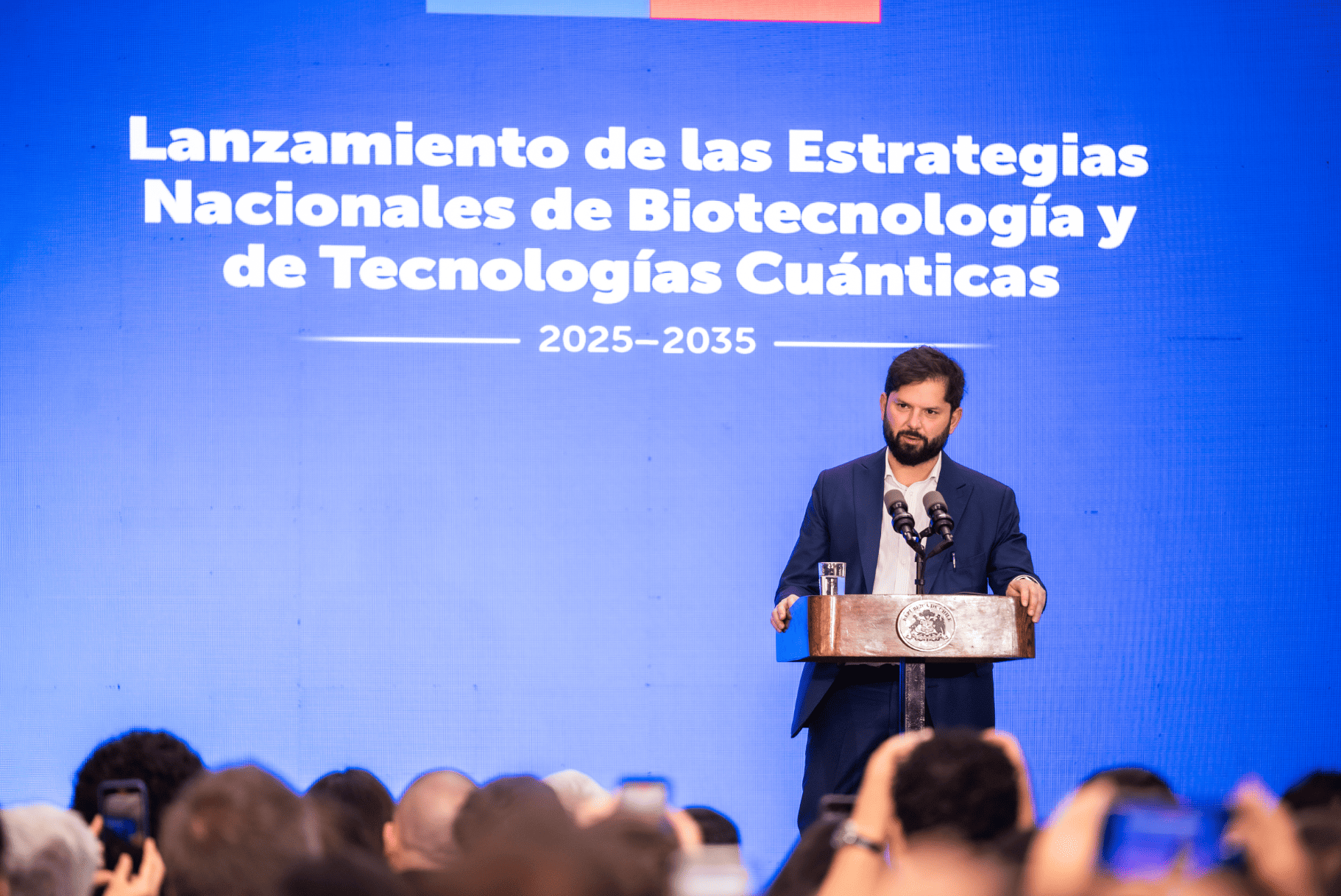
- Image: President of the Republic Gabriel Boric Font, the Ministry of Science, Technology, Knowledge and Innovation helped to officially launch the National Biotechnology and Quantum Technologies Strategies for 2025–2035. (MinCiencia)
Chile has formally set a 10-year course to anchor its economic future in biotechnology and quantum technologies, unveiling two national strategies that aim to shift the country from an extractive model toward a knowledge-based economy with global reach.
According to Ministry of Science, Technology, Knowledge and Innovation (MinCiencia), the National Biotechnology Strategy and the National Quantum Technologies Strategy, covering the period from 2025 to 2035, were launched this week in Santiago in a public event attended by more than 400 representatives from science, industry, academia and civil society. The plans are intended to guide public investment, talent development and industrial participation in two technology domains seen as central to long-term competitiveness and sustainability.
While the strategies set out long-term priorities, the ministry did not release a total budget in the announcement.

The launch, attended by Gabriel Boric Font, president of Chile, signals a growing, coordinated government effort to embed science and technology more deeply into national development policy. MinCiencia reported that the strategies are designed to ensure that advances in research translate into jobs, new companies and regional economic activity, rather than remaining confined to laboratories.
From Extractive Economy to Knowledge Base
The ministry indicated that the twin strategies as a turning point in Chile’s development model. For decades, the country’s economy has relied heavily on natural-resource extraction, including mining and agriculture. The new approach seeks to complement those sectors with industries built on scientific knowledge and advanced technology.
“I believe it is extremely important that the public policies we develop are grounded in scientific evidence. Our position on this is clear. We must ensure that technology, science, innovation, and the tools that help build a future that is more inclusive and more empathetic are accessible to everyone,” President Boric told the group.
Science Minister Aldo Valle, also speaking at the event, said the strategies aim to convert scientific capacity into tangible social and economic benefits. According to the ministry, this includes promoting higher-quality employment, encouraging innovation-led companies and expanding opportunities beyond Santiago into other regions of the country.
The strategies were developed through a multi-year participatory process, MinCiencia said, involving expert working groups, interministerial coordination, focus groups and a nationwide public consultation. Contributions were received from universities, research centers, companies, regional governments and citizen organizations, reflecting an effort to align policy with both technical expertise and public priorities.
Biotechnology and Quantum on Parallel Tracks
The National Biotechnology Strategy focuses on applying biological science to sectors already central to Chile’s economy, while pushing into newer areas of the bioeconomy. According to MinCiencia, the plan prioritizes health, food systems, agriculture, mining, environmental management and sustainable industrial processes.
In practical terms, this includes supporting industries based on bioprocesses, such as using microorganisms or biological reactions to produce materials, chemicals or energy with lower environmental impact. The strategy also emphasizes green innovation and the growth of science- and technology-based companies, which the ministry sees as key to diversifying exports and improving productivity.
The National Quantum Technologies Strategy addresses a very different, but increasingly strategic, field. Quantum technologies rely on the unusual behavior of matter and light at extremely small scales, where particles can act in ways that defy everyday intuition. The Ministry said the strategy sets a roadmap to build national capabilities in areas such as quantum computing, advanced sensing, secure communications and materials simulation.
Quantum computing, for example, uses quantum bits, or qubits, which can represent multiple probabilistic states at once, potentially allowing certain calculations to be performed far faster than on today’s computers. Based on this potential, governments worldwide are investing heavily in the field. MinCiencia said the strategy is intended to position Chile to participate in this global shift rather than remain a passive consumer of foreign technology.
Shared Priorities And Public Engagement
Despite targeting different technologies, the two strategies share three core pillars. The first is talent development, with an emphasis on training advanced human capital through education, research opportunities and international collaboration. The second is high-level scientific and technological infrastructure, including laboratories, computing resources and shared facilities. The third is governance, with principles centered on ethics, inclusion, decentralization and sustainability.
The launch event also highlighted national case studies and included messages from international scientists, underscoring Chile’s intent to integrate into global research networks, the ministry reported. A symbolic installation titled “From Cochayuyo to the Photon” was used to frame the strategies as a bridge between Chile’s natural heritage and frontier technologies.
Following the ceremony, MinCiencia opened the ChileEmergente 2025–2035 exhibition, featuring interactive displays from companies, universities and research centers. The ministry said the goal was to give the public direct exposure to real-world applications of biotechnology and quantum technologies.
This article contains computer translated information from the Spanish language source.