Enlightra Raises $15M to Advance Laser Interconnects for AI and Quantum Systems


Insider Brief
- Enlightra has raised $15 million to develop chip-scale multiwavelength laser technology aimed at replacing copper interconnects in AI and data center infrastructure.
- Its silicon-photonics-based lasers enable high-bandwidth, energy-efficient optical links between GPUs and other chips, addressing power and scaling limits in large AI clusters.
- Beyond AI data centers, the company’s laser platform has potential applications in quantum communications, subsea links, and future chip-to-memory interconnects.
PRESS RELEASE — Enlightra, a Swiss-American deeptech startup building chip-scale multiwavelength lasers for next-generation data transmission, today announced it has raised a total of $15 million in funding to tackle the biggest bottleneck in AI infrastructure: fast and energy efficient data transfer.
As AI clusters and data centers expand, Enlightra’s laser technology replaces copper wiring with compact ultra-high bandwidth optical links that move data faster while consuming dramatically less power. The market for such energy-efficient interconnects is projected to reach $24 billion by 2030, according to McKinsey.
The funding has enabled Enlightra to develop and demonstrate its multi-color laser technology, which connects computing chips (GPUs, TPUs) in AI clusters faster and more efficiently than copper cables can. The company’s investors include Y Combinator, Runa Capital, Pegasus Tech Ventures, Protocol Labs, Halo Labs, Asymmetry Ventures and TRAC VC, among others.

“The world’s AI infrastructure is hitting the limits of copper,” said Maxim Karpov, Co-founder and Co-CEO of Enlightra. “Our lasers unlock a new level of energy-efficient connectivity by turning light into the backbone of GPU communication.”
Rewiring the AI Era With Light
Modern AI training demands ever-faster links between GPUs. Yet most connections still rely on copper wiring, limited by both speed and power., Industry leaders such as NVIDIA, Broadcom, Google, and META are already investing heavily in optical interconnects to keep pace with exponential data growth.
Enlightra’s multi-color laser technology replaces dozens of discrete lasers with a single integrated source to cut power, cost, and footprint. Each color functions as an independent data channel, creating dozens of high-bandwidth connections from one laser source. “Using more colors is the only way to fully utilize the capacity of modern optical fiber networks,” says John Jost, Co-Founder and Co-CEO of Enlightra. “Our technology enables AI clusters and data centers to scale efficiently by separating performance growth from energy and the cost increases.”
Built using industry-standard silicon photonics fabrication processes, Enlightra’s lasers can be produced at massive scale, opening the door to millions of units per year for global data center deployment.
From Lab to Worldwide Deployment
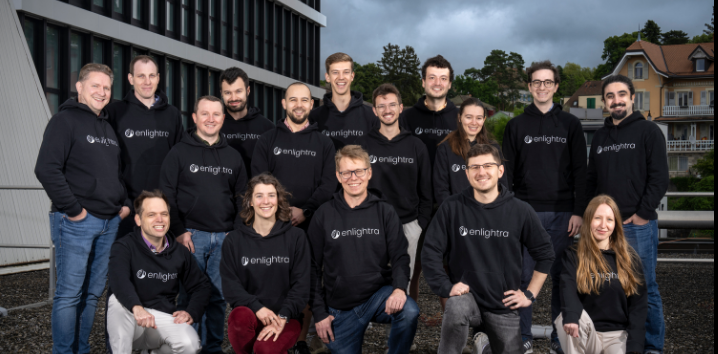
With a 25-person team, Enlightra has designed and built 8- and 16-channel lasers meeting customer specifications for AI chip interconnects, achieving error-free data transmission at target speeds and power levels. The pilot production is slated for 2027.
The company’s vision extends far beyond AI clusters. Its scalable comb-laser platform could power future optical links across entire data centers, subsea cables, and even chip-to-memory interconnects. Beyond data center applications, the same technology shows promise for quantum and space-based communications.
“AI is driving an optical revolution,” said Dmitry Galperin, General Partner at Runa Capital. “Enlightra’s multiwavelength lasers are a foundational technology for the next decade of high-performance computing, bringing the efficiency and scalability the industry urgently Needs.”
Founded in 2022 and based in Lausanne, Switzerland, Enlightra operates at the intersection of photonics, semiconductor manufacturing, and AI infrastructure. The company has participated in Y Combinator (W22) and Intel Ignite (2023), and is co-led by John Jost and Maxim Karpov. Jost’s work has contributed to two Nobel Prize–winning advances in quantum computing and optical frequency combs, while Karpov was honored in Photonics100 (2024) and named an MIT Innovator Under 35 in 2025.

Keep track of everything going on in the Quantum Technology Market. In one place.

Mohib Ur Rehman
Covering quantum and emerging technologies, Mohib explores the intersection of technology, security, and society. His work also frequently examines surveillance infrastructure and the institutions shaping the digital world. In addition to his work at The Quantum Insider, he co-runs SK NEXUS, an independent technology publication that helps readers understand the technologies shaping their lives.

Stay Ahead of Quantum
Get the latest research, company news, and market intelligence every week.
MENTIONED IN THE ARTICLE
NVIDIA
NVIDIA Corporation is an American multinational technology company and a global player in accelerated computing and Artificial Intelligence (AI). Founded in 1993, the company pushes the aerospace frontier with the Space-1 Vera Rubin Module, a platform for orbital data centers that delivers massive AI-compute Space Computing. This NVIDIA technology enables satellites and autonomous spacecraft to process and fuse sensor data rapidly Space Computing.
→

Broadcom
Broadcom Inc. is a global technology company that designs, develops, and supplies a broad range of semiconductor and infrastructure software solutions. While the current entity (Broadcom Inc.) was formed later through mergers involving Avago Technologies (which has roots back to 1961), the "Broadcom" brand and its foundational technology originate from the 1991 startup. Originally rooted in communications chips, the company has grown through strategic acquisitions to become a giant in data center networking, AI acceleration, and enterprise software, serving critical functions in aerospace, defense, and industrial automation.
→
Intel
Intel's mission is to drive the future of technology to contribute to a better world. By advancing in areas such as AI, analytics, and cloud-to-edge technology, Intel is central to many innovations.
→