


Insider Brief
- Pablos Holman argues that deep-tech investing must focus on solving hard real-world problems by bridging the “invention gap” between scientific discovery and commercial viability, a gap he says quantum computing largely still inhabits.
- Drawing on decades as an inventor and investor, Holman contends that quantum computing remains an unfinished scientific endeavor misaligned with venture timelines, especially as rapid advances in classical and AI-driven computing narrow quantum’s near-term advantage.
- He sees stronger near-term opportunity in quantum sensing and cautions that deep tech requires long-horizon, platform-level investment strategies rather than feature-level fragmentation borrowed from software and SaaS models.
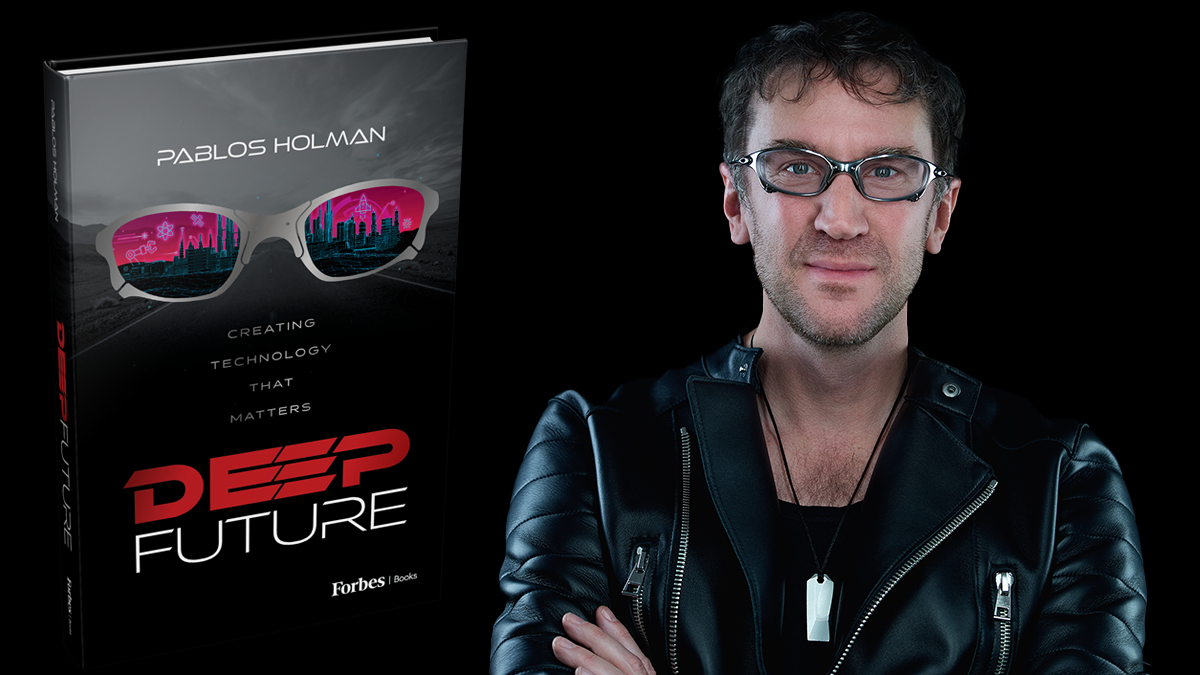
Deep-tech investing is entering a new phase, and few figures embody its possibilities and even its contradictions more clearly than Pablos Holman – a hacker-turned-inventor whose career has spanned cypherpunk cryptography, AI-driven trading systems, alternative spaceflight concepts for Jeff Bezos and more than 6,000 patented inventions from his years inside Nathan Myhrvold’s Intellectual Ventures Lab.
Oh, and by the way, you can also tack “published author” onto that list, as he just released a new book called, fittingly enough, Deep Future..
Currently, Holman now leads the deep-tech fund Deep Future and talks with founders building what he calls “technology that matters”.

In an interview with The Quantum Insider, Holman said that he approaches new technologies not with the underlying technology, but by starting with the problem the tech is positioned to solve. And he invests particularly in founders who are trying to invent technologies that can solve the world’s hardest problems.
“Invention sits between scientific research and entrepreneurs, because invention is where you take the output of research, and you turn it into something that works,” Holman said.
It is the same lens he used when inventing devices that ranged from malaria-detecting microscopes and hurricane-suppression systems to vaccine coolers that operate for months without power.
In his experience, deep tech succeeds only when it changes the physics or economics of foundational systems – not when it chases features or narrows itself to incremental improvements.
What About Quantum?
Applied to quantum, this investment approach quickly separates what is scientifically exciting from what is commercially investable, according to Holman.
Holman said that deep-tech investing must begin with the structure of invention itself. His background illustrates this gap better than most. Across three decades as an inventor – including a range of technologies – from laser mosquito zappers to hurricane suppression and from food-printing systems developed with the Modernist Cuisine team to nuclear reactors – he has repeatedly worked in the space between basic science and commercial products.
That middle layer is the “invention gap”, according to Holman, the place where scientific insights must be turned into something that actually works, long before a business model or customer exists. It is high-risk, unpredictable, expensive and poorly supported by both public research funding and private markets.
“Breakthroughs do not happen on a schedule, and these are financing mechanisms that require adherence to a schedule,” said Holman. “That’s not really true for scientific discovery, but it is true in the tech industry. And so the problem is there’s this mismatch between the kind of funding that’s available in research and the kind of funding that’s available in the tech sector.”
Quantum computing, based on Holman’s view, lives almost entirely inside this invention gap.
Much of what is described publicly as “development” or “productization” is, in reality, exploratory scientific work. It involves understanding how to create, control, stabilize and meaningfully use quantum states. Unlike software, these breakthroughs cannot be scheduled around investor timelines.
For decades, Holman has watched technologies move from science to invention to industry, and quantum computing stands out for how long the scientific phase remains unfinished. When research teams frame scientific uncertainty as an engineering roadmap, they often do so to access private capital.
The result is a mismatch between what venture investors expect and what scientific discovery can realistically deliver. That might spell trouble if expectations continue to increase and results are seen to fade, or lag.
Holman’s career gives him a distinct vantage point on understanding this mismatch.
Before founding Deep Future, he worked in the era when Silicon Valley shifted from hardware to software and later to SaaS, advising startups such as MakerBot and data.world and teaching at Singularity University.
Software models depended on predictable engineering cycles, rapid iteration and early product-market fit – conditions that do not resemble the realities of quantum science. As he sees it, deep tech cannot follow the SaaS playbook because breakthroughs do not obey quarterly timelines, and no amount of agile methodology can accelerate a physical process that scientists do not yet fully understand.
Quantum And Computational Maximalism
What complicates the quantum landscape further is the exponential rise of classical computing power.
Holman identifies himself as a computational maximalist — someone who has long believed that more computation always unlocks new advances.
He has spent years applying massive computational systems to physical problems, from modeling metamaterials to designing new forms of aerospace hardware. In his view, the world has just moved from a single-digit exaflop era to an early zettaflop era in roughly a year, as hyperscalers deploy data-center-scale accelerators by the thousands.
The implications of this are significant for quantum, according to Holman. Problems that once appeared out of reach for classical computers – materials science, biological modeling, climate dynamics – are now tractable using advanced AI and accelerated compute architectures.
“Quantum computing is at an awkward moment in time, because it’s sort of five or ten years ago the rationale for it was much, much stronger,” said Holman. “But now our classical computers are getting so much more powerful so quickly, and they can go so many places we haven’t even had time to take them, that adding a quantum co-processor probably wouldn’t accelerate things that much.”
From this vantage point, the near-term rationale for quantum computing becomes narrower.
A decade ago, quantum’s promise hinged on classical systems nearing their limits. Instead, classical systems have grown by several orders of magnitude. For investors, this raises a strategic question: if classical compute can still advance so dramatically, what is quantum’s competitive edge over the next decade? Holman views quantum as eventually useful for climate modeling, chemical simulation and a handful of specialized problems, but not as a near-term accelerator for most computational workloads.
Quantum Sensing
Holman draws an important distinction between quantum computing and quantum sensing.
While computing remains a scientific frontier, sensing is far closer to commercial adoption. Precision measurement, navigation, climate monitoring, and space-based instrumentation are domains where quantum effects already offer practical advantages.
To Holman, who has spent years building physical technologies –- from antennas to fission systems –- this distinction matters: quantum sensing fits the profile of an enabling technology with industrial traction, whereas quantum computing remains a long-range scientific endeavor.
Convergence or Expansion?
Many observers frame the relationship between AI, quantum, materials science, and aerospace as a convergence of technologies. However, this convergence narrative around deep tech may require nuance.
Holman views most of this as the expansion of computation: AI and classical compute are now powerful enough to reach domains that previously resisted modeling.
When he worked on rocket alternatives at the origin of Blue Origin, or on the mosquito-zapping laser system later funded by Bill Gates under the Global Good Fund, computation was the constraint. Today, it is the multiplier. Quantum may eventually become part of this expansion, but the driver of cross-disciplinary progress is still the scale of classical compute.
The Investment Challenge of Fragmentation
Holman sees countless feature-level breakthroughs – slightly better chips, slightly improved AI techniques, marginally differentiated quantum cybersecurity schemes – each pursued as a standalone company.
In software, this fragmentation worked. In deep tech, he argues, investors need the opposite: platforms that consolidate multiple breakthroughs into unified efforts. His experience inventing at scale in the Intellectual Ventures Lab showed that major physical challenges require concentrated talent, long timelines, and teams capable of integrating many breakthroughs at once.
Quantum, with its sprawling scientific and engineering challenges, is a prime example of this need.
Also – If you want to dive deeper into Holman’s journey from cypherpunk hacker to prolific inventor and deep-tech investor, Deep Future lays out the mindset and methods behind his approach to world-changing technology.