



Insider Brief
- Researchers at Waseda University have discovered that magnetic ordering can directly induce a Jahn–Teller structural distortion in Co₁₋ₓFeₓV₂O₄ via spin–orbit coupling.
- The team showed that the Jahn–Teller transition temperature aligns with magnetic ordering and weakens as Fe content decreases, revealing a magnetically driven orbital–lattice interaction.
- The doubly degenerate Fe²⁺ orbital states behave as a controllable two-level system, suggesting future quantum information applications and motivating further study of frustrated orbital–spin states.
- Photo from Pexels by Kelly.
PRESS RELEASE — The spin–orbit coupling in Jahn–Teller-active Fe2+ ions produces a novel correlation between spins, orbitals, and lattice distortions
The Jahn–Teller effect is a well-explored phenomenon in solid-state physics. In a new development, researchers from Waseda University, Japan, focused on spinel-type compounds with the formula AV₂O₄, discovering a phenomenon in which a structural phase transition occurs simultaneously with magnetic ordering in Co₁₋ₓFeₓV₂O₄. This innovation holds fundamental scientific interest and is expected to open new avenues for applications in quantum information.
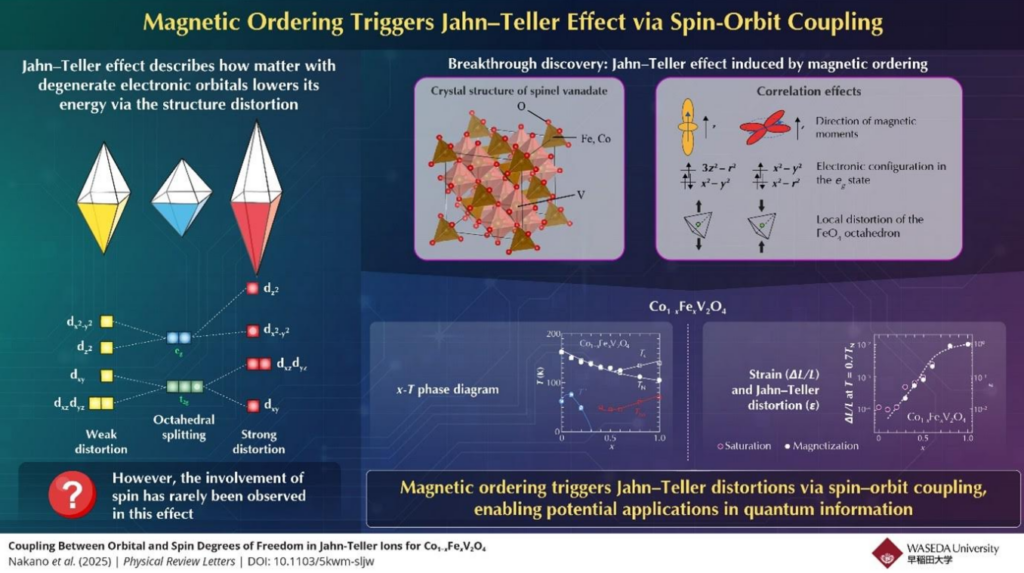
The Jahn–Teller effect, proposed by Jahn and Teller in 1937, describes how molecules or crystals with degenerate electronic orbitals can lower their total energy by distorting their structure. This distortion lifts the degeneracy, stabilizing certain orbitals that become occupied by electrons. While many materials exhibiting this effect have been found, the involvement of spin – the source of magnetism – has rarely been observed because magnetic ordering usually occurs at much lower temperatures than structural distortions caused by the Jahn–Teller effect.

In a breakthrough study, a team of researchers, led by Professor Takuro Katsufuji, including Master’s students Minato Nakano and Taichi Kobayashi, all from the Department of Physics, Waseda University, Japan, has discovered a new phenomenon in which magnetic ordering induces the Jahn-Teller effect, where spin–orbit coupling—the coupling between electron spin and orbital angular momentum – plays a crucial role. Their findings were published in the journal Physical Review Letters on October 29, 2025.
“Our group has been investigating degenerate orbitals and their coupling with the spin of electrons in materials. So far, we have found various compounds that exhibit orbital ordering, a phase transition in which electrons begin to occupy specific orbitals. During this research, we identified a new phenomenon in which a structural phase transition occurs simultaneously with magnetic ordering in Co₁₋ₓFeₓV₂O₄,” highlights Katsufuji.
The researchers notably focused on spinel-type compounds with the formula AV₂O₄. In FeV₂O₄, Fe²⁺ ions exhibit a Jahn–Teller distortion from cubic to tetragonal symmetry, whereas CoV₂O₄, lacking orbital degeneracy in Co²⁺, does not. By studying single crystals of Co₁₋ₓFeₓV₂O₄ with varying x, the team observed that the Jahn–Teller structural transition occurs at the temperature at which magnetic ordering sets in, while the magnitude of the Jahn–Teller distortion decreases with decreasing Fe content. These results establish that magnetic ordering can trigger Jahn–Teller distortions through spin–orbit coupling. This behavior can also be reproduced by a model that accounts for doubly degenerate orbitals coupled with a lattice distortion and magnetization.
The doubly degenerate eg states of the d orbitals in Fe2+ form a typical two-level system in quantum mechanics. The fact that they can be controlled by magnetic fields below one tesla suggests potential applications in quantum information. Currently, controlling or reading out the state of a single Fe2+ ion is difficult. However, by reducing the number of Fe2+ ions in the crystal, it may become possible to control and read out the state of a single Fe2+ ion using a magnetic field. This could open the door to applications in quantum information. However, to apply the proposed novelty to quantum information, it is necessary to reduce the number of Fe2+ ions and measure the magnetism of a single Fe2+ ion, requiring technological development.
Katsufuji points out the exciting theoretical breakthroughs that could emerge from their work. “Interestingly, by substituting the V in FeV₂O₄ with a non-magnetic ion instead of replacing Fe with Co, the ordering of Fe spins can be suppressed. This is expected to create a new state of matter where orbital–spin coupling exists, but both are simultaneously frustrated. Such a state, in which these two degrees of freedom are entangled and fluctuate together, is unprecedented. It holds fundamental scientific interest and promises novel applications in quantum information.”