

Insider Brief
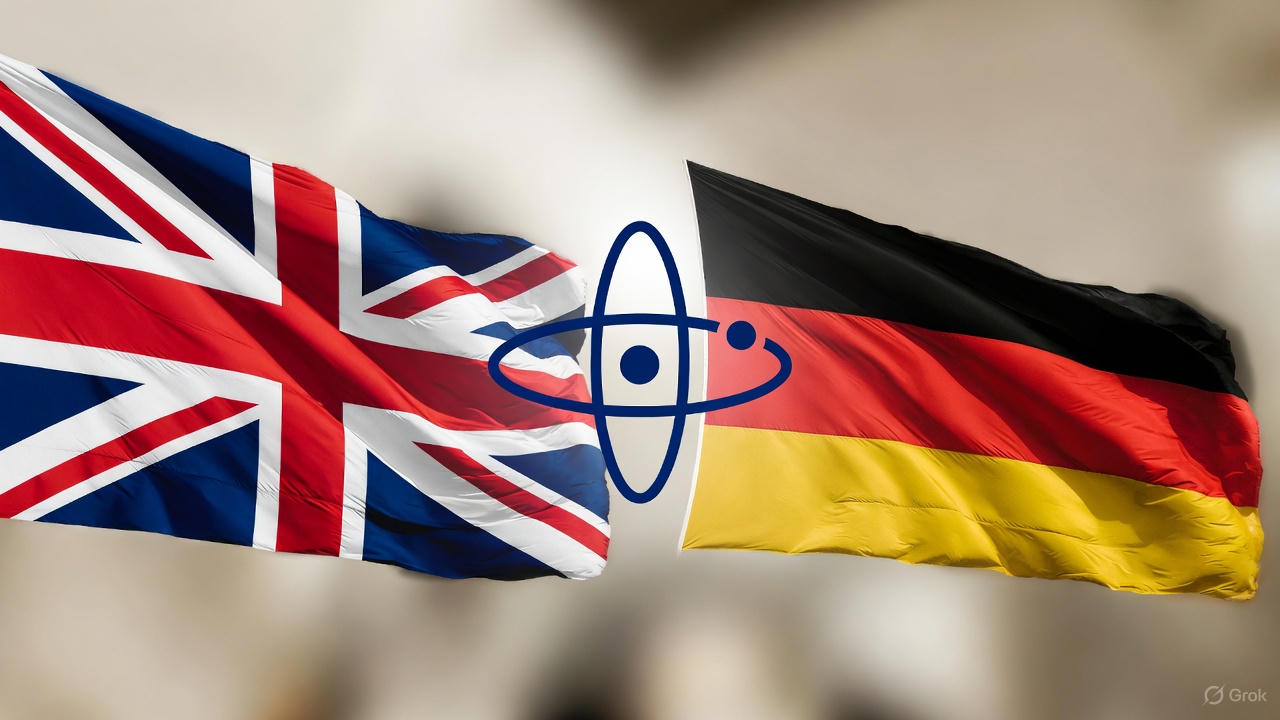
- The UK and Germany announced new joint initiatives to expand quantum technology collaboration, including shared funding, research standards, and support for commercialisation efforts.
- The countries will launch a £6 million joint quantum R&D call in 2026, invest £8 million in Fraunhofer UK’s applied photonics centre, and sign an agreement between national metrology institutes to advance shared quantum standards.
- The announcements build on broader UK-Germany cooperation across science, space, and high-performance computing, including joint ESA investments exceeding €6 billion and new collaborations on AI-ready supercomputing.
PRESS RELEASE — The UK and Germany have announced plans to work even more closely together to unlock the vast potential of quantum technology, as part of a suite of joint science and tech announcements unveiled on the final day of the German President’s State Visit to the UK (Friday 5 December).
Quantum is a technology with huge commercial potential. By 2045 it could contribute £11 billion to UK GDP and over 100,000 jobs in the UK alone. Quantum computers could help discover new medicines in a fraction of the time it takes today, while quantum sensors could be used in new medical scanners that are more affordable, portable and accurate than those used currently.
The UK and Germany are the closest of strategic partners, and the UK is already Germany’s biggest research partner in Europe. Today’s suite of announcements further cements that deep relationship, with £6 million pounds of joint funding for quantum R&D, £8 million investment in Fraunhofer UK’s world-leading applied photonics centre in Glasgow, and a new agreement on quantum research standards.

UK Science Minister Lord Vallance said: “Quantum technology will revolutionise fields such as cybersecurity, drug discovery, medical imaging, and much more. International collaboration is crucial to unlocking these benefits. With its deep R&D expertise, top-tier skills and world leading institutions, Germany is a natural partner to the UK in these efforts. This is work that will not only advance the bounds of knowledge, but will support stronger economies, better jobs and healthy secure societies, in both our countries.”
Today’s announcements include:
- A £6 million joint quantum R&D funding call from the UK and Germany will launch in early 2026, with Innovate UK and VDI Germany contributing £3 million each
- £8 million to support world leading research and development at the Fraunhofer Centre for Applied Photonics in Glasgow, accelerating growth by helping UK businesses to bring new quantum products to market
- The signing of a Memorandum of Understanding between the UK’s National Physical Laboratory (NPL) and Germany’s Physikalisch-Technische Bundesanstalt (PTB), which complements the NMI-Q initiative – a global effort to develop shared quantum standards
These announcements come on the final day of German President Frank-Walter Steinmeier’s State Visit to the UK. He will see first-hand an example of how UK-Germany collaboration on science and tech is supporting growth, high-skilled jobs, and better health in both countries on a visit to Siemens Healthineers. The site in Oxford produces superconducting magnets for MRI scanners.
All of this builds on recent progress to broaden and deepen the UK-Germany relationship on science and tech still further. Just last week, UK Minister for Space Baroness Lloyd concluded European Space Agency budget negotiations, where the UK and Germany jointly funded over €6 billion of activity, of a total ESA budget of over €22 billion.
This included €1 billion joint funding for launch programmes, and a €192 million shared commitment to the VIGIL severe space weather mission, as well as other UK-Germany investments in programmes driving growth and security. Elsewhere, both countries are investing in space launch capabilities, including €10 million for German company Rocket Factory Augsburg planning launches from Scotland in 2026.
While in October, the UK’s National Supercomputing Centre, based at the University of Edinburgh, was selected by the European High Performance Computing Joint Undertaking (EuroHPC JU) to host the UK’s AI Factory Antenna in partnership with the HammerHAI AI Factory, based at the High-Performance Computing Center Stuttgart.
To further strengthen AI and compute collaboration with partners including Germany, DSIT is allocating up to £3.9 million to match fund UK participation in 3 open EuroHPC Calls. This funding will support UK teams to develop exascale and AI-ready software, tools and workflows in areas of national importance while collaborating with Europe’s leading computing centres.
All of these announcements reflect the UK and Germany’s shared commitment to delivering under the Strategic Science and Technology Partnership, launched earlier this year alongside the signing of the Kensington Treaty.
While the UK and Germany already work together as members of some of the world’s foremost international scientific organisations, such as CERN, the European Laboratory for Particle Physics, and Horizon Europe.